









Replacing viaduct KW58 is an impressive final piece of De Groene Boog
Text Roel van Gils Image De Groene Boog
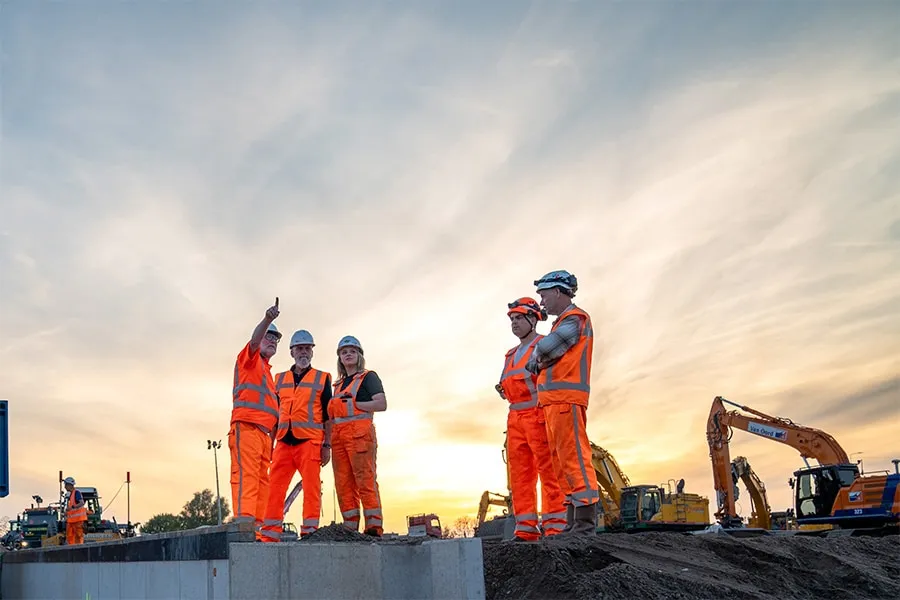
The existing viaduct on the A16 over the Hoofdweg in Rotterdam (KW58) no longer meets requirements. The original plan was to repair the structure, but this ultimately proved unfeasible. The decision was therefore taken to replace the entire viaduct, while minimising disruption to through traffic. The operation also has to be completed in record time to meet the planned opening of the A16 Rotterdam at the end of 2025. De Groene Boog is carrying out the replacement on behalf of Rijkswaterstaat.
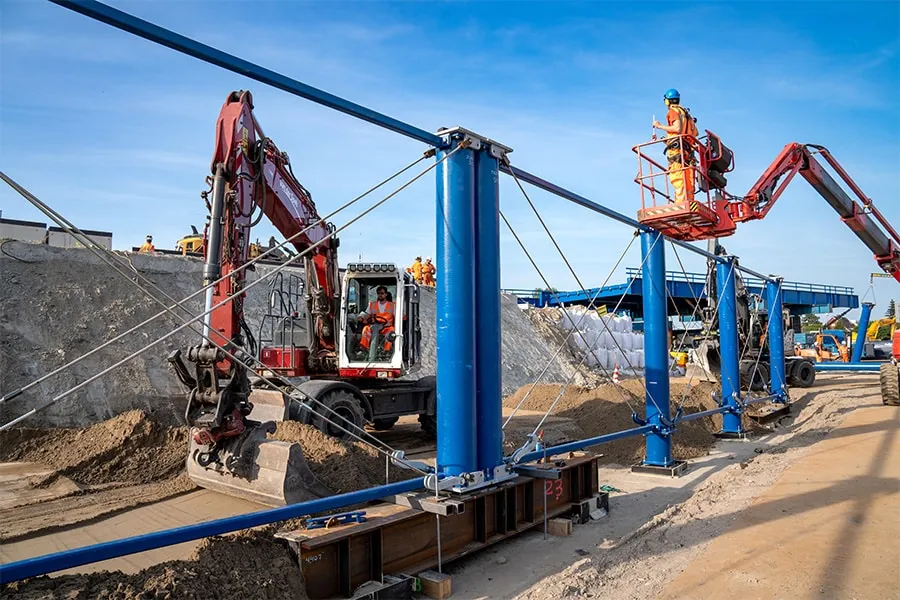
KW58 was built in the 1960s and had developed cracks on the underside of the structure. “Using archive drawings, we assessed whether the structure could continue to fulfil its function, taking account of current traffic loads and volumes,” says Jaco van Duijn, KW58 project manager at De Groene Boog. “We soon concluded that there was more to it than that and that the viaduct no longer met current requirements. There was a risk of brittle fracture, which could cause the deck to fail suddenly. As a precaution, we therefore quickly developed a plan to install a passive support structure beneath it. A weight limit was also imposed on freight vehicles weighing more than 100 tonnes.”
Risk of collapse
The support structure was installed in mid-2022, a few millimetres below the deck. “The idea was that, if the deck were to fail, it would not lead to an emergency,” explains Pieter Deleu, KW58 project coordinator at De Groene Boog. “Traffic could then be safely cleared from the structure.” The support structure has since been removed, and since early May this year, traffic on the A16 has been diverted over two temporary bridges across the Hoofdweg. Pieter: “At the same time as installing the support structure, we began working with Rijkswaterstaat to devise a construction method that would allow us to replace the existing structure efficiently, without causing too much disruption to through traffic on either the A16 or the Hoofdweg. We considered several options, including closing the A16 completely for a few weeks. The old viaduct would have been demolished and the new one built during that time. But this would have caused too much disruption and was deemed undesirable at a location near one of the country’s busiest traffic interchanges. In the end, we chose a solution involving a road diversion and temporary bridges.”
Forward planning
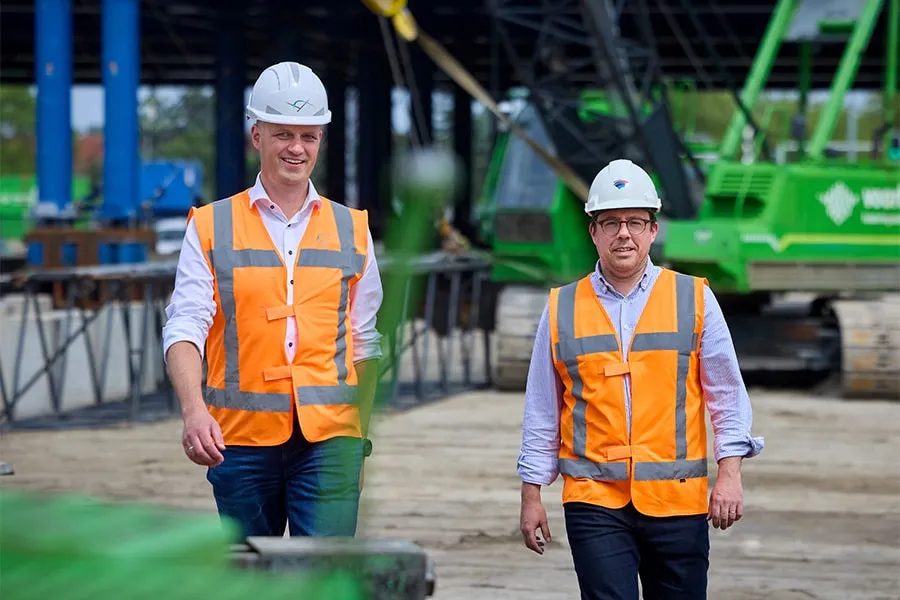
The existing viaduct had four lanes heading towards the Van Brienenoordbrug, with an entrance ramp from the Hoofdweg. There were also four lanes heading north and an exit to the Hoofdweg. In addition, a wide central deck had been provided for a future connection between the A16 Rotterdam and the viaduct over Terbregseplein. “So they had the foresight to allow for this when the viaduct was built,” says Jaco. “But that central deck was never used.” The new structure will have the same layout, but with just one central support instead of three intermediate supports.
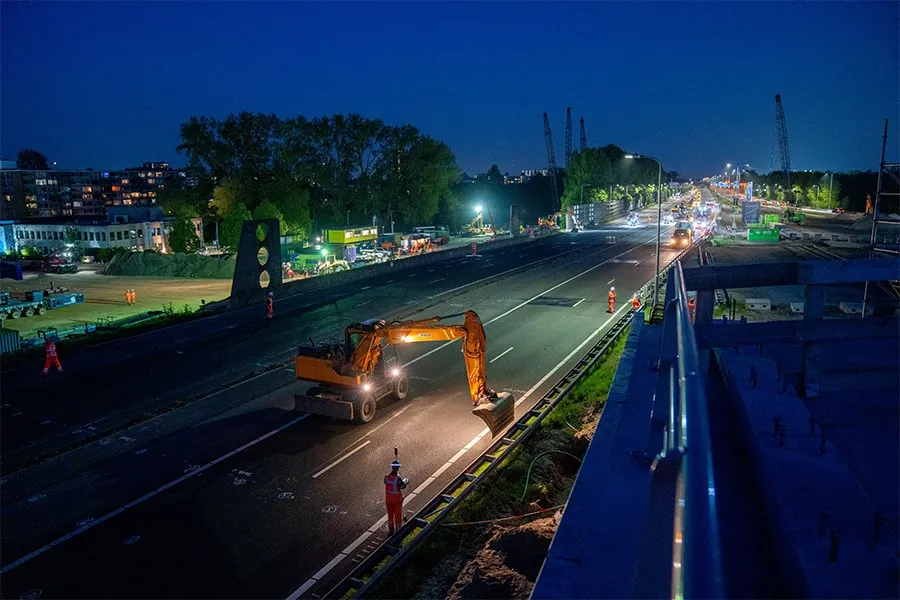
Before the new structure could be built, the existing one had to be demolished. Several stages of work were required to avoid a prolonged closure of the A16. “In July 2023, we began building a road diversion on the west side of the existing viaduct, with a huge temporary bridge from Retro Bridge (TK58) over the Hoofdweg. Since Monday 29 April 2024, southbound traffic has been using this diversion, so it will not be affected until the work is complete. Traffic will then be switched over to the new viaduct in one go. The only drawback of this phasing is that the entrance ramp from the Hoofdweg (27, Prins Alexander) will be closed for an extended period.”
Temporary structures
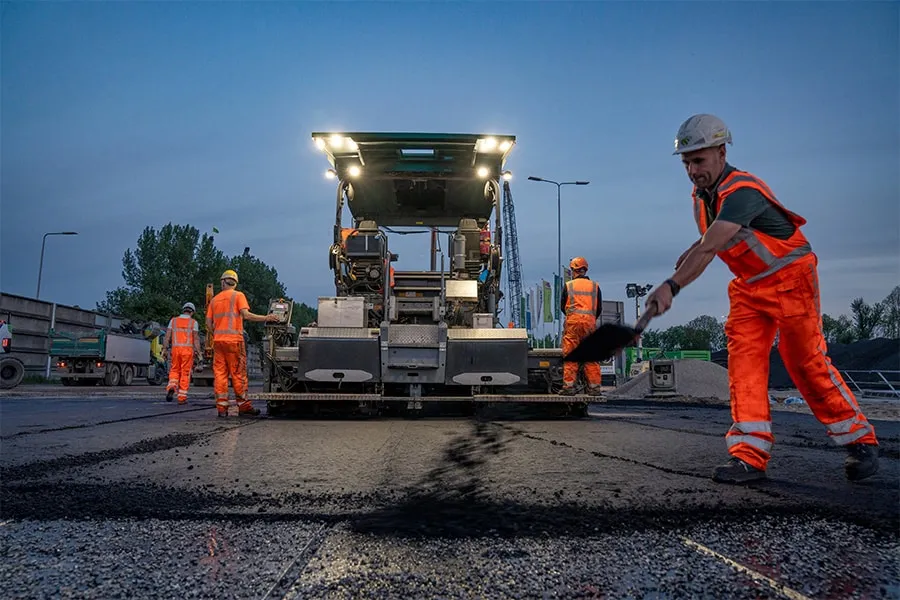
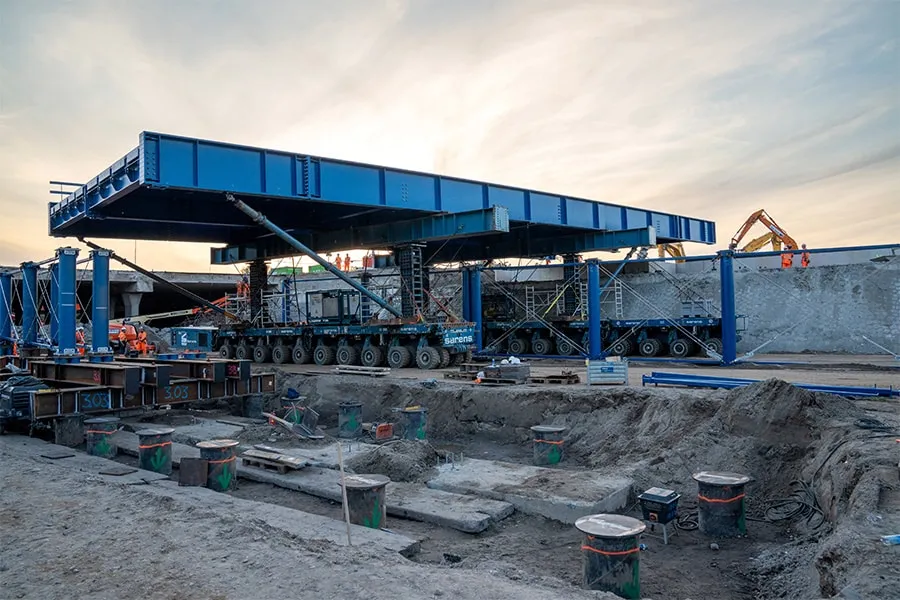
Road design is constrained by curve radii and alignments. “Shifting a carriageway by 50 metres has a huge impact,” says Pieter. “In practice, there was only enough space on the west side to do this safely and to position the required temporary bridge (TK58), measuring 100 metres long and 25 metres wide.” The temporary bridge is so large because the A16 passes the structure on a curve. Once TK58 was opened to traffic, part of the existing viaduct was no longer in use. Jaco: “We then closed the northbound carriageway over the long Ascension Day weekend, from 8 to 13 May, so that we could demolish the eastern section of the existing structure. During the same weekend, the temporary structure (TK59) was built at this location and its deck moved into place. This steel temporary bridge over the Hoofdweg had been prefabricated by Civiele technieken deBoer in the space within the slip road from exit 27, Prins Alexander. This meant northbound traffic could use the A16 again first thing on Monday morning, 13 May.”
Ascension Day weekend
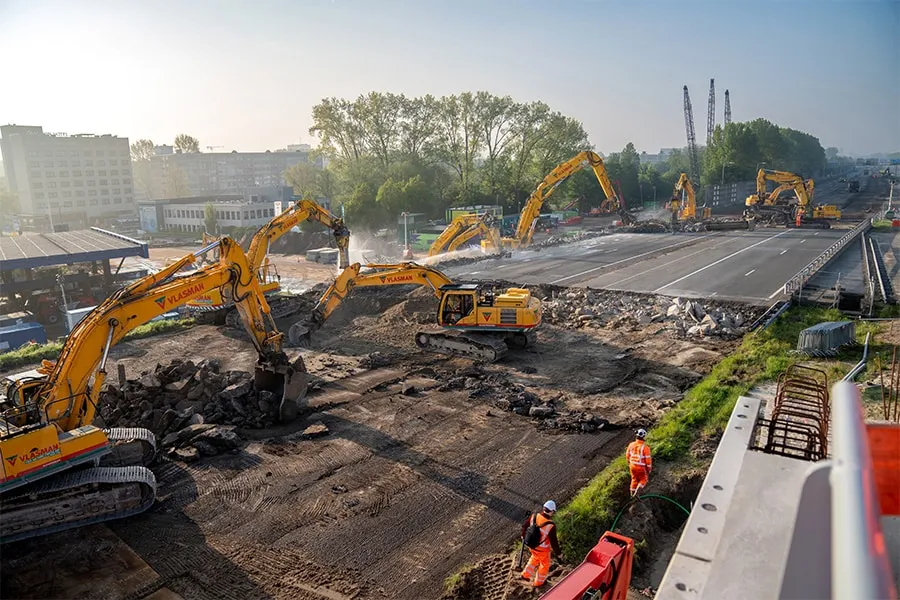
The operation over the long Ascension Day weekend was, of course, far from as straightforward as the description above might suggest. A huge amount of work had to be completed in around 100 hours. “Vlasman spent the first day and a half demolishing the eastern section of the structure. Several parties then carried out various tasks simultaneously, including installing the piled foundations and welding the steel beams and splice plates. Sarens also lifted the precast abutments for deBoer’s TK59 into place. The abutments were then anchored using anchor walls. Sarens then moved the four sections of TK59 into place using Self-Propelled Modular Trailers (SPMTs). Once positioned and aligned, the joint beams were cast in steel-fibre-reinforced concrete and the bearings in grout. Finally, the road structure was tied in and reinstated, and the diversion was ready for use,” says Jaco, summarising the work carried out over the long Ascension Day weekend. “We also had to deal with a challenge caused by the high groundwater level. Driving in the tubular piles caused groundwater to rise to the surface. That is not ideal when welding is also required. We managed this unforeseen situation by adjusting the sequence of work and using pumps to lower the water level. All in all, it was a tough but successful weekend for everyone.”
New entrance ramp
TK59 will remain in use for around seven months. De Groene Boog needs this time to build the new viaduct on the west side. The new viaduct is being built in two sections. “From December 2024, we will divert northbound traffic in a loop over the western section of the new structure,” says Pieter. “There will then be no traffic on deBoer’s eastern temporary bridge, allowing it to be dismantled. From January to August 2025, we will build the eastern section of the new structure in its place. According to the schedule, traffic in both directions will switch to the new viaduct from mid-September 2025.” After that, TK58 by Retro Bridge will be dismantled, the road diversion removed and entrance ramp 27 from the Hoofdweg reinstated. The A16 Rotterdam is then due to open to traffic at the end of 2025, including the new entrance ramp from the Hoofdweg towards Delft and The Hague.”
Under pressure
The new viaduct will consist of two abutments and a central support. “The abutments will comprise a combi-wall with precast elements, while the central support will be built using precast driven piles, pile caps, columns and a crosshead beam. Given the tight schedule, we have opted to use as many precast elements as possible, including the beams for the spans,” explains Pieter. “All of this can be prepared in advance, but everything still has to fit when it comes to construction. There is little that can be resolved on site, and the tolerances are tight.” The structure features a 60-metre-wide deck in relation to a 49-metre span. There will be four lanes in both the northbound and southbound directions, while the central section is intended for the connection with the A16 Rotterdam towards the viaduct at Terbregseplein and the Rottemerentunnel. KW58 must therefore be ready for the opening of the A16 Rotterdam. “It is the final piece of De Groene Boog. Given that we have only just put away the wrecking ball, it is quite a challenge,” says Jaco in conclusion.
A business enquiry for Sarens? Get in touch
Who worked on De Groene Boog
- De Groene Boog construction consortium
 BesixMentioned in De Groene Boog is targeting maximum CO2 emissions reductions
- De Groene Boog construction consortium
 Van OordMentioned in De Groene Boog is targeting maximum CO2 emissions reductions
- De Groene Boog construction consortiumDura VermeerMentioned in De Groene Boog is targeting maximum CO2 emissions reductions
- De Groene Boog construction consortiumRebelMentioned in De Groene Boog is targeting maximum CO2 emissions reductions
- De Groene Boog construction consortiumJohn LaingMentioned in De Groene Boog is targeting maximum CO2 emissions reductions



Keep following this
Get an email when a new story is published. No account needed.
- ProjectDe Groene Boog
- ThemeExtending the life of roads and civil engineering structures
- SubjectRoad construction
- CompanySarens
- CompanyRetro Bridge Nederland







