









De Groene Boog builds the Rottemerentunnel
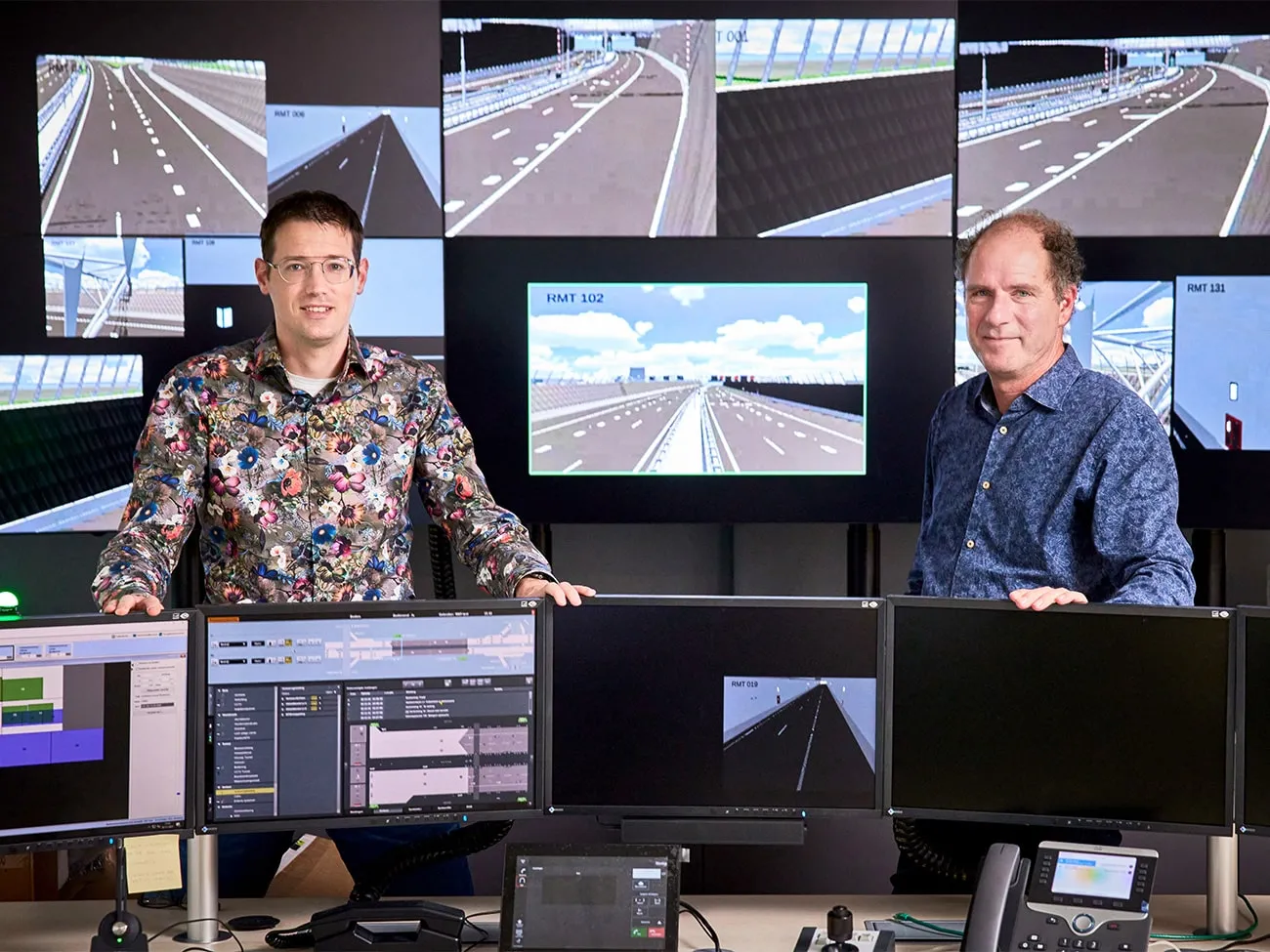
It is still a remarkable experience: one moment you are on site in the Rottemerentunnel construction pit in Rotterdam, and a few days later you are standing face to face with an indistinguishable ‘digital twin’ of that same tunnel at Croonwolter&dros in Amsterdam. Hans Pos and Hugo Buijense, test manager and assistant test manager respectively for Croonwolter&dros at De Groene Boog, get a ‘digital head start’ every day on what is currently being built. This is essential, as the tunnel technical installations designed by Croonwolter&dros must be fully tested and approved before they are installed in the actual tunnel. It is important work, and the men make no secret of their enthusiasm.
A fully virtual environment
Croonwolter&dros has already used the virtual tunnel on several projects, including the Rijnlandroute. “Think of it as an evolution,” says Pos. “We are getting better at it all the time. Here in our Amsterdam office, an entire team is working on the Rottemerentunnel. We designed the TTI (tunnel technical installations), developed the user interface for tunnel traffic control and can simulate every part of the TTI. Images from the tunnel are also rendered to look completely lifelike, and the system is fully interactive, working in both directions, just as it will in the real situation. We are in the test room here. Programming takes place upstairs. If there are parts we cannot test here, we take a laptop under our arm and go to the supplier of the relevant component with the control software.”
A bit of ‘tech talk’
We ask Buijense to explain how the system is structured schematically. He says: “Think of it as a pyramid. At the top is the Graphical User Interface (GUI), which is what the tunnel traffic controller sees on screen. It is a dashboard that displays alerts and from which action can be taken when necessary. Below the GUI is the ‘brain’ of the system, also known as the 3B module: Control, Operation and Monitoring. This is where alerts are translated for the GUI, and instructions from the GUI are processed. Various control programmes sit below the 3B module, each controlling one part of the installation. These include barriers, traffic lights, fire suppression systems and cameras. The control programme is part of the (sub)system and sends a signal to the Autonomous Logic, or AL. This is a piece of intelligent software embedded in the hardware of the relevant subsystem on site. A subsystem must never control or affect another installation.”
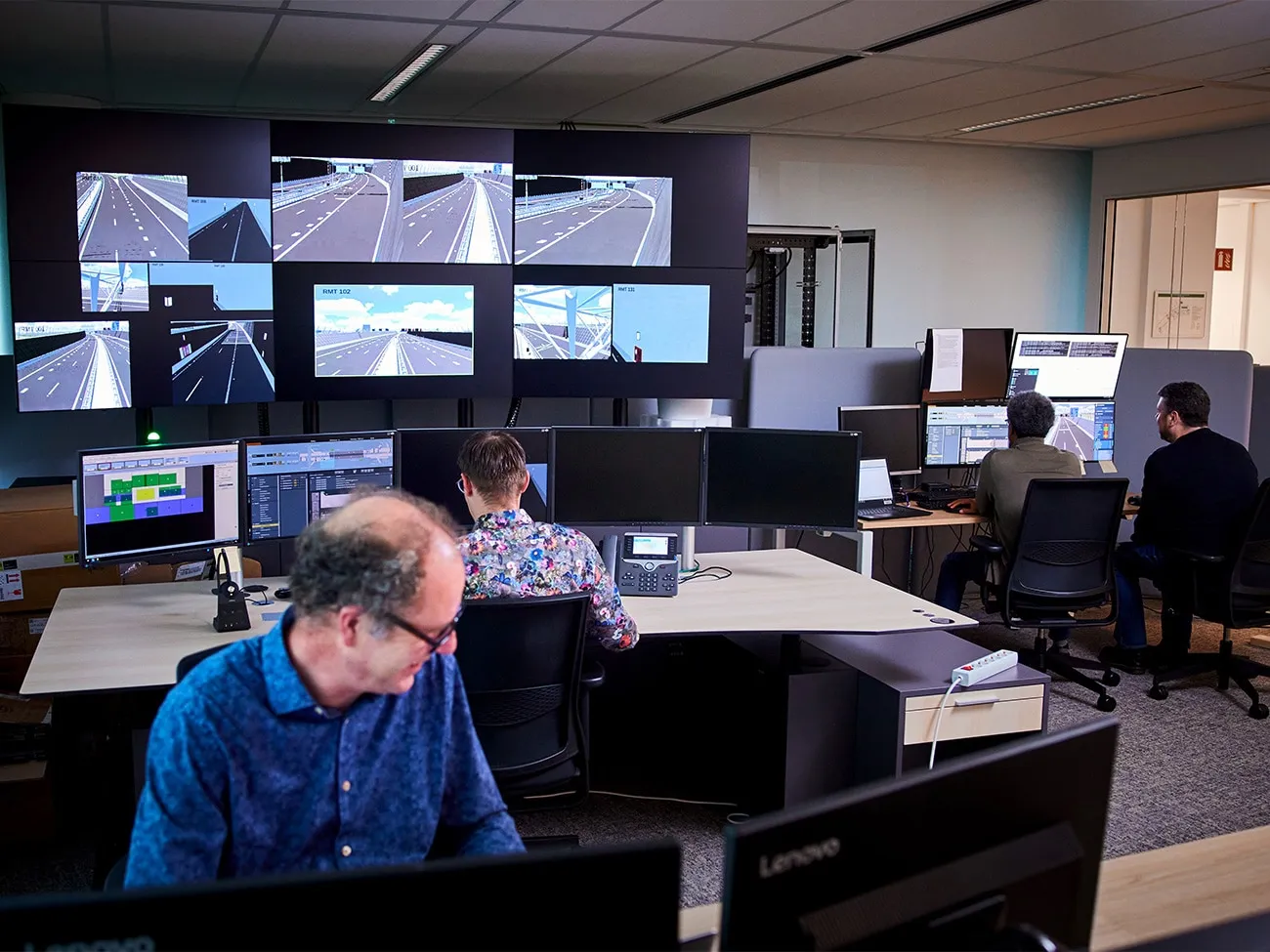
When faults or traffic-related alerts appear in the GUI, the emergency button can be pressed, triggering the emergency procedure in the 3B module. “We can simulate various emergency scenarios,” Buijense continues. Pos adds: “Ultimately, the system will run in the traffic control centre in Rhoon. What we have built here will also be used there as a training environment. We are now in the FAT phase, the Factory Acceptance Test of the subsystems, and are working towards the Integral Factory Acceptance Test (IFAT), where we have to demonstrate that everything works. During the IFAT, we test ‘use cases’. Rijkswaterstaat will carry out the Site Integration Test (SIT) once all the subsystems have been installed in the tunnel. In our test environment, we are already going through the protocols for this SIT and checking whether everything does what we expect. We do this for the technical side. Rijkswaterstaat then carries out its own tests to check that all the necessary processes are functioning properly.”
The implementation must also meet expectations
Pos notes that everything must not only meet the technical requirements, but also the expectations of the traffic controllers, emergency services and road users. “All these users are involved at an early stage. A traffic psychologist is also involved, for both the motorway and the tunnel. The traffic psychologist looks at the model and how road users experience it. Together with the traffic controller, we determine the positions of the CCTV cameras in the model. Those positions are saved as presets, along with a photo book. We will be able to upload those presets all at once later. Testing virtually at an early stage in this way helps us become more and more efficient. It also has benefits for future tunnel projects, including renovation projects.”
A business enquiry for Croonwolter&dros? Get in touch
Who worked on De Groene Boog
- De Groene Boog construction consortium
 BesixMentioned in De Groene Boog is targeting maximum CO2 emissions reductions
- De Groene Boog construction consortium
 Van OordMentioned in De Groene Boog is targeting maximum CO2 emissions reductions
- De Groene Boog construction consortiumDura VermeerMentioned in De Groene Boog is targeting maximum CO2 emissions reductions
- De Groene Boog construction consortiumRebelMentioned in De Groene Boog is targeting maximum CO2 emissions reductions
- De Groene Boog construction consortiumJohn LaingMentioned in De Groene Boog is targeting maximum CO2 emissions reductions



Keep following this
Get an email when a new story is published. No account needed.
- ProjectDe Groene Boog
- ThemeUnderground construction
- SubjectRoad construction
- CompanyCroonwolter&dros







