









Preventive maintenance of asphalt wearing courses
Text Latexfalt en Chris Elbers Beeld Latexfalt
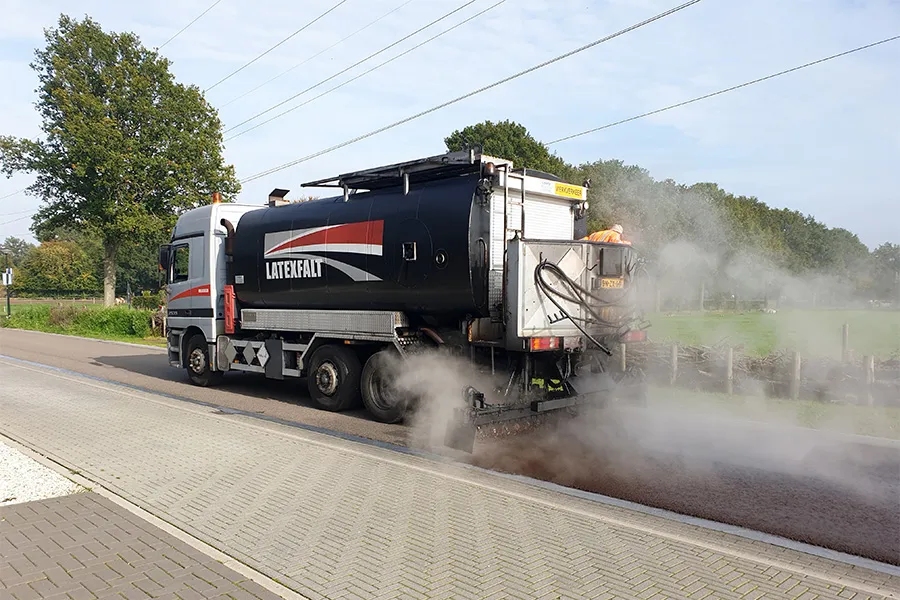
Preventive maintenance in road construction is scaling up significantly. Life-extending maintenance of asphalt wearing courses using in-situ-applied rejuvenating products (LVOv) is rapidly evolving from an innovative technique into a standard part of maintenance strategies. Whereas intervention previously often took place only once a road had already developed defects, more and more road authorities are taking a preventive approach. This shift calls for a different approach to budgeting: investing before damage becomes visible. The results? A much more efficient use of resources and a longer service life for existing infrastructure.
The principle behind life-extending maintenance using rejuvenating agents is ingenious, but conceptually very simple: replenish what is missing from the road and would ultimately cause it to fail. The key, however, is knowing exactly what is missing.
Replenishing and softening
Latexfalt, a developer of bitumen- and polymer-based products, has been investigating this for several decades. The company, based in Koudekerk aan den Rijn, has now reached a clear conclusion, as manager research & development Hans Hendrikse explains. “Over time, every road loses some of its binder, and the binder that remains also becomes brittle. This is particularly true of the top layers. As a result, stones eventually start to come loose from the road, a phenomenon known as ravelling. This creates weak spots that can then lead to more extensive damage. The solution is simple: replenish the binder and soften it appropriately.” To this end, Latexfalt has developed products such as Modimuls ZV for porous asphalt and Neomex Eco SE for SMA and AC Surf. “With each treatment, we can extend a road’s service life by up to 6 years. With minimal effort, no less. That is great news for both budgets and the environment.”
Applications
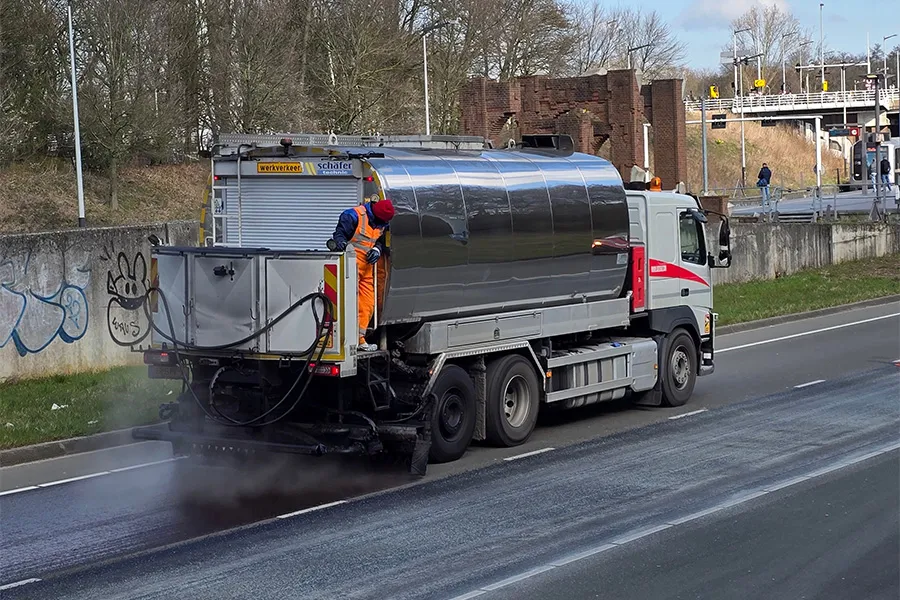
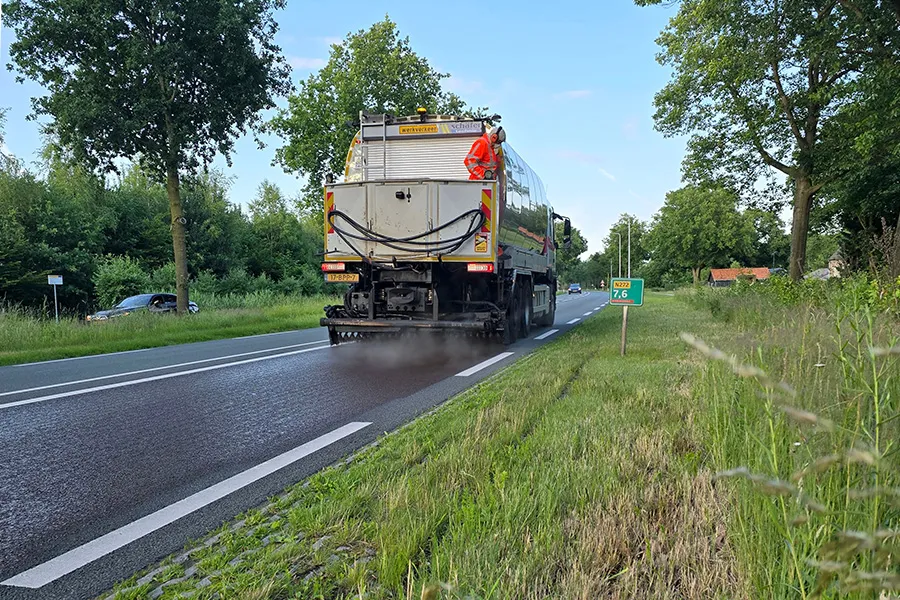
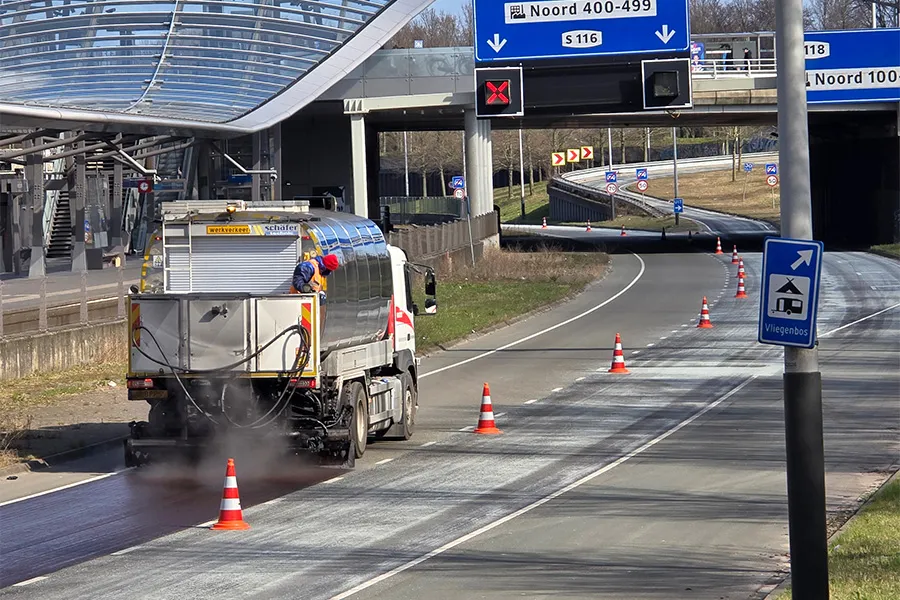
Latexfalt has been using the technique Hendrikse describes for a number of years, both in the Netherlands and abroad. “In the Netherlands, the development of LVOv was driven in part by sustainability targets,” says commercial manager Tom Peppink. “The longer a road lasts, the less CO2 is emitted and the less new asphalt and waste there is. The method is also attractive in terms of execution. Once the product has been applied within a traffic closure, the road can reopen almost immediately. Traffic disruption is therefore minimal. This is a decisive advantage, particularly on busy roads.”
In Portugal, Latexfalt has been carrying out LVOv for some time on behalf of a private company that manages toll roads on behalf of the government. Although sustainability and reducing disruption carry less weight there, LVOv remains the preferred option. “It extends the service life of infrastructure at relatively low cost and with limited material use,” says Peppink. “At the same time, its use in Portugal shows that the technique also makes economic sense in its own right. In short, LVOv literally gives roads extra years of life. The technique combines economic benefits with sustainability and minimal disruption to traffic. It has therefore become an essential element of the modern maintenance toolkit.”
Question about this story? Ask your question
Keep following this
Get an email when a new story is published. No account needed.
- ThemeExtending the life of roads and civil engineering structures
- SubjectRoad construction







