









King opens world’s first rapid-charging hub for heavy construction equipment and electric lorries
Text Susan PeekImage Joep Rijk
And walks on the most sustainable, 100% circular asphalt
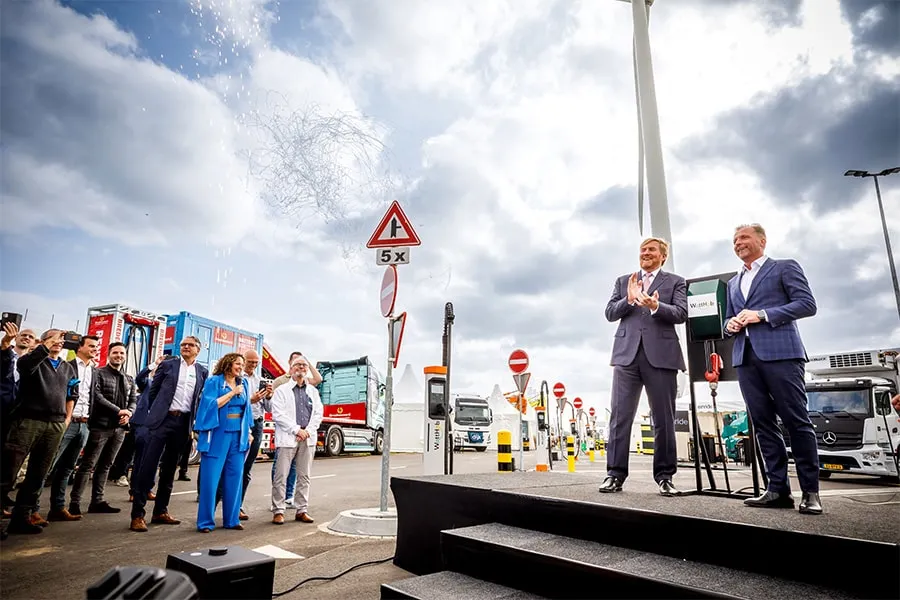
On 28 September, His Majesty the King officially opened the world’s first rapid-charging hub for heavy road and construction equipment: WattHub. This semi-public charging hub was developed on the initiative of the Betuwewind cooperative, together with the Mekante Diek construction consortium, comprising Dura Vermeer, Ploegam and Van Oord. The impetus was the zero-emission brief for the Tiel-Waardenburg dike reinforcement project.
High ambitions for zero-emission construction
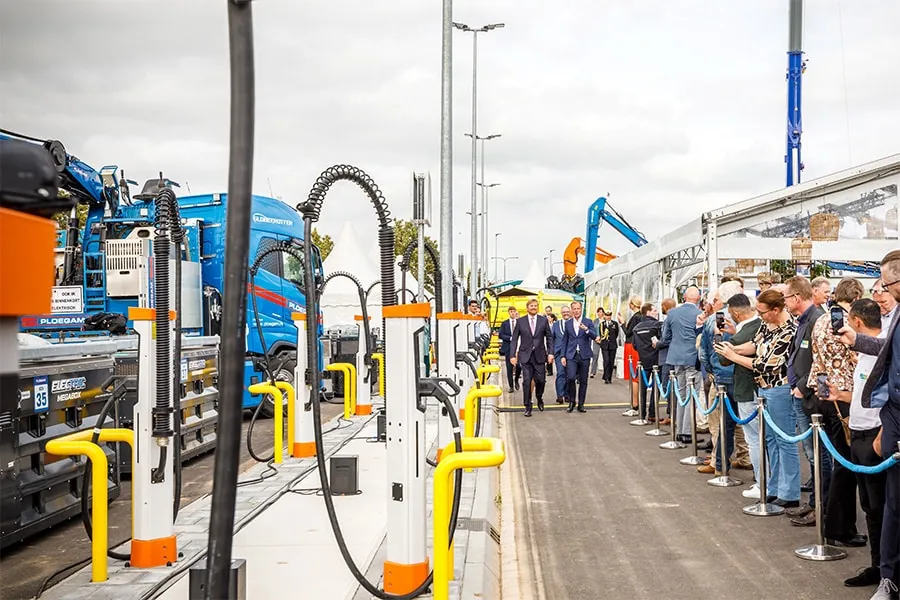
The Tiel-Waardenburg dike reinforcement project aims to operate entirely emission-free. Making this possible requires a substantial increase in charging infrastructure in the region to charge the batteries of heavy construction equipment and electric lorries. The WattHub charging hub has been built on the Avri site in Geldermalsen and has 42 smart charging points with a capacity of up to 400 kW. This makes it possible for the transport and construction sectors to switch to electric vehicles and carry out construction work emission-free using locally generated solar and wind power.
100% circular asphalt
As part of its sustainability efforts, Circularpave was chosen for the WattHub site: Dura Vermeer’s 100% circular asphalt mix, which includes circular bitumen from Roof2Road. “This choice alone cuts CO2 emissions by 25% in the base and binder courses and by around 60% in the surface courses,” explains Gerben Bijker, director of Roof2Road.
Circular bitumen
Bitumen is used all over the world and is an indispensable component of asphalt roads, dikes and roofing. Yet this valuable raw material for the infrastructure and construction sectors is becoming increasingly scarce. It is therefore crucial to use it sparingly and in a circular way. In the Netherlands, bitumen is put to circular use. Roof2Road produces circular bitumen by recycling roofing materials, supplying a high-quality circular construction material for asphalt. “Using this bitumen preserves valuable raw materials by putting them to use again instead of burning them. This upcycles asphalt roads and also achieves a substantial reduction in CO2 emissions,” says Gerben.
Asphalt Quality Desk
Circularpave is certified by CROW’s Asphalt Quality Desk. “The same applies to other sustainable asphalt mixes containing circular bitumen,” says Gerben, describing it as a ‘golden’ milestone for sustainable and circular asphalt. “It also means every client can make an informed choice to use Roof2Road asphalt.” More than twenty types of asphalt mixes using the circular binder are already available to municipalities and provinces. Certification of recycled bitumen for road construction provides an important boost to the circular economy.
CO2 reductions in asphalt
“By using circular bitumen in asphalt, the government can reduce CO2 emissions and make a significant contribution to meeting climate targets,” Gerben concludes.
Question about this story? Ask your question
Companies in this story

Keep following this
Get an email when a new story is published. No account needed.
- ThemeExtending the life of roads and civil engineering structures
- SubjectRoad construction
- CompanyVan Oord







