









Independent, sustainable power supply anywhere
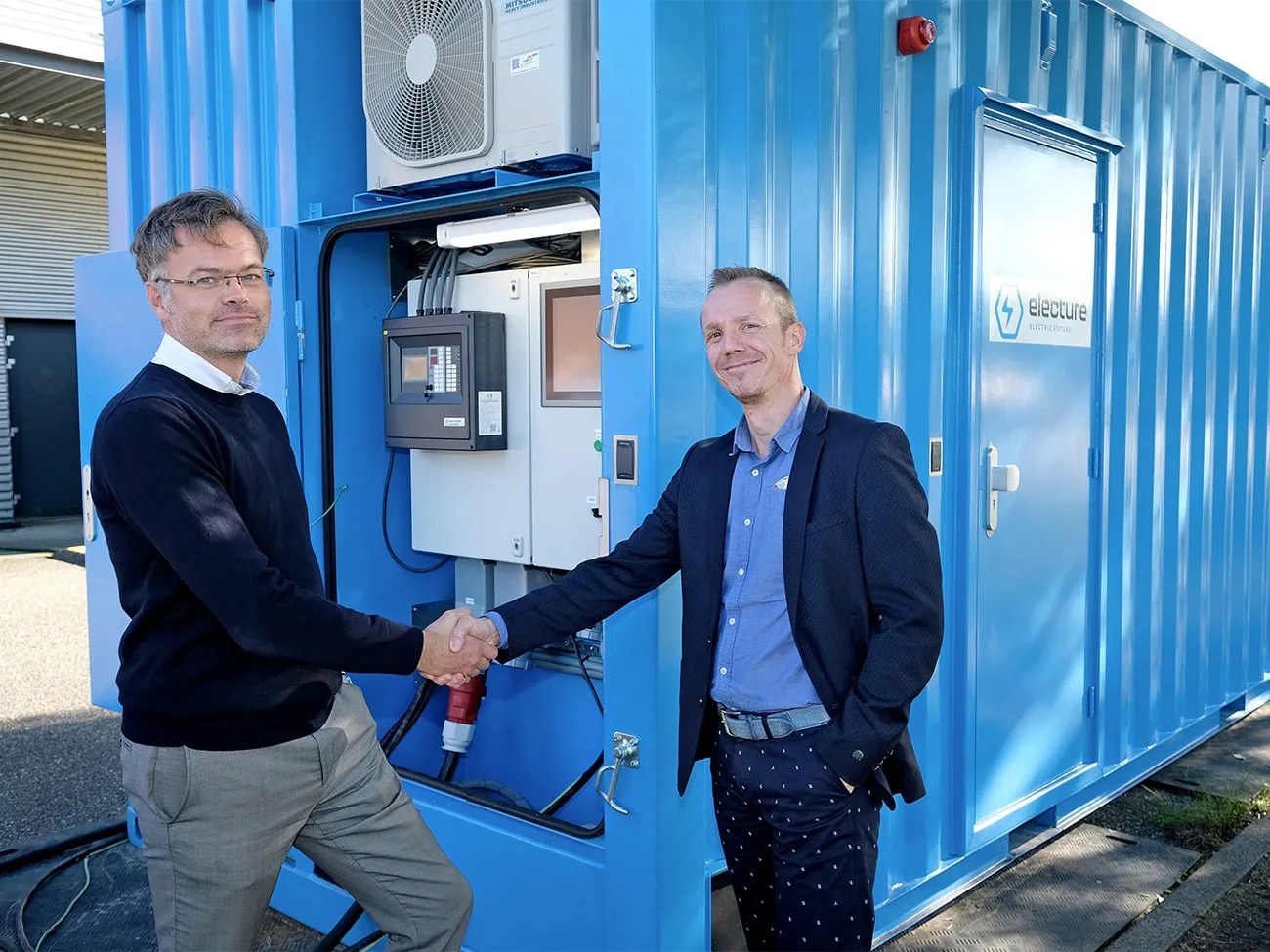
In January 2020, this magazine introduced you to the result of a revolutionary idea born at Mobilis. In an interview, Jeroen Ritzer-van Dinther, the ‘father’ of the e-CO2tainer, explained in detail how Mobilis had found a solution for an independent, mobile power supply. An idea that had only just seen the light of day is now actively being used by the De Groene Boog construction consortium. We are pleased to speak to Ritzer-van Dinther again, this time about a sustainable solution that has come of age.
‘Power from a container’
“The e-CO2tainer has been developed into a fully operational solution for supplying sustainable energy anywhere,” says Ritzer-van Dinther. “Since its introduction at Mobilis, we have not stood still, and I have been able to make the e-CO2tainer my own line of business. Electure was set up for this purpose. The end result speaks for itself: we are talking about a 6 x 2.5 x 2.5 metre container packed with energy technology. On board, we have a generator running on HVO 100, the clean biofuel chosen by De Groene Boog. The container also houses an impressive bank of LFD batteries, along with all the electronics that control the system and handle communications with the outside world. It is ‘power from a container’, and clean power at that.”
First Euro 5-certified HVO generator
The generator on board the e-CO2tainer is the world’s first Euro 5-certified HVO generator. “We are proud of that. As well as the generator, we have batteries on board with a combined capacity of 240 kWh. A door on the outside of the container gives the contractor access to a display with a range of monitoring functions and contact details. There is also a 380 V 3-phase mains connection on the outside of the container. This connection can be used to charge the batteries and draw additional power from the grid during peak demand. Power is supplied through CEE connectors: 380 V, 1 x 125 Amp and 2 x 63 Amp. You can connect anything that needs a power supply, from a ‘distribution mushroom’ on site to electrically powered equipment and vehicles. We can set which power outlet has priority.
Convenient app-based control
The e-CO2tainer can be switched on and off using an app. “We do that remotely, although this is the ‘back end’ of the system and only we have access,” explains Ritzer-van Dinther. At the time of writing, one e-CO2tainer is already in operation in project area 1, supplying power to the site. A total of 5 e-CO2tainers are planned for De Groene Boog. Sustainability comes not only from using HVO as a fuel and batteries, but also from smart energy management. Ritzer-van Dinther explains: “Conventional diesel generators run continuously, even when no power is being drawn. This causes a great deal of CO2 and particulate matter emissions. The e-CO2tainer only runs its generator when it is really needed, because in off-grid mode everything runs on the batteries. When it is on-grid, meaning connected to the mains, we monitor the relationship between power input and power output. This allows us to use the e-CO2tainer as efficiently as possible at all times.”
The figures
“An e-CO2tainer has higher fixed costs (purchase price), but lower variable costs (consumption). A traditional diesel generator costs less to buy, but consumes far more fuel. The combination of the e-CO2tainer and a mains connection also makes it attractive in terms of variable costs and sustainability. It is a win-win situation. I firmly believe in the e-CO2tainer when it comes to TCO (total cost of ownership).”
According to Ritzer-van Dinther, the e-CO2tainer is a true ‘TBI baby’. “It was developed at Mobilis and is now built by our sister company Eekels. It is great to see how this concept has been developed into a solution that can be used in practice!”
Have a business enquiry for Mobilis? Get in touch
Companies in this story

Keep following this
Get an email when a new story is published. No account needed.
- ThemeLower emissions and more reuse
- SubjectRoad construction
- CompanyMobilis







