









How Emulsion Asphalt Concrete can help accelerate housebuilding
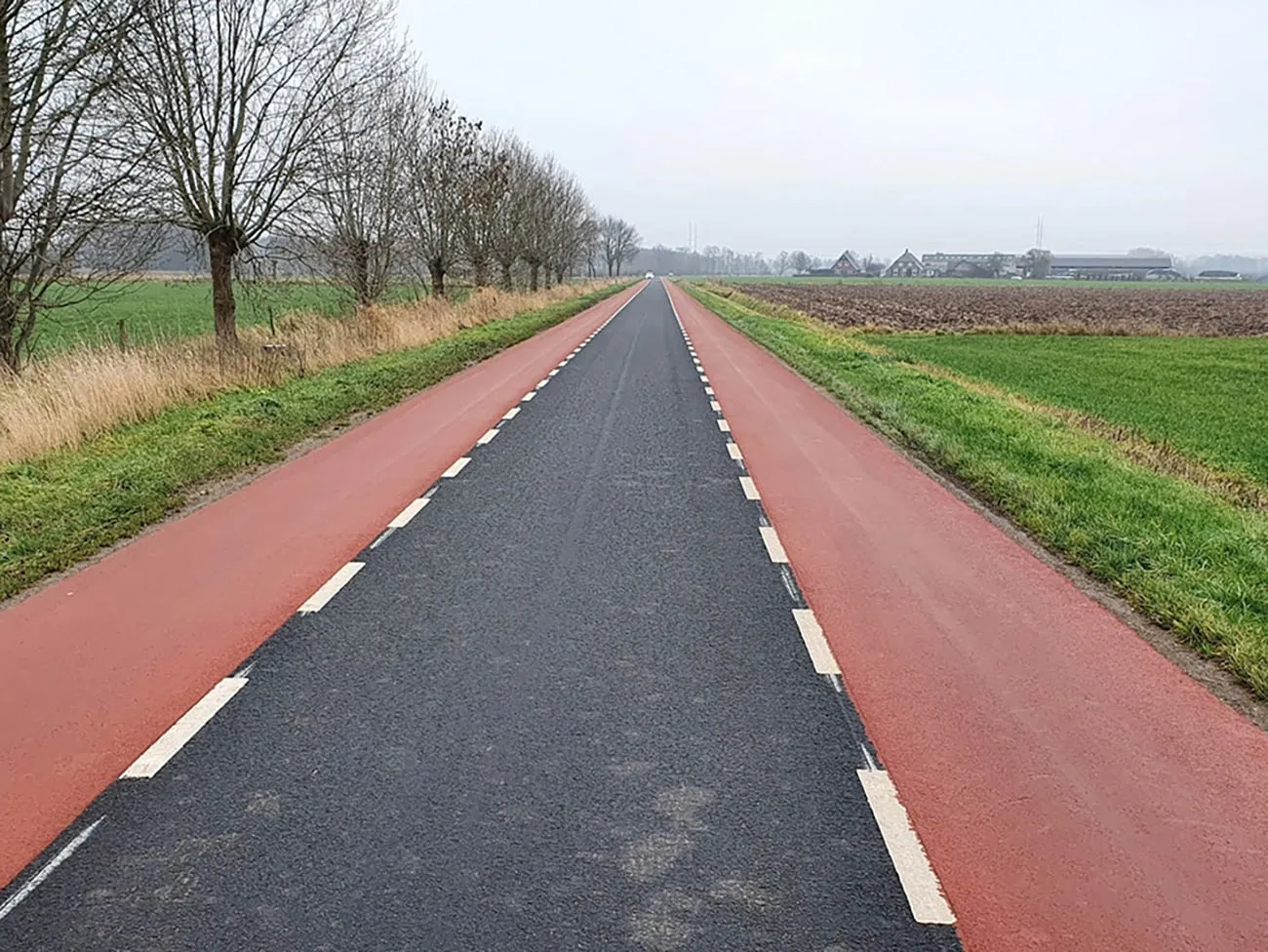
Increasing traffic, stricter environmental requirements and sustainability targets: all factors that have a major bearing on the measures needed to construct, manage and maintain our infrastructure. We speak to Michel Langereis, commercial manager at Rapid Asfalt, and Bert Boekholt, operations manager at Rapid Asfalt, about how Emulsion Asphalt Concrete (EAB) can help accelerate housebuilding.
Investing in infrastructure
The huge housebuilding task will undoubtedly have implications for infrastructure. “Substantial investment will be needed to deliver new infrastructure,” says Langereis. “It is also important to make existing infrastructure fit for the future in view of the expected growth in traffic. And all this with our sustainability targets in mind: it is quite a challenge,” says Langereis. “Naturally, we are responding to that. Our Emulsion Asphalt Concrete has a favourable environmental cost indicator (MKI) and strong life cycle assessment (LCA) performance. It is important for clients to understand that EAB can not only extend the service life of asphalt, but also reduce CO2 emissions, which is advantageous in tendering and in light of the huge construction plans.”

Extending the service life of asphalt
Boekholt explains: “EAB has a favourable environmental cost indicator because it uses few primary raw materials, is produced cold and is applied in a thin layer. Over a period of thirty years, the usual approach is to replace the asphalt every 10 years and the surface course four times. We recommend applying EAB at 80% of the asphalt’s service life, so after around 8 years. You then replace the surface course after 15 years. After 23 years, you apply new EAB, followed by a new surface course after 30 years. Over a thirty-year cycle, that means saving one surface course. That saves not only material, but also the associated energy and construction costs. Other benefits include fewer associated works, such as verge reinstatement, milling, raising manholes or connecting paving, and minimal disruption to the surrounding area because the road can be reopened to traffic quickly. Our EAB is therefore a perfect fit with sustainability policies.”
Red EAB
Rapid Asfalt is taking further important steps towards sustainability: “We have developed a new red EAB,” says Langereis. “It is based on black bitumen emulsion.” Black emulsion is much closer to crude oil than clear bitumen emulsion, which is essentially a synthetic material. “So it breaks down more easily when it is closer to crude oil. From an environmental perspective, clear bitumen has a very heavy impact and is really a no-go in the asphalt sector,” he says. “Our red EAB, made with black bitumen emulsion, is highly recyclable, has a lower environmental impact and is more sustainable. It takes less energy to produce this emulsion, and it is also more attractive in terms of price.” Boekholt adds: “That applies not only to the price of the product itself, but also to its application. It is less sensitive to moisture and therefore easy to apply in less favourable weather conditions, without compromising quality, of course!” Langereis concludes: “Combine that favourable environmental cost indicator with strong LCA performance, and it seems clear to us that companies, public authorities and local councils will choose this new, sustainable alternative from now on.”
Question about this story? Ask your question
Keep following this
Get an email when a new story is published. No account needed.
- ThemeExtending the life of roads and civil engineering structures
- SubjectRoad construction







