









High-quality light rail sleepers made from circular concrete
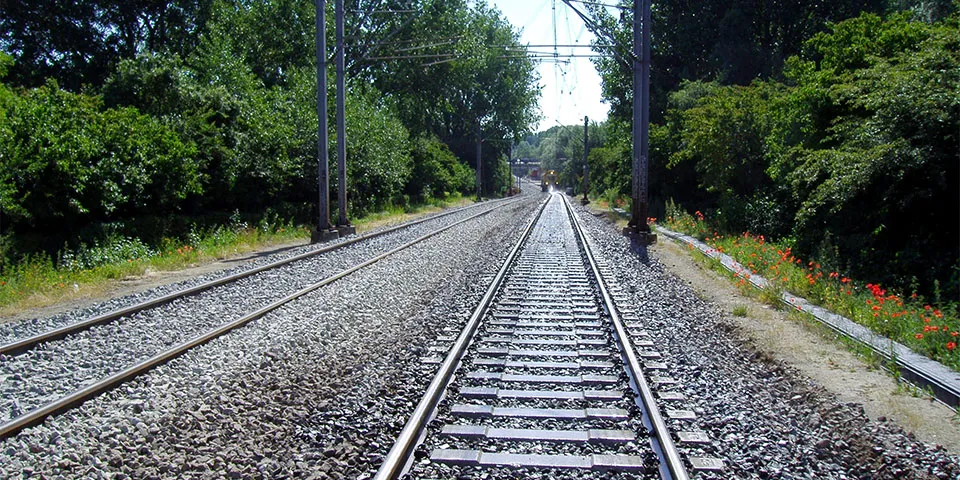
A circular Netherlands by 2050. The government’s goal of making the Netherlands circular as quickly as possible is already part of everyday life for concrete producer Betonfabriek Nigtevecht. High-quality concrete is a sustainable product, but with a technical service life of more than 100 years, it takes a considerable time before circularity becomes an issue.
“That is precisely why it is essential to use raw materials that do not hinder reuse when the concrete is recycled into aggregate,” says Sascha Tasseron of Betonfabriek Nigtevecht.
Recycled concrete aggregate as a constituent
Betonfabriek Nigtevecht has been putting concrete reuse into practice for several years. As one of the first, and still one of the few, producers to do so, the company uses certified recycled concrete aggregate as a constituent in its mixes, replacing part of the sand and gravel. “And without any loss of quality!” Tasseron adds. “Given the raw materials used, these products will be suitable once again, far in the future, for conversion into concrete products in recycled form. That completes the circle.”
Track structures for light rail and tram lines
Since 1975, Betonfabriek Nigtevecht has produced twin-block sleepers and block-and-slab track systems for rail infrastructure, such as those used in the tramway systems in The Hague, Rotterdam and Amsterdam.
‘Dry cast’ production process
These concrete products are manufactured using a direct-stripping system and reinforced with flexural reinforcement. “This production method enables high daily output using a single production mould,” Tasseron explains, “allowing us to offer short lead times and competitive prices.”
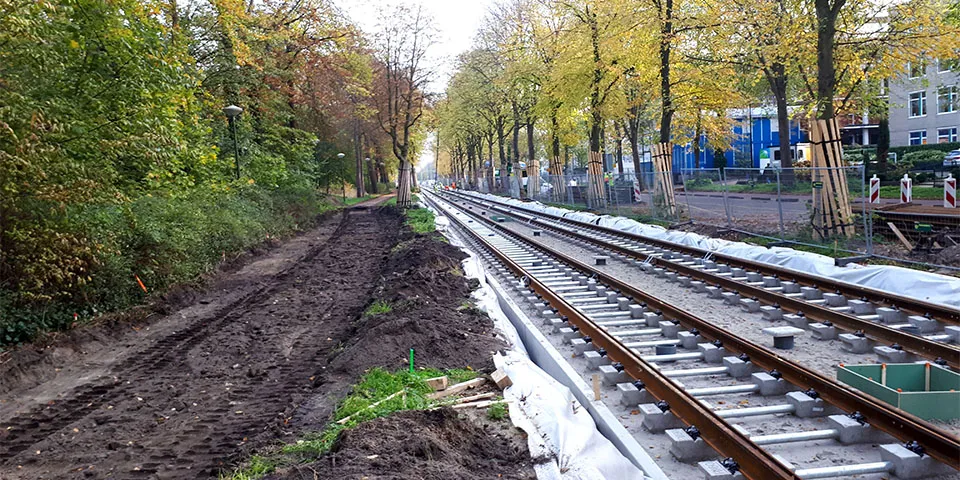
The Duo-bloc tube sleepers are used in closed asphalt/concrete track structures for light rail and tram lines. As here, on a project in Scheveningen.
Reinforced concrete monoblock sleeper
The rise of light rail and metro systems created demand in 1998 for a lower-cost alternative to sleepers with prestressing reinforcement, such as those used in railway track structures. “As Betonfabriek Nigtevecht, we therefore commissioned TU Delft’s Section of Traffic Engineering to design and test a reinforced concrete monoblock sleeper. It had to be suitable for vehicles with a nominal static axle load of 130 to 160 kN, speeds of up to 100 km/h, and a sleeper spacing of 0.60 metres. Following research and development, and extensive successful testing, this resulted in a patented monoblock sleeper.”
Minimising environmental impact
The light rail sleepers are manufactured using low-CO2-emission concrete, minimising their environmental impact. The concrete product meets demanding durability requirements (>50 years) in terms of strength class and exposure classes. “The product has now been used for many years to great satisfaction on projects in the Netherlands, Belgium and France.”
Over the years, alongside its many products for the water and infrastructure sectors, Betonfabriek Nigtevecht’s rail infrastructure range has expanded to include sleepers for switch tongues, crane tracks, roof and façade installations, and amusement railway tracks. Tasseron concludes: “We are happy to work with our clients to achieve the best possible result, not only through our extensive range but also in terms of the environment.”
Question about this story? Ask your question
Keep following this
Get an email when a new story is published. No account needed.
- ThemeLower emissions and more reuse
- SubjectRoad construction







