









Guideline and acceptance sections for Warm Mix Asphalt in the pipeline
Text Roel van Gils Image Bouwend Nederland
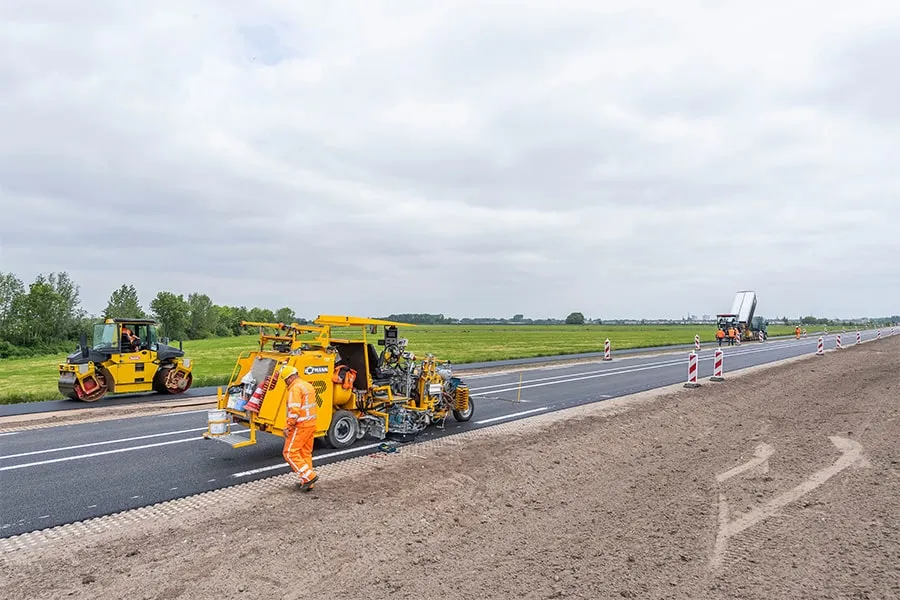
At the Asphalt Day in December 2022, the Bituminous Works Group of Bouwend Nederland unveiled the concept of Warm Mix Asphalt. Phasing out the current Hot Mix Asphalt is a first serious step towards reducing CO2 emissions from asphalt production. From 1 January 2025, Warm Mix Asphalt will be the norm. A step that looks significant on paper, but experts say will prove very small in practice. To make things easier for all stakeholders, road builders and clients, work is under way on a new CROW guideline. Acceptance sections are also being laid to show the outside world that the techniques described in the new guideline produce good-quality asphalt.
The Warm Mix Asphalt initiative came from the Bituminous Works Group. “In 2021, we brainstormed with our members about how we, as a sector, could contribute to climate targets,” says Ron Wesseling, group manager of the Bituminous Works Group at Bouwend Nederland. “What is the relatively low-hanging fruit? Naturally, it is lowering the production temperature. That means you need substantially less gas to produce asphalt. By switching to Warm Mix Asphalt, we are reducing the temperature from around 170 degrees Celsius for current Hot Mix to between 100 and 140 degrees Celsius for asphalt mixes. This reduces CO2 emissions by 10% to a maximum of 30%.”
No longer available to buy
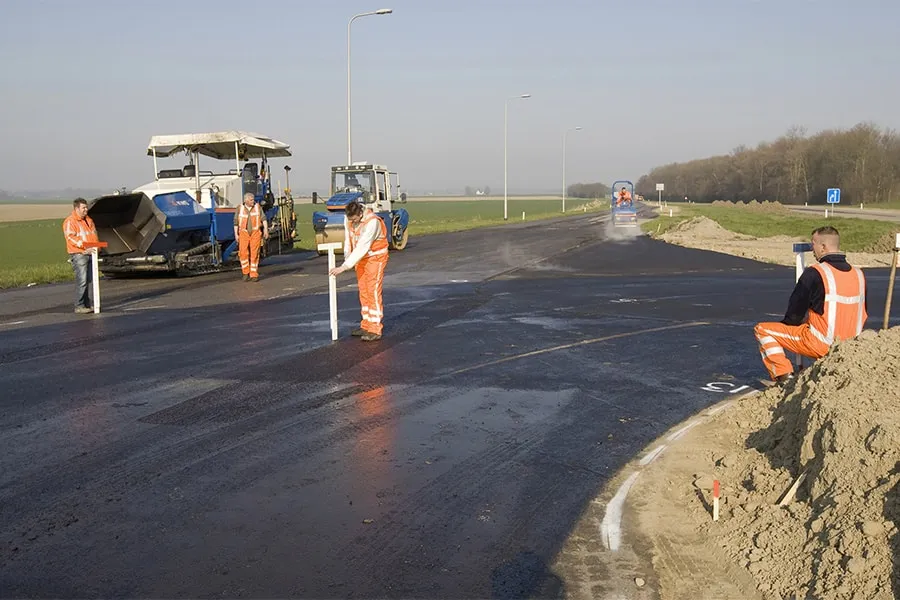
According to Ron, the challenge is not so much about lowering the temperature. “Basically, any asphalt plant can produce a Warm Mix. The biggest challenge is getting used to the fact that the asphalt available today will no longer be available to buy tomorrow. For certain types of road, people automatically turn to a particular solution that has performed extremely well for years. That specific mix will soon no longer be available. In the Netherlands, we use all kinds of type tests to bring products to market, so Warm Mix Asphalt is formally a different asphalt mix. It is not included in CROW’s standard RAW provisions. So there is work to do.”
Road Surfacing Transition Pathway
Following its presentation at Asphalt Day 2022, various parties took up the Warm Mix Asphalt concept. “The only way to make a transition successful is to do it together,” says Ron. “We were approached by the Road Surfacing Transition Pathway, an initiative of the Ministry of Infrastructure and Water Management delivered by Rijkswaterstaat, to work together. They are also working to make the entire road surfacing chain more sustainable and achieve net-zero CO2-eq emissions. Warm Mix Asphalt is a good first step. In 2023, we started discussions and formed a working group to develop a CROW guideline for processing and laying Warm Mix Asphalt.”
A level playing field
CROW, says Ron, is a highly important and well-established organisation where clients and contractors agree on how to deal with road surfacing within CROW’s rules, and which also manages various types of contract. “I see it as a level playing field for the sector, where clients and contractors can talk freely about how things are organised. There is no traditional client-contractor relationship and no competition. This produces very useful ideas that we incorporate into the guideline. These include matters such as what a contract should look like and the requirements an asphalt product must meet.”
CROW guideline
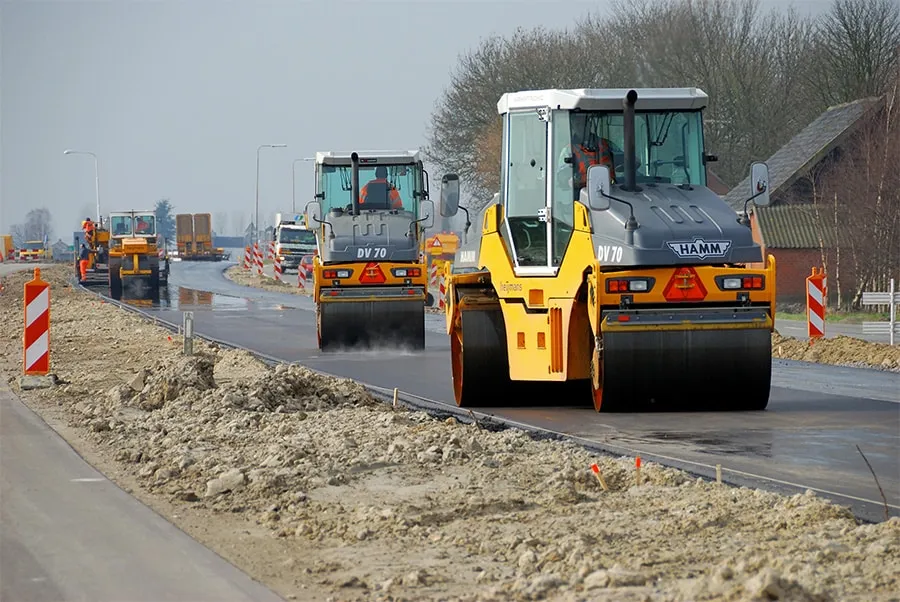
The CROW Warm Mix Asphalt guideline will describe a number of techniques for producing Warm Mix Asphalt. “For example, it will explain how to process it outdoors and how to lay it,” Ron explains. “This provides clarity for road builders, as well as for the client commissioning the work. That is the beauty of a CROW guideline. You can, so to speak, take everything in it straight off the shelf. It has been carefully thought through, so you can specify and approve it for use across your road network with complete confidence.” The CROW Warm Mix Asphalt guideline is expected to be presented in the second quarter of 2024.
Acceptance sections
Alongside the guideline, the parties working together to develop the WMA guideline are introducing so-called acceptance sections. “It is a new term,” Ron acknowledges. “Acceptance sections are intended to show the outside world that the techniques described in the new guideline produce good-quality asphalt. An independent party will inspect and assess the acceptance sections. How did the paving go? Is the compaction satisfactory? Do the joints fit together properly? In short, is the road smooth and well laid?” According to Ron, the new guideline and the acceptance sections will enable clients to switch from current Hot Mix Asphalt to Warm Mix mixes without penalty. “Quite a few clients are already convinced and have switched to Warm Mix mixes, either fully or in part.”

Communications and implementation plan
There is still a great deal of work to do, however. The 12 provinces, 342 municipalities, Rijkswaterstaat and all the water authorities also need to be informed. “Our implementation group, with representatives from municipalities, provinces, asphalt plants and road builders, has drawn up a communications and implementation plan for Warm Mix Asphalt. We are working together on this, which is quite unique. It is an organic process that takes all kinds of aspects into account,” Ron explains, giving an example: “Suppose you have a maintenance contract that still has several years to run. You will need to amend it to include the new asphalt mixes. That, too, is part of the communications and implementation plan, which is developed jointly and presented to the market in manageable chunks.”
The asphalt of the day after tomorrow
And then it will be 1 January 2025. “We expect that by then people will have fully understood that the switch to Warm Mix Asphalt looks significant on paper, but will ultimately prove very small in practice,” Ron assures us. “And yes, it is true that some perceived certainties are being given up, because we will no longer get what we used to. On the other hand, stepping off the beaten track offers many opportunities for the future. Warm Mix Asphalt is a very good and important first step, but we need to take many more steps as a sector to become carbon-neutral. I am convinced that we will make enormous strides in the coming years.” Ron hints at the increasing use of bio-based materials in asphalt mixes and expects the recycling rate to rise. He also does not rule out lowering the temperature even further. “Perhaps, in the distant future, we will even be able to produce asphalt at ambient temperature. There is a great deal of development under way. Formally speaking, it will mean that in the future we will increasingly be dealing with different asphalt mixes. The asphalt of the day after tomorrow is not the asphalt of tomorrow.”
Looking back at Asphalt Day 2023
As you would expect, phasing out Hot Mix Asphalt was the main topic of conversation at Asphalt Day 2023 on Thursday 21 December 2023. “We had almost 500 people through the door,” says Ron Wesseling, group manager of the Bituminous Works Group at Bouwend Nederland. “The atmosphere was very good. That was also thanks to the interesting programme of speakers, with a strong focus on sustainability and all its implications from different perspectives. Phasing out Hot Mix Asphalt is just one of many changes the sector faces on the road to circular, carbon-neutral asphalt.”
Particular attention was paid to sustainable equipment for laying asphalt. “Progress is being made here too,” Ron notes. “Electrification is gradually finding its place. Progress is slow because the major machinery manufacturers are only making limited efforts in this area. Innovative as we Dutch are, many companies are taking matters into their own hands and working on all kinds of developments. These are good steps towards gaining the experience needed with electric equipment. At the same time, conventional machines are increasingly running on HVO 100 biofuel. That, too, leads to significant savings in CO2 emissions. Much more attention is also being paid to efficient, smart logistics on site. In short, real progress is being made. Combined with sustainably produced asphalt, this means the road construction sector is making huge strides towards sustainability.”
Another important issue raised at Asphalt Day was the recruitment of staff. “The road construction sector is also feeling the effects of a tight labour market,” Ron acknowledges. “But with all the developments, partly driven by sustainability, the sector will also need staff with different qualifications in the future. Maintaining electric equipment, for example, requires people with specific training. This ties in seamlessly with Bouwend Nederland’s ‘De Bouw Maakt Het’ campaign. Through all kinds of interesting developments, we are trying to raise the sector’s profile and convince young people that technology also plays an important role in it.”
Question about this story? Ask your question
Keep following this
Get an email when a new story is published. No account needed.
- ThemeExtending the life of roads and civil engineering structures
- SubjectRoad construction







