









Extra-thick concrete cycle paths: riding through the Reevediep
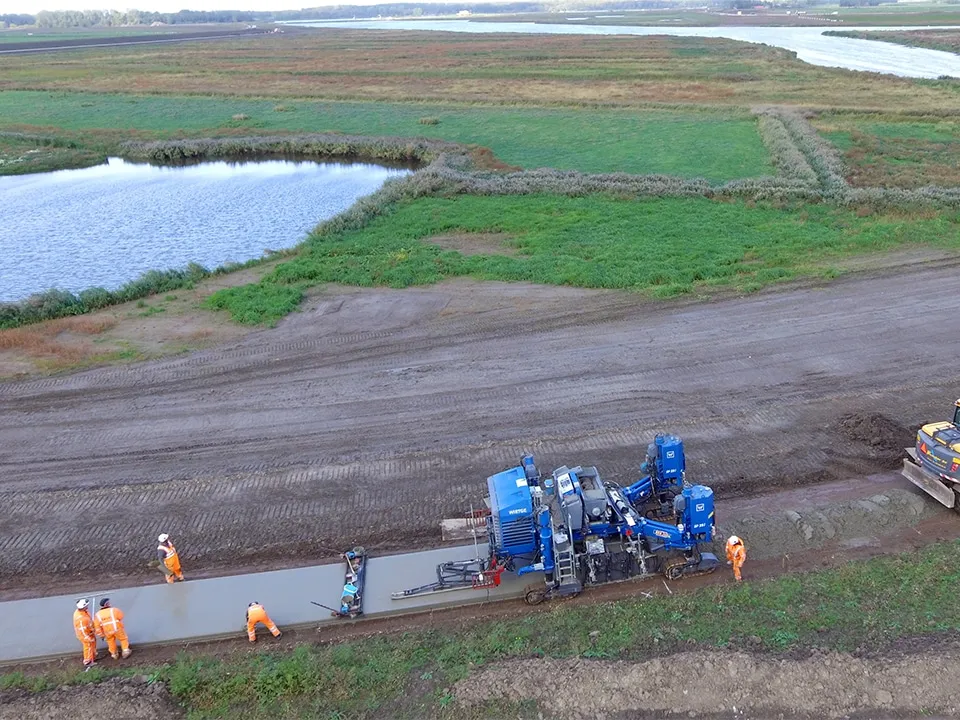
The construction of the Reevediep in the IJsseldelta also provided an opportunity to create new recreational facilities.
A 12.5 km concrete path through the Reevediep, partly laid as two wheel tracks, is a fine example. It has created an attractive cycle route from Kampen, through the floodplains, to the Drontermeerdijk.
The concrete paths on the new embankments in the IJsseldelta are intended for cyclists. Over a length of 7 km, the cycle path is 3 to 3.4 m wide; over 5.3 km, it takes the form of two wheel tracks. Here, the path is divided lengthways, with a grass strip down the middle. The designer used the two-track layout to create a cultural-historical link with the surrounding landscape. BKB Infra built the concrete cycle paths on behalf of Boskalis.
Concrete: the ideal material
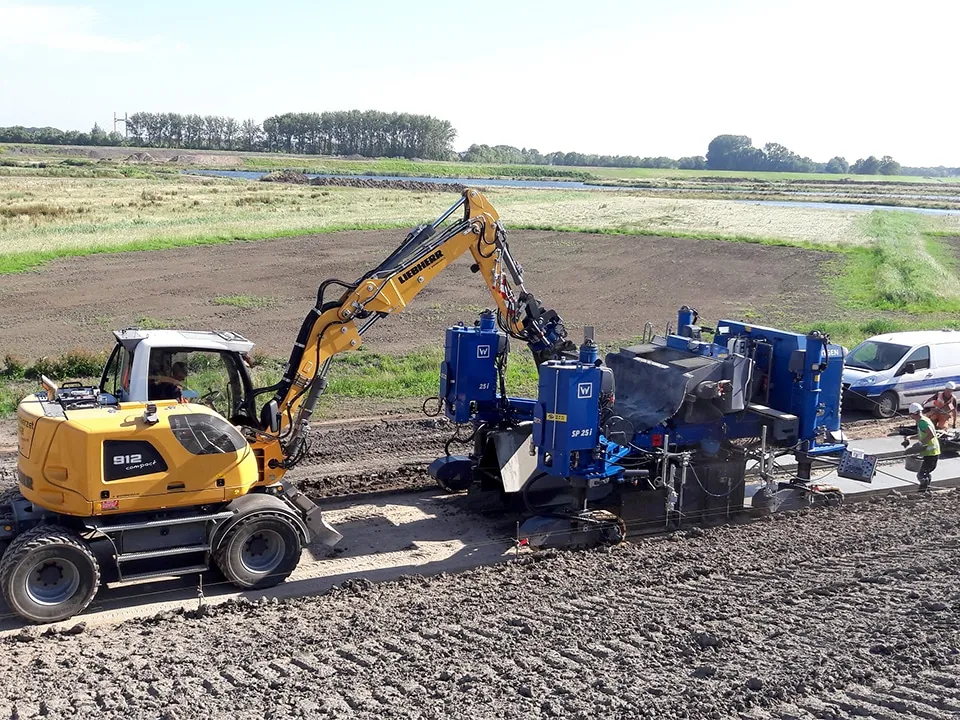
The cycle path as a whole was built with a robust structure. To allow maintenance vehicles to use it as well, the two-track sections were built with a concrete thickness of 210 mm, while the standard cycle paths are 190 mm thick. “Concrete is the ideal material for cycle paths,” says Laurens Bogerd, project manager at BKB Infra. “It stands up to a water-rich environment. It lasts well over fifty years with virtually no maintenance. It retains its shape at both low and high temperatures. And its light colour provides a sense of safety.”
Crack inducers and contraction joints
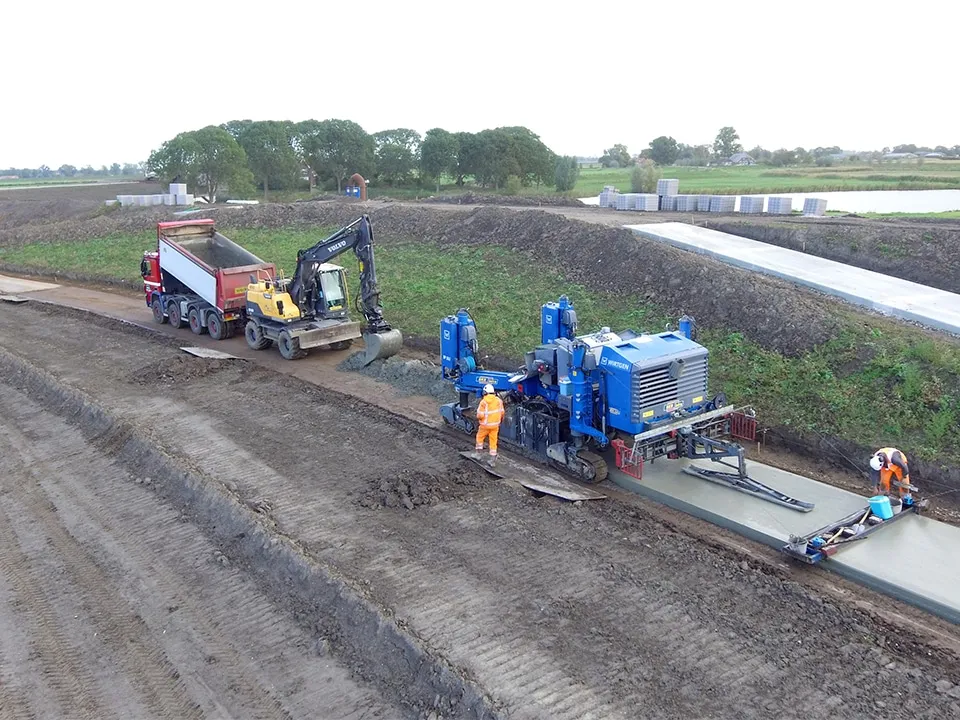
BKB Infra placed the concrete using a slipform paver. In a single pass, the machine compacted the concrete mix and poured it to its final shape. To accommodate shrinkage and expansion, BKB Infra installed contraction and expansion joints. Bogerd explains: “We installed a contraction joint every 3 m and an expansion joint every 100 m. We formed the contraction joints/crack inducers by sawing into the hardening concrete to a depth of one-third of its thickness. The expansion, or movement, joints are around 3 cm wide and accommodate the lengthwise expansion of the concrete slab. To ensure the expansion joints could function properly, we filled them with a plastic material and finished the surface with a bituminous joint sealant.”
Junctions with ‘rounded corners’
The cycle path features curves along its entire length, including at junctions. “This has given the cycle path a welcoming appearance. Building it this way did require some extra care, but it certainly adds character.” All the cycle paths were finished with a broom texture perpendicular to the direction of travel.
“It has turned into an attractive, durable project. The main challenges were logistics and the wet ground. Working with Boskalis, we had to make extensive arrangements to reach the work area. The extended programme allowed us to deliver a tailored solution in every season. Cyclists will enjoy this concrete path for years to come!”
A business enquiry for BKB Infra? Get in touch
Who worked on Reevediep
- civil engineering structuresVan Hattum en BlankevoortMentioned in A bypass for the River IJssel: Room for the River

Keep following this
Get an email when a new story is published. No account needed.
- ProjectReevediep
- ThemeMaterials and techniques for infrastructure
- SubjectRoad construction
- CompanyBKB Infra
- CompanyBoskalis Nederland







