









Colourless binder in Warm Mix coloured asphalt
Text Susan PeekImage Ooms Producten
A high-quality, circular and safe application
The Netherlands has one of the most densely connected road networks in the world, with around 130,000 kilometres of paved roads, most of them made of asphalt. To ensure a sustainable and safe road network, work is under way on solutions and improvements to asphalt, its service life and its maintenance. Latexfalt and Ooms Producten are at the forefront of innovation and research in asphalt and bitumen. “We see innovation, sustainability and collaboration as the way to success in road construction, among other sectors,” says Dr. Ir. Eyassu Hagos, senior R&D specialist at Latexfalt.
Latexfalt and Ooms Producten BV: Sealoflex recently investigated the use of a colourless binder in Warm Mix coloured asphalt. Read on to find out what led to the study and its main conclusions.
Coloured pavements
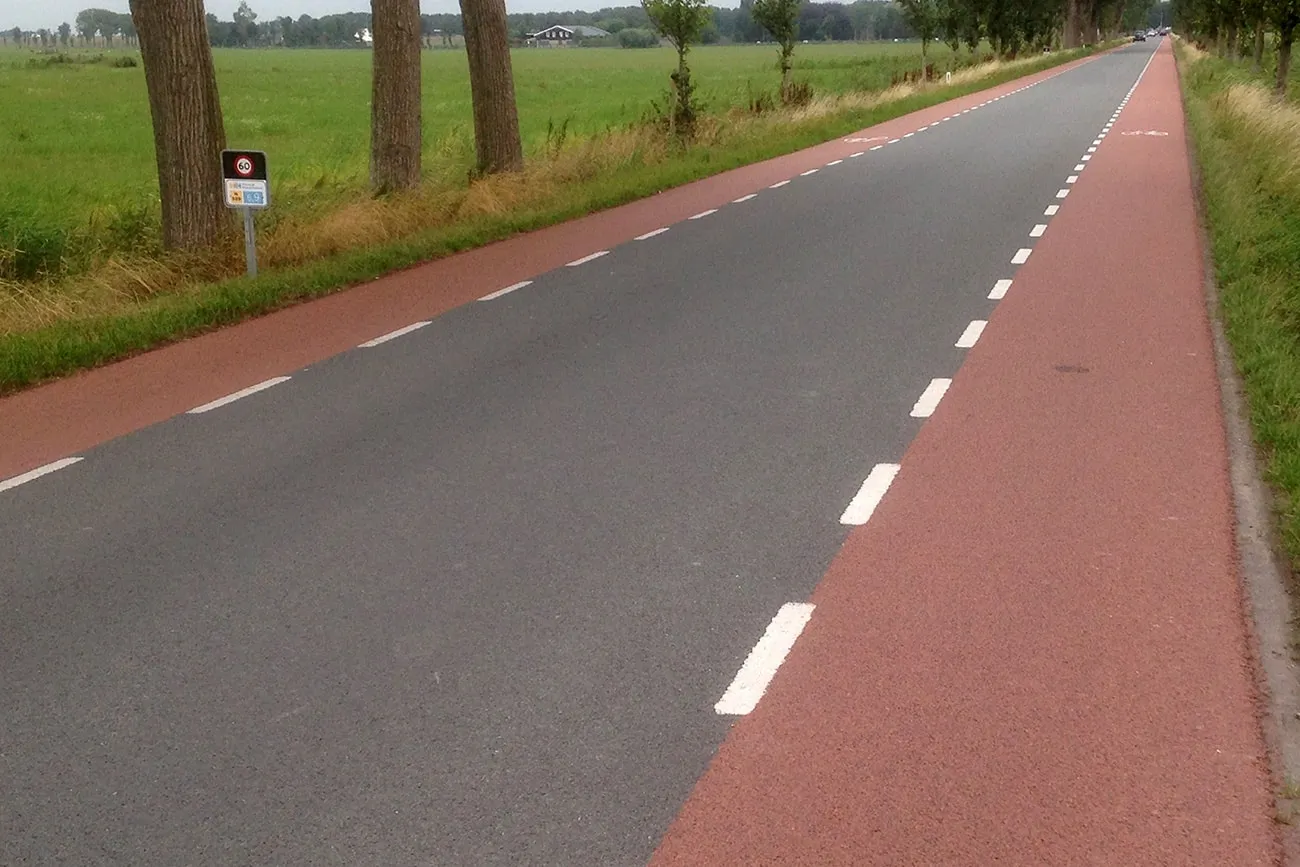
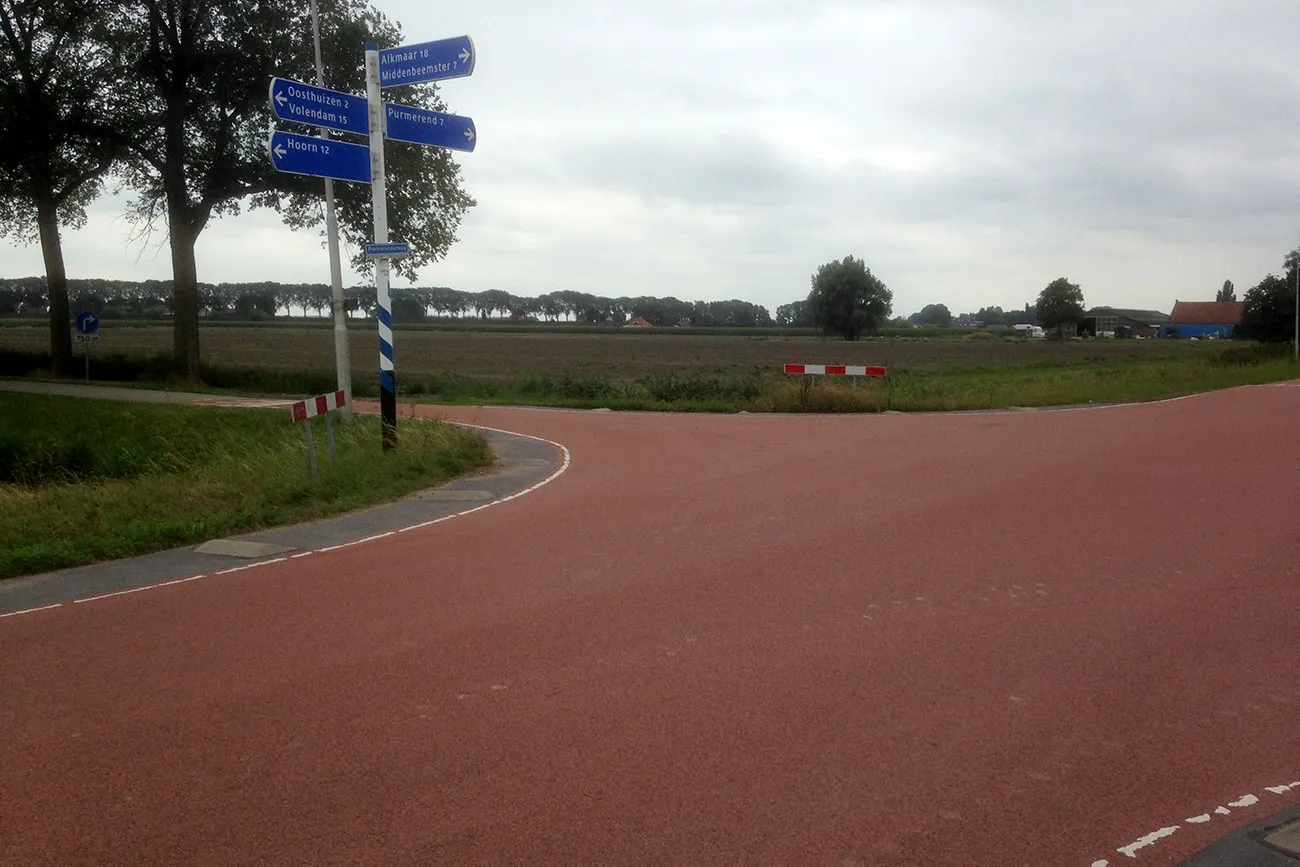
Coloured pavements are used in the Netherlands, and increasingly abroad as well. They are often intended to improve road safety by adding coloured markings, such as the familiar red or yellow cycle lanes, and at junctions, roundabouts and speed bumps. Coloured pavements may also be used for aesthetic reasons or to improve residents’ wellbeing by reducing heat stress in city centres. Light-coloured road surfaces also help reduce CO2 emissions, as less lighting is needed.
Different techniques
There are various ways to create a coloured pavement, from painting the road surface to applying an epoxy resin coating or using coloured aggregate with synthetic pigmentable (colourless) binders. “Each application has specific advantages and disadvantages in terms of both quality and service life. The different techniques also vary considerably in cost,” says Hagos. According to him, a bituminous surface treatment with coloured aggregate is the cheapest option. “However, weather conditions during construction have a major impact on the service life. If the aggregate does not bond properly with the emulsion, for example because the work is carried out in poor weather, the service life is very short. The same applies to an epoxy resin coating, which can only be applied to a dry surface.” Hagos notes that coloured asphalt made with standard black bitumen and a large quantity of colour pigment is regularly used because its initial cost is lower than that of asphalt made with a colourless binder. “The drawback is that the colour is much darker than what can be achieved with a colourless binder. In addition, the large quantity of pigment in black bitumen seems to reduce the quality compared with standard black asphalt.” One possible cause, according to Hagos, is that the pigment used is incompatible with certain types of bitumen. “This can even become apparent straight after paving, in the form of an almost impossible-to-compact ‘dry’ asphalt mix.”
Best results with pigmentable colourless binders
In practice, coloured pavement made with a good-quality colourless binder delivers the best results and a long service life, according to Ir. Kees Plug, specialist at Ooms Producten. “Colourless binders have the advantage that a bright colour can be achieved with relatively little pigment. This contrasts with conventional black bitumen, which remains dark even when large quantities of powdered pigment are added. However, doubts have arisen in the market about the quality and workability of colourless binders, and about whether coloured asphalt made with a colourless binder is circular and safe from an occupational health and safety perspective. These concerns relate to the possible emission of fumes during production and laying.” Recent research by Ooms Producten and Latexfalt shows that these concerns are unfounded and that a high-quality Warm Mix asphalt can be produced safely with a colourless binder. This article looks at the specific properties of pigmentable colourless binders and how best to use them in practice, including from an occupational health and safety perspective. We do this by means of a laboratory simulation test. The circularity of coloured asphalt is also discussed.
Visual inspections
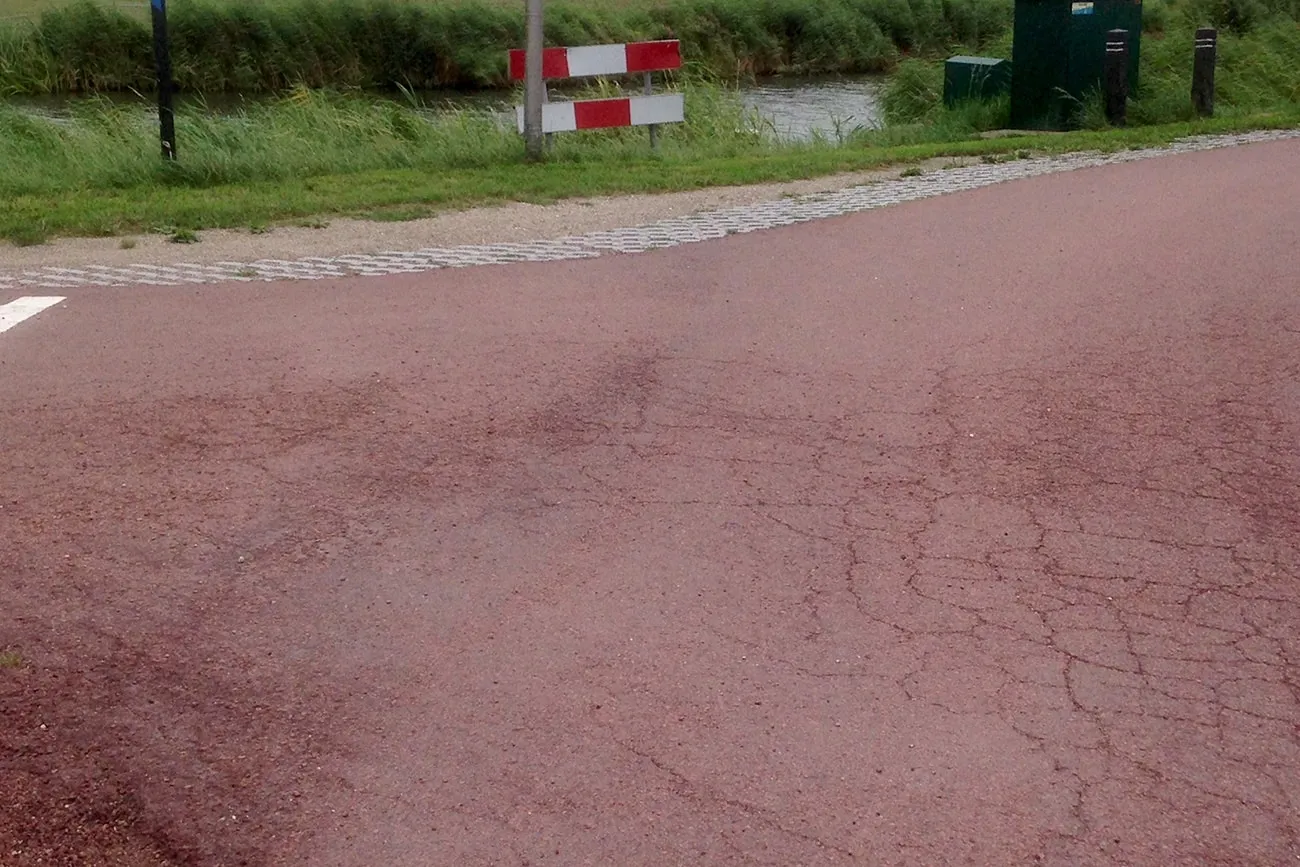
But first, let’s look at coloured asphalt in practice. Since little research has been carried out into its properties at laboratory scale, and coloured asphalt made with a colourless binder is not subject to CE marking requirements, visual inspections are the only way to gain an impression of its performance. “More research is needed,” says Plug. “To assess the performance of coloured road surfaces, we inspected several sites with red asphalt in the Koggenland/Beemster region in 2019. Although the exact laying date is unknown for most of the sites, the asphalt is thought to have been in place for more than 10 years in most cases. These visual inspections showed that damage was limited at sites where a polymer-modified colourless binder had been used.
Particularly compared with the cheaper alternatives,” says Plug. He concludes that the unmodified version was often used in the past in situations for which it was unsuitable. “For example, on speed bumps, resulting in premature damage.”
These limited visual inspections therefore suggest that the best-quality coloured asphalt is achieved by using a modified colourless binder.
Specific properties
“A synthetic pigmentable binder has properties comparable to those of conventional polymer-modified bitumen,” says Plug, stressing that it is important to use a good-quality colourless binder. “The quality of the asphalt depends on the type of synthetic pigmentable colourless binder used. As there are no standards for colourless binders in the Netherlands, their quality can vary considerably. Unfortunately, some colourless binders with poor performance are available on the market and are used for unsuitable applications. As a result, a low-grade, unmodified colourless binder may perform worse than standard black asphalt. On the other hand, a good-quality synthetic pigmentable colourless binder can match or exceed the performance of standard polymer-modified bitumen (PmB), provided the asphalt mixing and laying temperatures are properly adjusted. “Its resistance to fatigue and rutting is very high, so premature failure due to mechanical properties is not expected with this type of binder,” says Plug. He acknowledges that modification does reduce stiffness, but says this parameter is not decisive for a surface course.
Asphalt mixing temperature
“As mentioned, the mixing and laying temperature of the asphalt is crucial to the laying process and the quality of the finished asphalt. It is therefore important to follow the supplier’s recommended temperatures for the specific type of binder,” says Plug. “Not only is the pigment itself sensitive to excessive heat, which can cause discolouration, but mixing at excessively high temperatures (180 °C) can also lead to unnecessary emissions of asphalt fumes. To ensure safe handling, these emissions must be kept as low as possible. Thanks to recent developments, coloured asphalt made with synthetic pigmentable colourless binders can be produced as Warm Mix Asphalt (WMA) at a low temperature (120-140 °C), with fume emissions comparable to those from standard bitumen. This will save gas and significantly reduce emissions of volatile compounds during production and laying.”
Laboratory simulation test of emissions
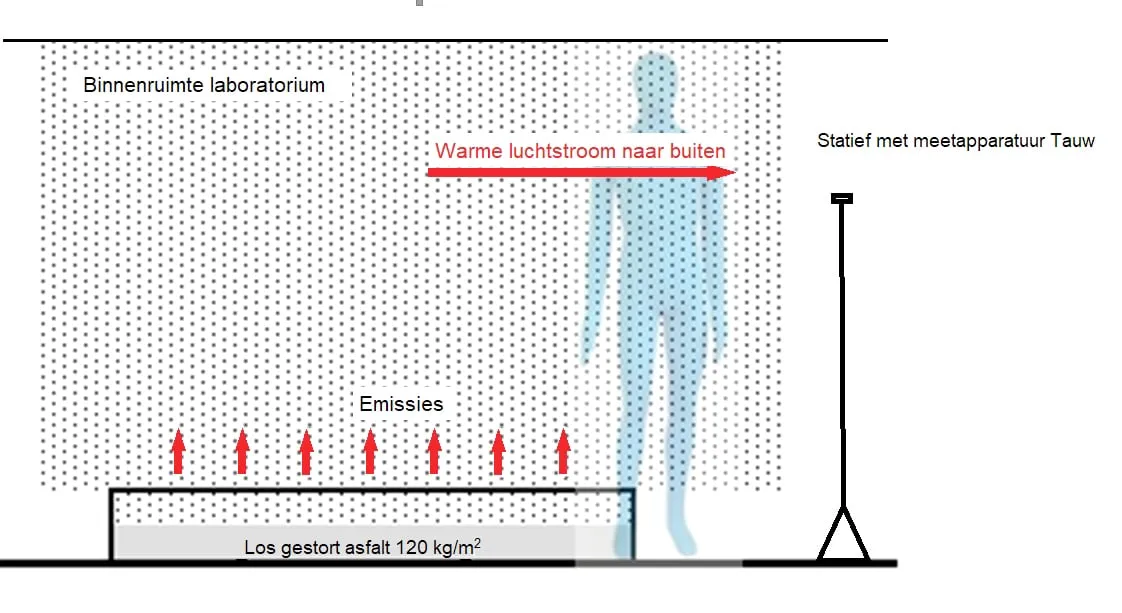
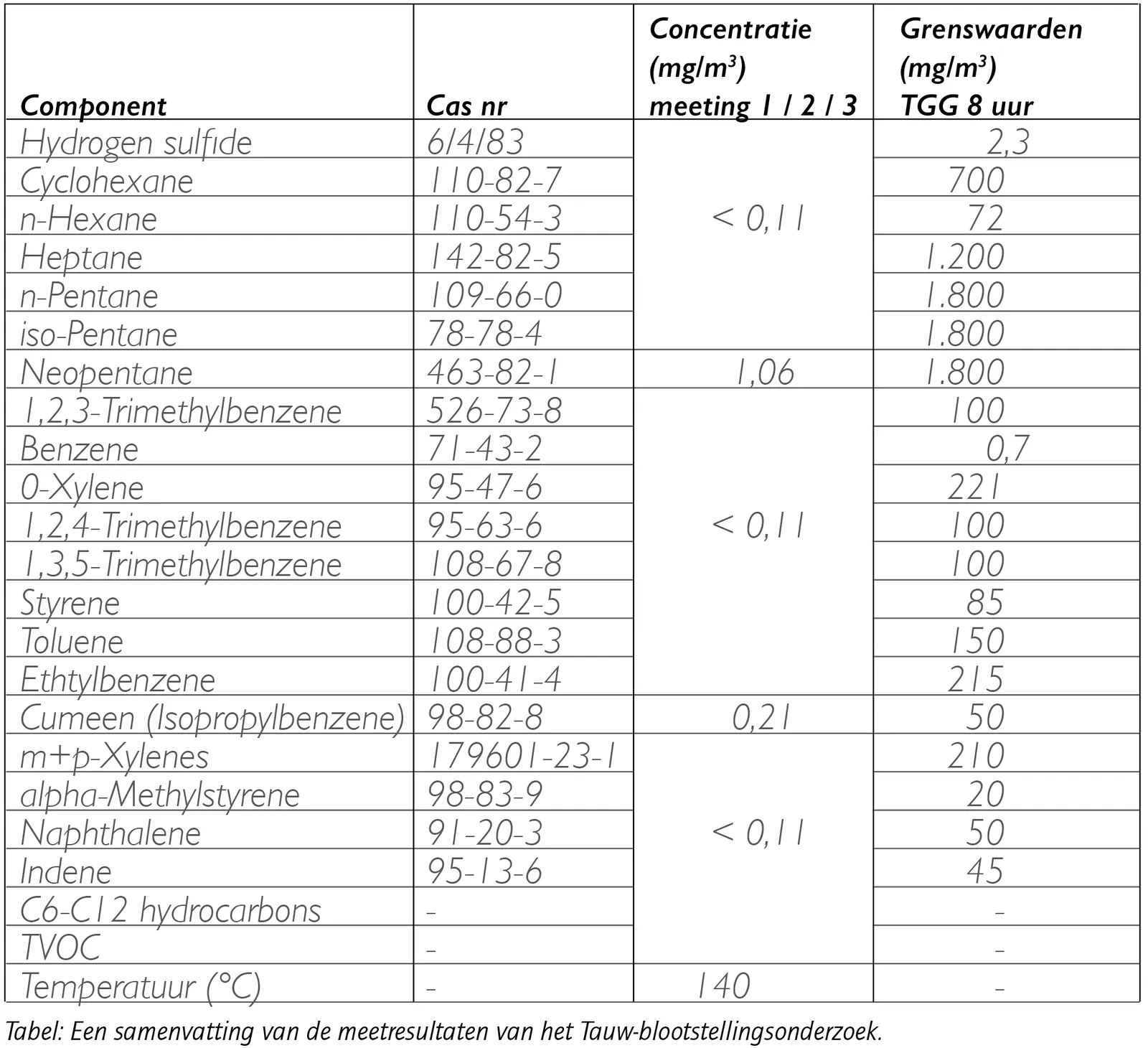
“We don’t just make that claim, of course, we also want to substantiate it carefully,” Plug continues. “That is why we set up a simulation test in our laboratory to quantify emissions during the paving process for a red asphalt mix made with a synthetic pigmentable colourless binder.” The measurements show that even in a ‘worst-case’ scenario, measured in an enclosed space, the time-weighted average (TWA) exposure limit is not exceeded. Measurements in an open space, simulating emissions behind the asphalt paver, show that emissions are below the detection limit in every case and therefore well below the time-weighted average (TWA) exposure limit. The conclusion is that there is no occupational health and safety barrier to using coloured asphalt as Warm Mix Asphalt, since emissions of fumes and aerosols are minimal at these lower temperatures and remain well below the limits set by occupational health and safety standards.
Results of the Tauw exposure study
The table below summarises some of the exposure study measurements. The full results are included in the Tauw report.
Circularity of coloured asphalt
Since asphalt in the Netherlands is widely reused in new asphalt through partial recycling (PR), the circularity of coloured asphalt was also examined. “The findings show that coloured asphalt made with a synthetic pigmentable colourless binder is, in principle, just as circular as conventional asphalt. However, because volumes of coloured asphalt are smaller, it is challenging to reuse old coloured asphalt in new coloured asphalt. It is also not preferable to use it in a standard black surface course because of the differently coloured aggregate,” says Plug. “Low-grade reuse in standard asphalt base courses, however, can be done without much effort or difficulty. So far, the resulting asphalt quality has been at least comparable to that of standard asphalt without PR material. This is because a colourless binder is fully compatible with (rejuvenating) bitumen and also contains active polymers. Horizontal recycling of coloured asphalt granulate can therefore make a significant contribution to road authorities’ goals of producing more sustainable asphalt mixes. Unfortunately, for logistical reasons, coloured asphalt granulate is not currently kept separate at asphalt plants. If this changes in the future, coloured asphalt containing recycled asphalt could also be produced easily.
Conclusion
With the right choice of materials and the correct production and application procedures, coloured asphalt can be produced responsibly with a service life at least equal to that of standard (black) asphalt. Emissions research into the production and application of coloured asphalt using a synthetic pigmentable colourless binder has shown that:
· Colourless binder is at least equivalent in quality to black bitumen and has more consistent quality;
· A synthetic pigmentable colourless binder is needed to achieve a bright colour;
· Colourless binder is more compatible with colour pigments, giving the asphalt a longer and more predictable service life;
· The new generation of colourless binder (low temperature) can be produced and applied with ease at temperatures of 120-140 °C (warm mix);
· Emissions, vapours and aerosols are minimal at these lower temperatures and remain well below the limits set out in occupational health and safety standards;
· This fits perfectly with Bouwend Nederland’s ambition to stop producing road construction asphalt at high temperatures (hot mix) by 2025;
· Colourless binder is fully compatible with standard bitumen, so recycling coloured asphalt is entirely feasible. For horizontal recycling, which enables optimum reuse, the advice is to store coloured asphalt reclaimed material separately at asphalt depots and plants.
Based on practical experience, there is no evidence that synthetic pigmentable colourless binders are any less responsible, sustainable or circular than the alternatives currently available.
The full research report by Latexfalt, in collaboration with Ooms Producten BV: Sealoflex, is available on the Ooms Producten website.
Question about this story? Ask your question
Keep following this
Get an email when a new story is published. No account needed.
- ThemeExtending the life of roads and civil engineering structures
- SubjectRoad construction







