









Rijkswaterstaat and BAM join forces for sustainable A10 road surfacing
Text Suzanne van Gaale Images BAM/Rijkswaterstaat
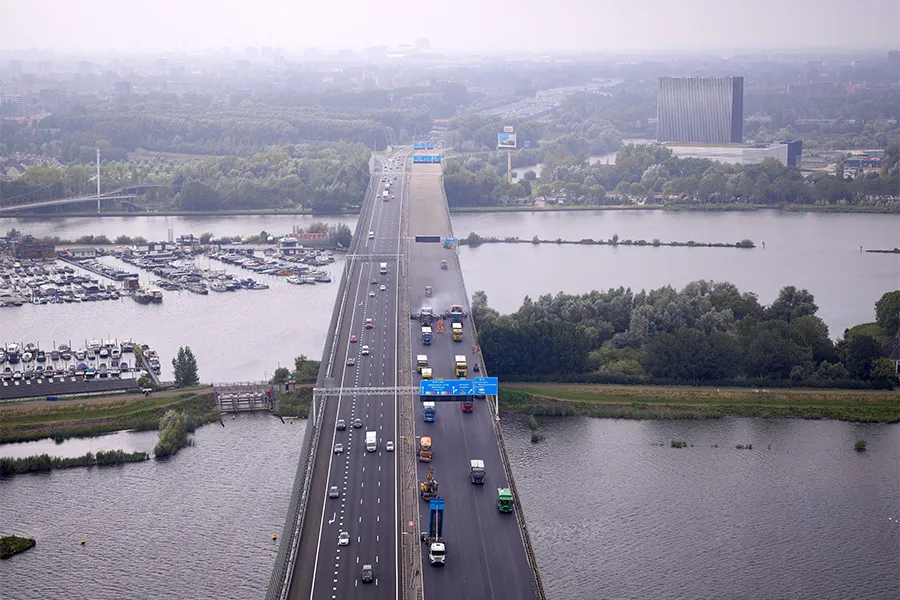
Last summer, construction company BAM Infra Nederland carried out major maintenance on the Zeeburgerbruggen on the A10, commissioned by Rijkswaterstaat. What makes this project special is that it is part of the Koploperaanpak Duurzame Wegverharding. Tom van Beekum and Rémy van den Beemt, both of BAM, explain what this means in practice.
Rijkswaterstaat sets high standards for sustainability, particularly when it comes to renewing the road network in the Netherlands. To realise its sustainability ambitions, Rijkswaterstaat has introduced the Koploperaanpak Duurzame Wegverharding. The major maintenance work on the Zeeburgerbruggen is one of the projects selected to put the desired improvements in sustainability into practice. BAM emerged as the best bidder for the work. “This project is a great example of how we can work together across the supply chain and apply innovations,” says Rémy van den Beemt, Head of Technology at BAM Infra Nederland. “Asphalt is ideally suited to becoming more sustainable. In fact, BAM began experimenting with lower-temperature asphalt production 25 years ago, resulting in LEAB-asfalt (low-energy asphalt concrete). LEAB production uses less energy than traditional asphalt production because it takes place at 130 rather than 165 degrees Celsius. This cuts our CO2 emissions by 30%.”
Fibres instead of polymers
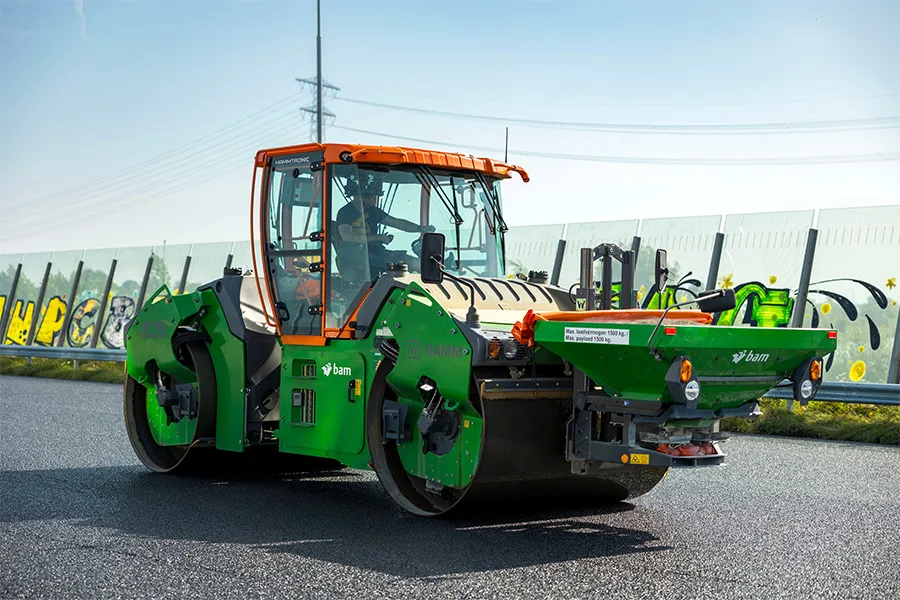
All BAM’s asphalt innovations focus on lowering production temperatures. Alongside LEAB-asfalt, the company is working to replace polymers with fibres wherever possible. “What you lay today must be reusable in fifteen years’ time. If you use polymer-modified asphalt produced at a high temperature, it will be even stiffer in ten to fifteen years and therefore much less suitable for reuse. That is why we are already working to replace polymers with fibres wherever possible. Fibres can be produced at a lower temperature and reused later. In ten to fifteen years, we will undoubtedly be producing asphalt at just 80-90 degrees Celsius. This will also increase the amount of asphalt that can be reused. It fits well with our focus on lowering temperatures. All in all, it is certainly a challenge and an interesting puzzle.”
Greener still
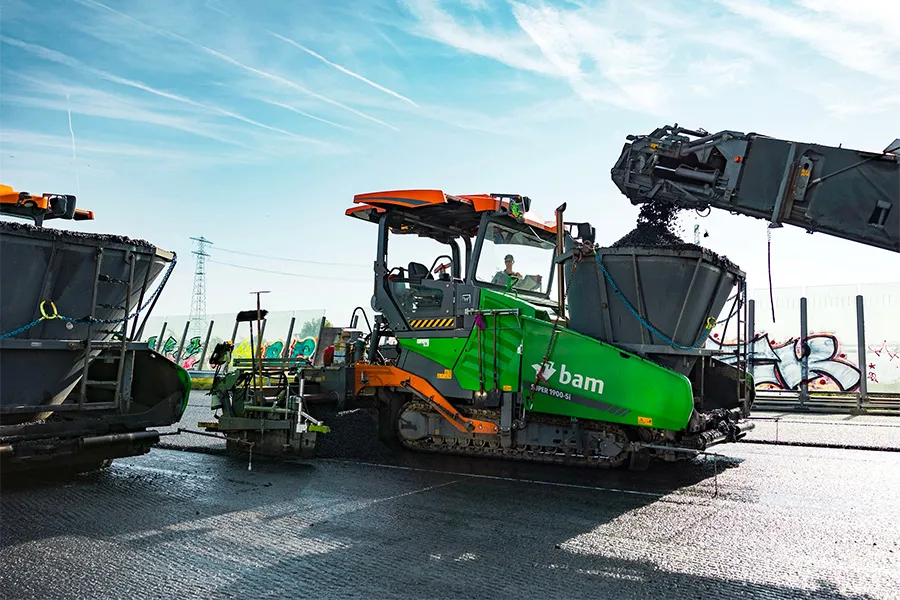
The sustainability measures for the major maintenance work on the Zeeburgerbruggen go further still. “All asphalt is transported using HVO100,” says Tom van Beekum, project manager at BAM Infra Nederland. “The asphalt itself was produced using green gas.”
Lessons and opportunities
However many sustainable measures are available on the market, applying them and getting them validated takes time. Tom says: “The variety of asphalt mixes is a good example. There are many mixes, but that does not mean they can simply be used as a matter of course. At the same time, we see opportunities here too. If we can recover and separate milled asphalt on a larger scale, this will create opportunities to increase the proportion of reusable asphalt. The same applies to electric plant. BAM is investing heavily in electrification, including of our asphalt equipment. Our subcontractors and partners are also working on this, albeit on a smaller scale. In addition, most of our subcontractors’ and partners’ equipment can also run on HVO100.”
First major test for finger joints
As well as new asphalt, the Zeeburgerbruggen have been fitted with new expansion joints: so-called finger joints, each 20 metres long and weighing 18 tonnes. These are the largest finger joints installed in the Netherlands. They have not previously been used in the Netherlands to span such a large gap between a bridge deck and an abutment: they bridge a distance of about half a metre.
Scope for more sustainable innovations
The Koploperaanpak is designed to create opportunities for proven innovations and allow new sustainable measures to be trialled. “Throughout the project, Rijkswaterstaat provides scope for additional sustainable measures that are still in development,” Tom explains. “These could include trial sections using innovative asphalt mixes that have not yet been validated, and low-CO2 block paving at the service areas that we will reconstruct later in the project. It is still to be decided what we will ultimately use. That is the tension between sustainability ambitions and technical possibilities.”
Question about this story? Ask your question
Who worked on Zeeburgerbruggen
- construction companyBAM Infra NederlandIn this story
- sweepers and road surface cleaners
 Wolfswinkel ReinigingMentioned in Wolfswinkel Reiniging gets the A10 ready for new sustainable asphalt
- asphalt reinforcement
 S&P Reinforcement BeneluxMentioned in Longer-lasting asphalt thanks to glass fibre reinforcement
- main contractor
 De Klerk WerkendamMentioned in Integrated project safeguards Amsterdam’s flood protection
- administratorWaterschap Amstel, Gooi en VechtMentioned in Integrated project safeguards Amsterdam’s flood protection
Keep following this
Get an email when a new story is published. No account needed.
- ProjectZeeburgerbruggen
- SubjectBridge construction
- CompanyBAM Infra Nederland







