Smart temporary works system for a bridge deck
Text Roel van Gils Image Safe
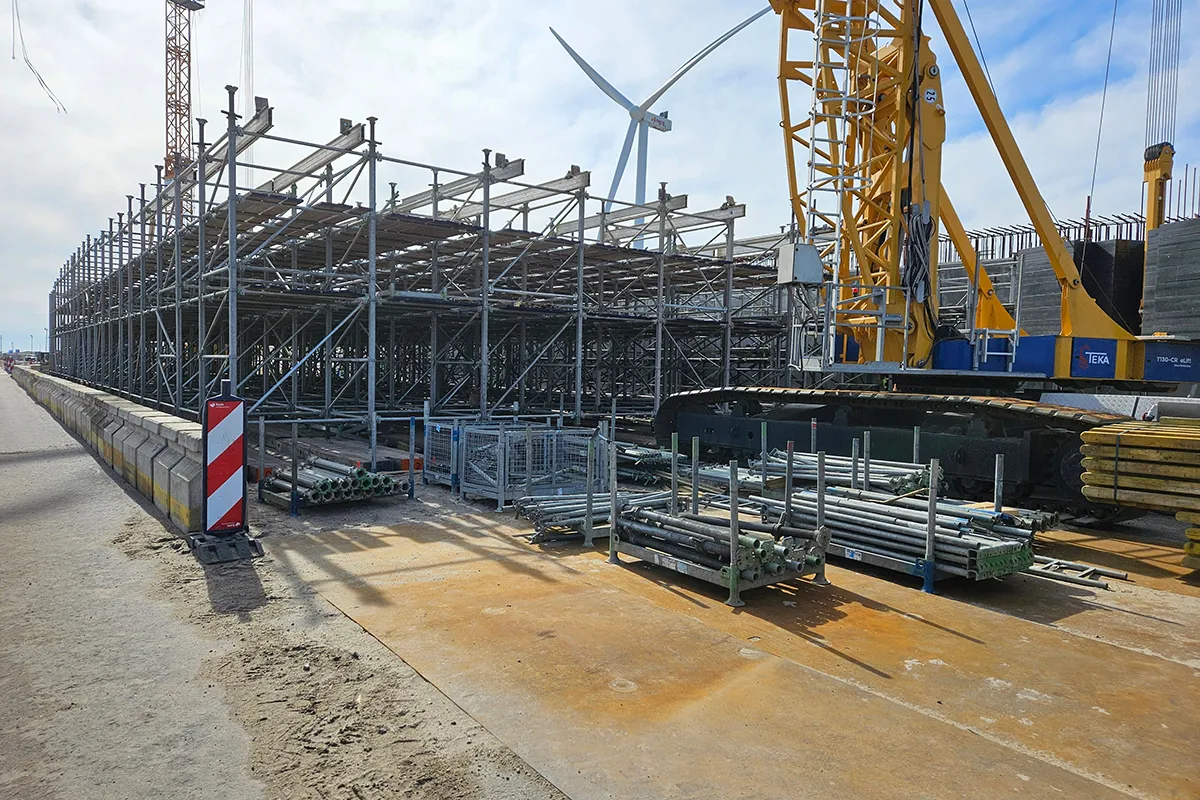
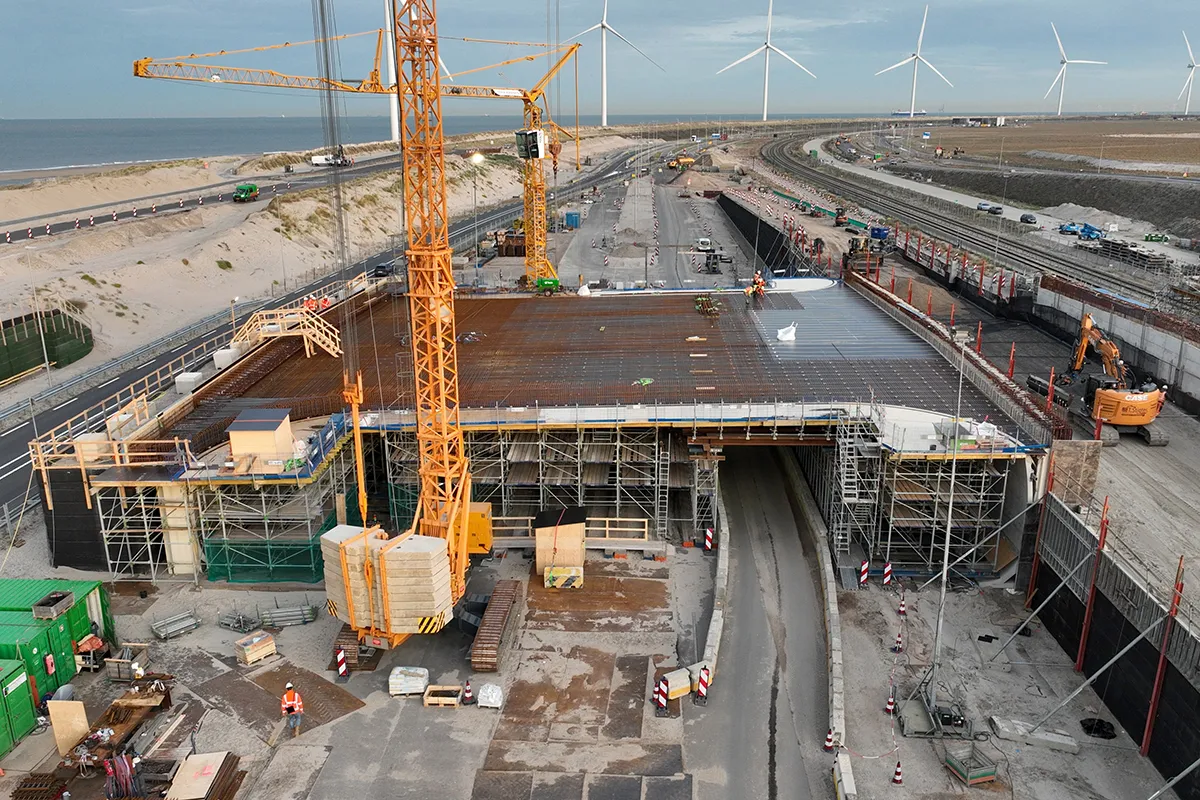
Safe is making a major contribution to construction of the deck of the new Prinses Alexiaviaduct with its in-house developed support system. The system achieves high load-bearing capacity with relatively little support material, while allowing construction traffic to continue passing beneath the deck.
The project has much in common with the Amaliaviaduct, which Safe built earlier, but it also brings new challenges, says Hans Verbunt, project manager at Safe. “The concrete deck, 90 centimetres thick and cast entirely in situ, requires a temporary works structure calculated with the utmost precision. The design must also allow through traffic to continue passing beneath the works. This means a clear space of 4 by 4 metres must be maintained, as concrete trucks and materials can be brought onto the site from only one side.”
Polysysteem
Safe has developed its own system for building temporary works structures of this kind. “With its distinctive square, ribbed profile, our Polysysteem can carry higher loads and is stiffer than conventional round scaffold tubes,” says Julian van der Veen, draughtsman and structural engineer at Safe. “On civil engineering projects, we design for loads of up to 90 kN per prop. That means a single prop can support a 180 by 180 centimetre bay with 1 metre of concrete. That really sets us apart, as eliminating one row of props delivers substantial savings, including on labour.” Verbunt adds: “The props can be extended very efficiently, and we use screw jacks at the top and bottom to accommodate the deck’s slope and unevenness in the ground.”
Tailor-made solution
The precast decorative edge wall presented an additional challenge. “It was already in place and could not be damaged under any circumstances,” says Van der Veen. “The L-shaped wall required a raised steel beam, partly cantilevered. We installed our support structure on top of it, paying particular attention to stability and the risk of overturning during the pour. We also used mini props above the clear passage for construction traffic, in some places no more than 10 to 30 centimetres high. In other areas, there was just 50 centimetres between the steel beam and the deck, leaving room for the timber H20 beams, aluminium beams and props. That is what makes the Polysysteem so useful: its modular design gives it a wide range of applications.”
Special connector
In addition to vertical loads, the horizontal loads from the formwork also had to be carried. Safe developed a special connector for this purpose. “We would not normally need to take loads from the edge formwork, but in this case it was specifically requested,” says Van der Veen. “We carried out additional calculations and made extra components. The aluminium beams are linked underneath by a kind of tie, allowing them to resist the forces from the edge formwork on both sides.”
Combining engineering, innovation, in-house drawings and calculations, and its own installation crew, Safe is providing reliable support for a complex civil engineering project in the heart of the Maasvlakte, where the conditions are every bit as challenging as the structure itself.
Question about this story? Ask your question
Wie aan Prinses Alexiaviaduct werkte
- contractorBAM Infra NederlandMentioned in New viaduct supports sustainable development at Alexiahaven
- reinforced earth structures
 VoetsMentioned in Reinforced soil structures and sustainable construction
- support systemSafeIn this story
- jointless transitions
 StruktonMentioned in Jointless transitions for maximum availability and durability

Keep following this
Get an email when a new story is published. No account needed.
- ProjectPrinses Alexiaviaduct
- SubjectBridge construction
- CompanySafe