









Piet Heintunnel renovation in full swing
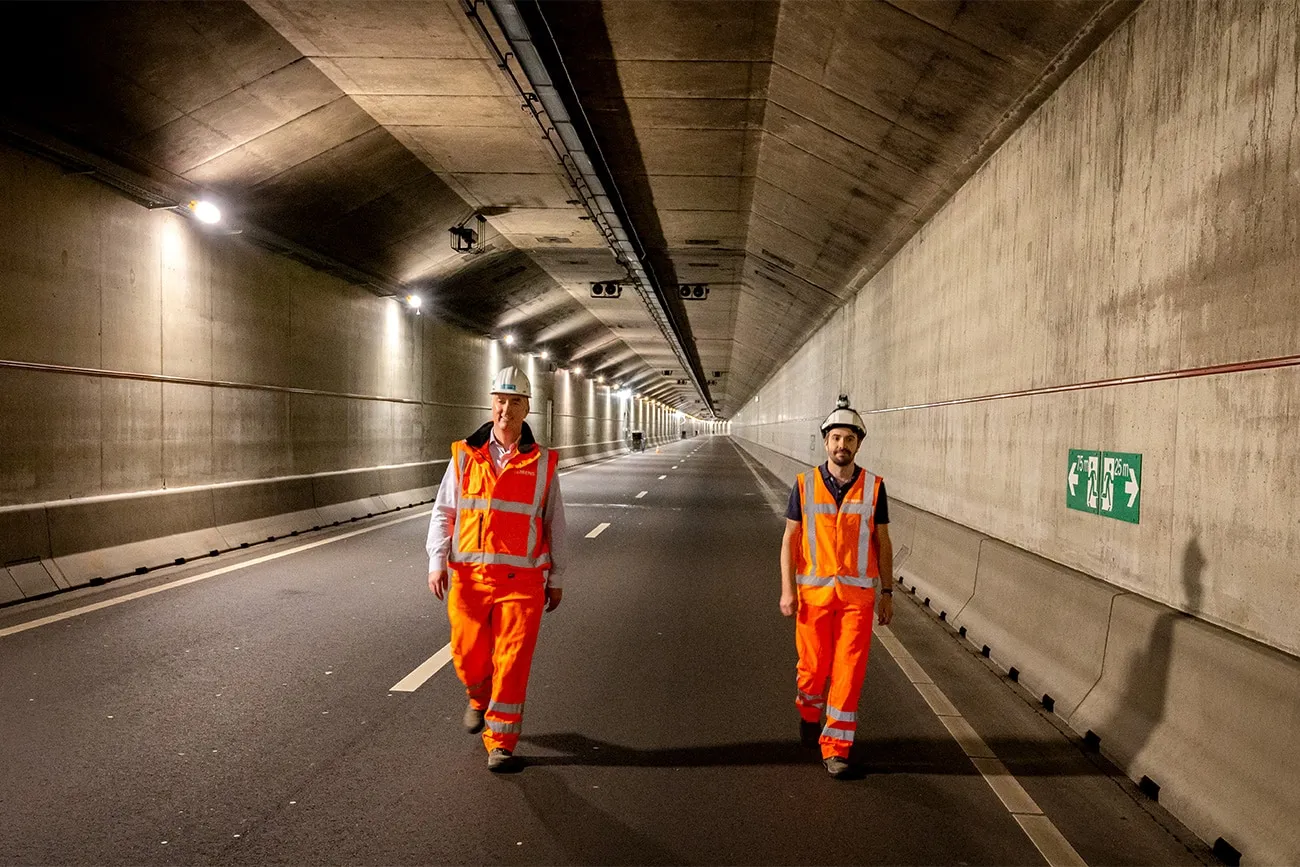
Alliance between the Municipality of Amsterdam and Yunex Traffic/Heijmans
The Yunex Traffic (formerly Siemens Mobility ITS)/Heijmans joint venture is renovating the
Piet Heintunnel in Amsterdam in an alliance with the Municipality of Amsterdam. Yunex Traffic is part of Siemens Mobility and specialises in
technical infrastructure solutions in the Netherlands. Work on the renovation began in late June 2021 and will continue until September 2022. The project is part of the ‘Aanpak Wegtunnels Amsterdam’ programme, abbreviated to ‘AWA’.
The Piet Heintunnel opened in 1997 and is a major artery in Amsterdam’s road network. It connects the city centre with Zeeburgereiland and the A10 ring road. After almost 25 years of intensive use, with 30,000 vehicles passing through each day, the tunnel is due for renovation. The Piet Heintunnel must also fully comply with safety legislation (the Additional Rules on the Safety of Road Tunnels Act). We speak to Renard Kox and Leon Turmaine, both of whom work for Yunex Traffic. Renard is assistant design manager for the Municipality of Amsterdam, while Leon is assistant design lead and Renard’s right-hand man.
Work on the Piet Heintunnel
“The Municipality of Amsterdam, Yunex Traffic and Heijmans will completely renew and expand the existing installations and systems in the tunnel, along with their controls,” Renard begins. “Major maintenance will also be carried out on the civil engineering and structural elements.” Renard is responsible for the entire design team, which covers areas such as civil engineering, communications, control systems and installations. “We are working on a consistent, integrated design with Denis Walraven, who has overall responsibility for the design team on behalf of the municipality,” Renard explains. Leon adds: “I am currently acting as the link to the delivery phase, together with Heijmans.”
Taking systems to the next level
The Piet Heintunnel’s installations date from 1997 and no longer meet current standards. “The legislation has changed, so the systems need to be taken to the next level,” says Renard. “As part of the renovation, AWA is focusing on greater redundancy and less interdependence between systems. The design is therefore even more modular, so that future work causes significantly less disruption to traffic. Fire resistance also needs to be improved: the joints and sheet piling will be fitted with heat-resistant cladding. The installations have reached the end of their service life and will be renewed in line with a design that meets both legislation and the municipality’s requirements.”
Defining sections
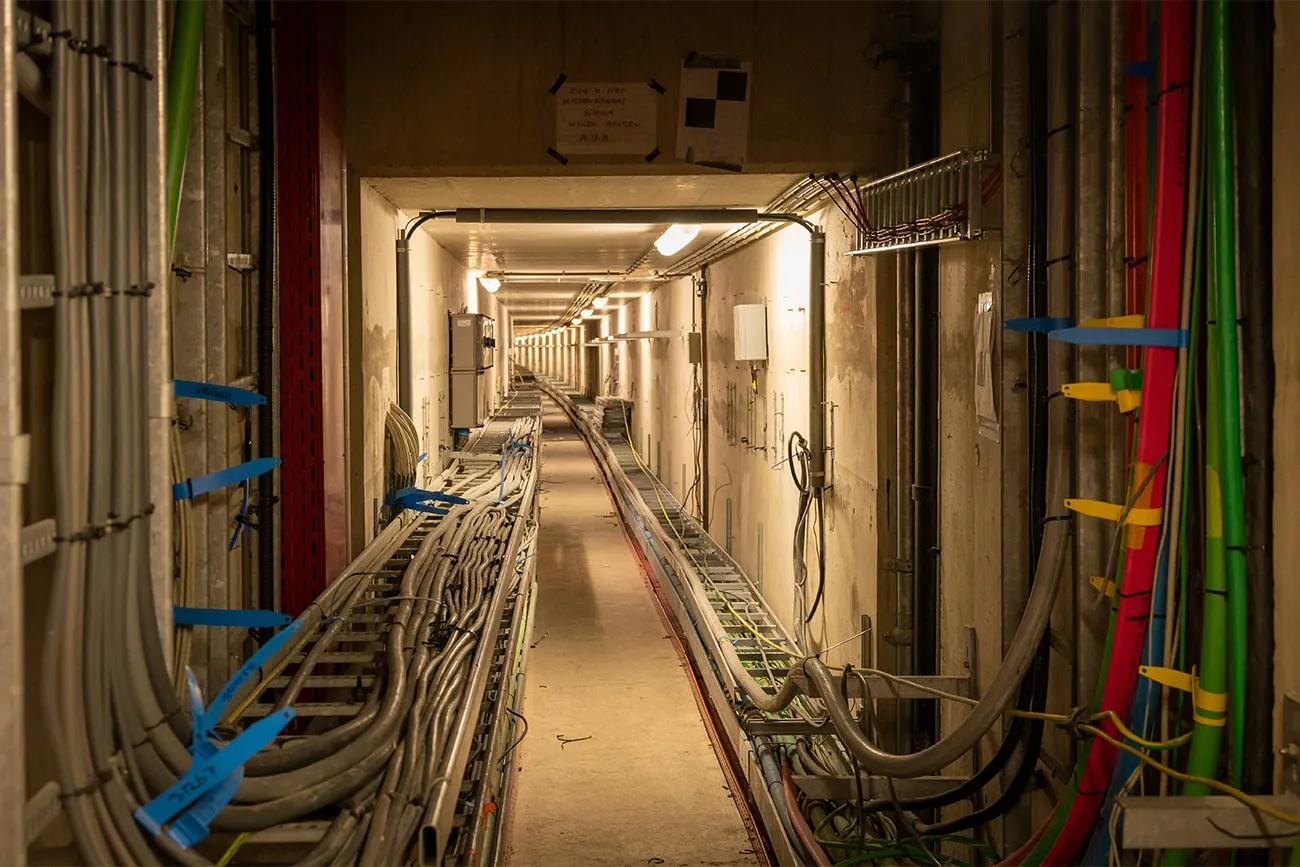
Leon outlines the modular construction approach: “We define sections around the escape doors. Each section is about 100 metres long and has its own design, identical to that of the other sections. It is entirely modular. The advantage is that there are no longer different components, and maintenance, servicing or repairs can be carried out with a limited stock of spare parts and will only affect one section, rather than the whole tunnel. The strength lies in repetition: it raises quality and makes everything easier to maintain. Each section gets an identical control cabinet. This is not the cheapest option in terms of purchase cost, but it is more economical in the long run.”
Renard adds: “This approach also provides a blueprint for AWA, as more tunnels are due to be renovated. Every tunnel has escape doors, so the section-based approach can be used anywhere.” Leon says: “In fact, the longer the tunnel, the more cost-effective the section-based approach becomes.”
The work at a glance
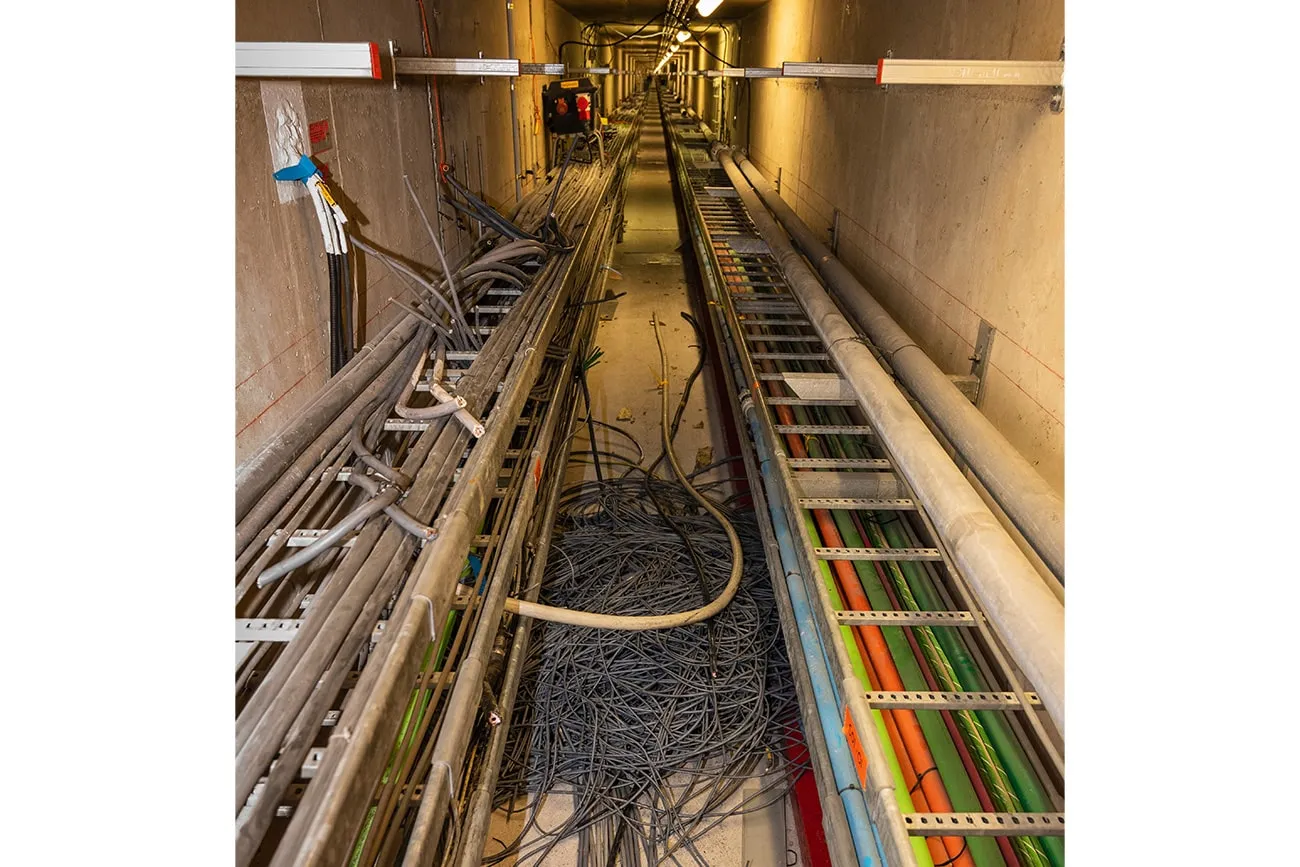
The project follows a “Best for Project” approach, with no “scopesplit” agreed. Renard explains: “For each activity, we look at what is best for the project. Yunex Traffic’s scope includes operation and control, the network, emergency station cabinets, lane-control signals, traffic detection, air-quality monitors, fans and differential pressure meters between the traffic tube and the service corridor. The latter system creates positive pressure in the service corridor, which is needed to prevent smoke or gas from entering in the event of a fire or gas leak during an emergency. The pressure has to be just right, a considerable challenge over 1.5 kilometres. One unusual feature of the Piet Heintunnel is that it has hinged doors rather than sliding doors. The doors therefore have to be pushed against the air pressure to open them. To make this easier, they will be fitted with a mechanical opening aid, a solution borrowed from the maritime sector. All the installations are located in the service corridor.”
Work is also taking place outside the tunnel. Leon lists some examples: “These include barrier gates and the connection to the VTI (traffic engineering installation). Work on the new traffic control centre is also part of the project. The tunnel also has a local control room, a copy of the control room in the traffic control centre. The operator monitors and controls the tunnel from the Municipality of Amsterdam’s central traffic control centre, with a local backup control room at the tunnel, in the West service building. It is a staffed standby location that can be brought into operation immediately if needed.”
Digital Twin
Yunex Traffic uses an interactive digital twin of the tunnel. Renard says: “It is a 3D model of the tunnel, including its surroundings, with the functionality of all the new installations. It is linked to the new tunnel control software and the new workstation for operating and monitoring the tunnel, making it possible to accurately recreate all kinds of scenarios in the renovated tunnel before the renovation even starts. This allows the tunnel’s functional behaviour to be tested accurately. It reduces costs, shortens delivery times and increases efficiency. The Digital Twin has two phases.
The first phase is the physical Digital Twin, a control room with equipment physically connected to it. This allows you to check whether the hardware is working properly, including the interface between the control system and the hardware. The second phase is a Digital Twin with simulated hardware, using SIMIT, a software package developed by Siemens. Among other things, this enables virtual testing without hardware, testing automation applications in a virtual environment and training a tunnel traffic controller in a realistic but safe setting. In phase 1, you physically test one lamp; in phase 2, you can test 100 virtually.”
The third phase involves a software test bench. “Connect SIMIT to the control system and you have a field simulation. Connect the control system to the 3D visualisation as well, and you can test integrated scenarios very realistically. You can also use it to simulate camera footage. This makes it possible to view the equipment in the tunnel from a road user’s perspective. You can also check the camera view to see whether its position is optimal.”
Working in an alliance
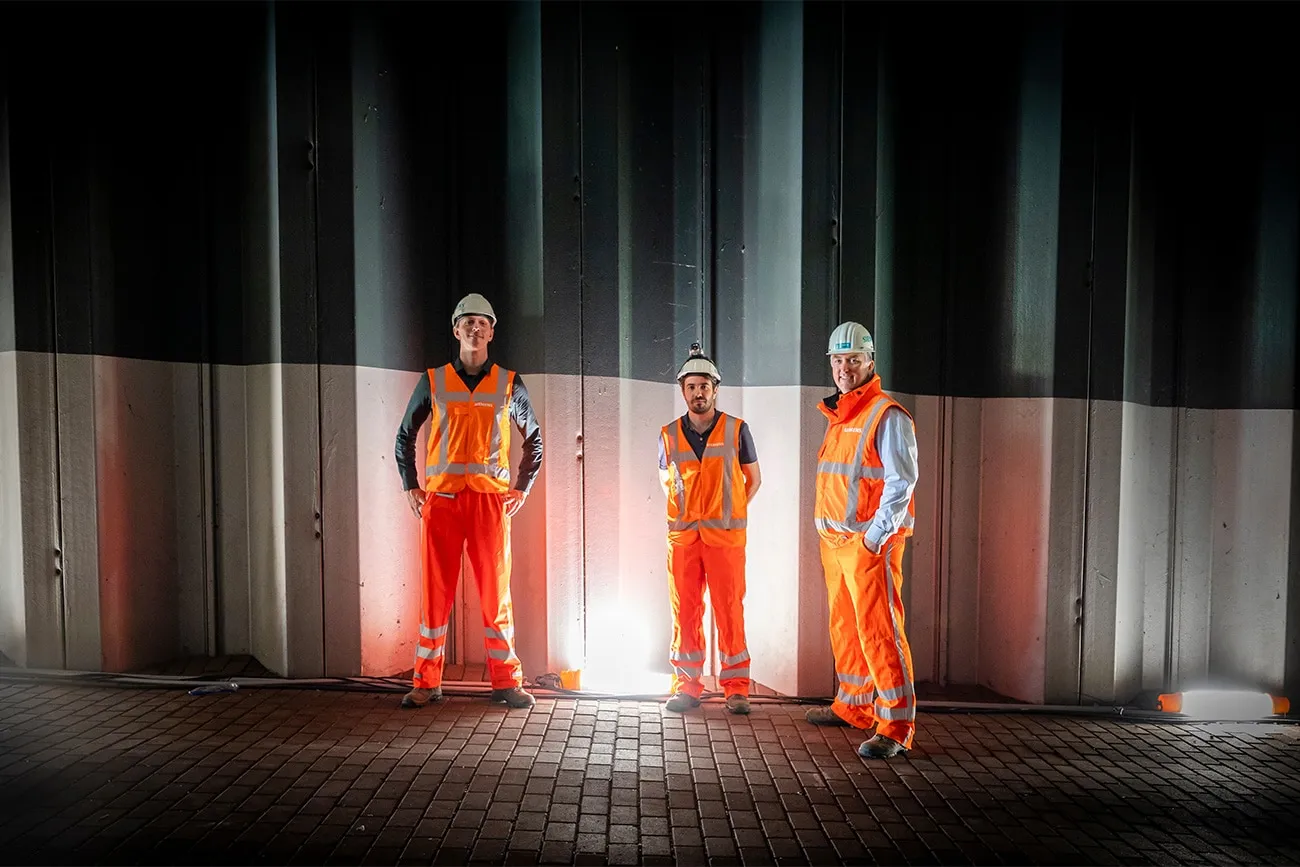
Renard says the collaboration between Yunex Traffic and Heijmans within the alliance is good and enjoyable. “Working in an alliance works well, and it helps that Yunex Traffic and Heijmans already know each other from a similar form of collaboration. We worked together on the Koningstunnel using the same approach and can now put the lessons learned into practice. All parties are open and transparent, there is a great deal of job satisfaction and a strong sense of goodwill on both sides. The Best for Project approach creates an ideal division of work. Heijmans is responsible for the cables, pipelines, lighting, energy and communications systems. Within the VTTI, we handle operation and control, traffic installations, mechanical engineering installations and systems engineering. In that sense, we act as the integrator,” says Renard.
Leon adds: “We try to ensure coordination between the three collaborating parties, which do have three distinct corporate cultures. The differences between those cultures mean that processes require a lot of guidance and instruction. So far, however, things have gone well because we pay close attention to individual colleagues and communicate openly and honestly.”
A business enquiry for Yunex Traffic B.V.? Get in touch
Who worked on Piet Heintunnel
- constructionHeijmans InfraMentioned in Piet Heintunnel renovation: strict schedule and unique collaboration in an alliance
- detailed engineeringSiemens MobilityMentioned in Piet Heintunnel renovation: strict schedule and unique collaboration in an alliance
- mobility managersXTNTMentioned in Keeping Amsterdam accessible during the closure of the Piet Heintunnel
- energy distributionSiemens Smart InfrastructureMentioned in Busbar trunking for energy distribution at Piet Heintunnel
Keep following this
Get an email when a new story is published. No account needed.
- ProjectPiet Heintunnel
- SubjectBridge construction
- CompanyYunex Traffic B.V.







