









Krúsrak bridge renovation: controlled drying process in purpose-built shed
Text Suzanne van Gaale Images Bouwcombinatie HWO
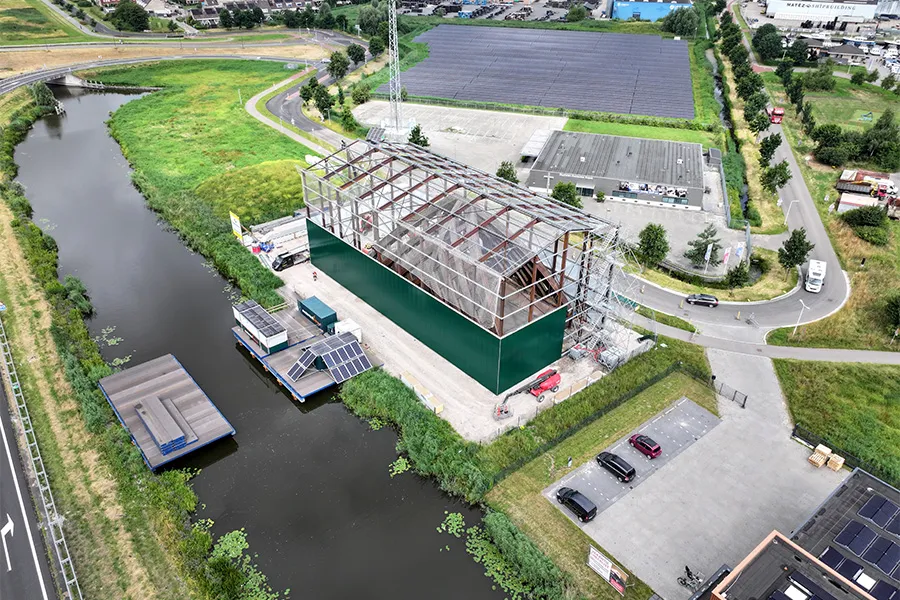
The renovation of the Krúsrak bridge over the N7 near Sneek is far from an everyday project. The wooden bridge has not only been moved in its entirety to a separate worksite, but a complete shed has also been built around it. This is to ensure the timber bridge dries properly. A project that is a perfect fit for Bouwcombinatie HWO, comprising Hupkes Wijma and Koninklijke Oosterhof Holman.
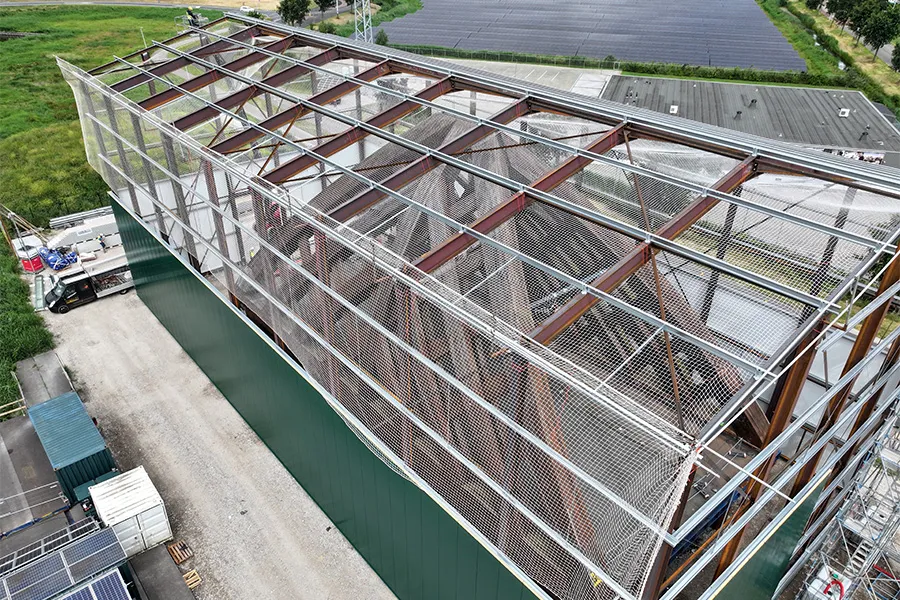
Anyone driving along the N7 near Sneek cannot miss the impressive shed near Krúsrak and Akkerwinde. This temporary shed is the setting for an unusual renovation project: that of the wooden Krúsrak bridge. The client is Rijkswaterstaat. Bouwcombinatie HWO is responsible for the entire renovation. “As a joint venture, we often work together on projects. Our companies complement each other well in terms of knowledge and specialisms,” says Martien Tolboom, project manager at Koninklijke Oosterhof Holman in Harlingen. Martien is closely involved in the renovation alongside Marcus Schiere, product and sales manager at Hupkes Wijma. The Krúsrak bridge, built in 2008, has developed cracks in its Accoya timber. For a durable repair, the timber must first be completely dry. The chosen solution is an insulated, demountable shed measuring 21 metres high, 40 metres long and 20 metres wide. “This gives us an energy-efficient, climate-controlled environment in which to dry the bridge in a controlled way,” Tolboom explains. “The shed protects us from the weather and minimises the emission of dust and noise into the surrounding area. Scaffolding has been erected all around the bridge inside the shed, giving good access to every side of the structure.”
Renovation plan
Bouwcombinatie HWO has drawn up a renovation plan. Schiere explains: “Fans, heaters and industrial dehumidifiers are being used to raise the temperature to 35 to 40 degrees Celsius and control the relative humidity. Sensors in the timber monitor moisture levels in real time. An estimated 20,000 litres of water will be extracted from the bridge in total. Several ‘hotspots’, where moisture levels were initially far too high, are concentrated in the southern part of the bridge.”
Technical repair process
Once the timber meets Rijkswaterstaat’s requirements, the repair work will begin. Larger cracks will be repaired using glued-in timber strips, which accommodate stresses better than fillers. The steel threaded rods will also be replaced with stainless steel ones. All work is carried out in accordance with detailed work and inspection plans, drawn up in consultation with knowledge partners Stichting Houtresearch and Lüning.
Durable protective coating
The final stage is to protect the bridge with a multi-layer paint system comprising an epoxy primer and UV-resistant topcoats, providing long-lasting protection. All joint seals will also be replaced with durable, vapour-permeable sealant. This will ensure the structure is optimally protected against moisture, temperature fluctuations and loading.
Pride
Tolboom and Schiere expect to have completed the job by early 2026, a moment they are certainly looking forward to. “Every project brings challenges, and you learn something from each one. We are carrying out the renovation of the Krúsrak bridge together with a great many companies. We need one another. We will be proud when the bridge is ready and handed over.”
Question about this story? Ask your question
Who worked on Krúsrak brug
- construction consortiumHWO (Hupkes Wijma & Koninklijke Oosterhof Holman)Mentioned in Krúsrak bridge: carefully managed renovation and smart contract split
- construction consortiumHWO construction consortiumIn this story
- clientRijkswaterstaatIn this story
Keep following this
Get an email when a new story is published. No account needed.
- ProjectKrúsrak brug
- SubjectBridge construction
- CompanyHWO construction consortium
- CompanyRijkswaterstaat







