









Krúsrak bridge: carefully managed renovation and smart contract split
Text Suzanne van Gaale Images Dave van Schaik
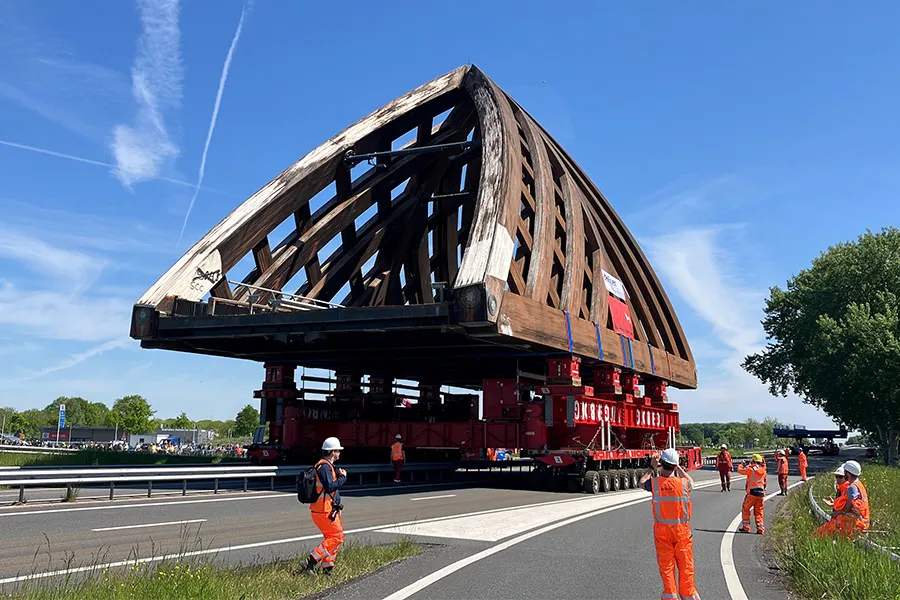
Renovation work on the wooden Krúsrak bridge over the N7 near Sneek is well under way. At least two years of preparation preceded the work. Hans van Ooijen, project manager at Rijkswaterstaat, and Theo Oenema, project manager for planning studies and delivery at Rijkswaterstaat, explain what makes this renovation different and the challenges it involves.
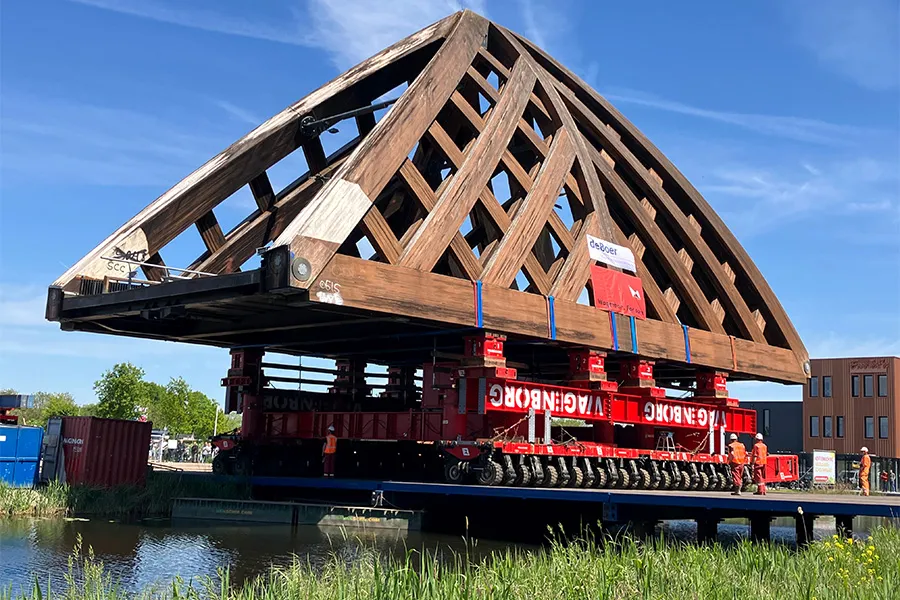
“It is a bold design,” begins Oenema, who was also involved in the construction of the Krúsrak bridge in 2008. “The bridge is made entirely of wood, and every piece of timber is curved. Nothing is straight. The span consists of glued-laminated Accoya timber trusses, each bent, bonded and impregnated. This makes them as strong as hardwood and suitable for 60-tonne lorry traffic.” The design even earned the Krúsrak bridge the Houtinnovatieprijs in 2010.
Too much moisture in the timber
Despite the durable timber and robust construction, the laminated structure proved to retain too much moisture. After more than 16 years, cracks have appeared in the Accoya timber and the protective paint is peeling, leading to moisture build-up, black patches and corroding pins. “Water gets in as a liquid and has to leave as vapour,” explains Van Ooijen. “That is not happening at present. We have carried out a thorough investigation in collaboration with Stichting Houtresearch. Measurements show that the timber has an elevated moisture content. The renovation is essential in any case, particularly because Rijkswaterstaat must be able to guarantee the structural safety.”
Controlled conditions
The renovation involves a series of processes: drying the timber, repairing it, replacing the pins and applying a new coating, all under controlled conditions. This has required extensive planning and calculations. How can a 354-tonne timber structure like this be renovated safely and responsibly? “In the end, we decided to move the entire bridge to a temporary workshop. A temporary steel bridge has been installed for the duration of the renovation. It connects the Duinterpen district with Sneek town centre. A temporary building has been erected at the workshop, where the timber bridge structure is being thoroughly dried under controlled conditions. This means the temperature is carefully regulated to speed up the drying process, which takes about two months. The entire bridge will receive a new protective, breathable coating. It has been thoroughly tested and protects the Accoya timber from moisture, UV radiation and wear for at least 25 years. In addition, the architect has been commissioned to design an extra measure to protect the bridge against initial water ingress, while respecting its design.”
Work split into two contracts
Another feature that makes this project unusual is that Rijkswaterstaat split the work into two contracts. Contract 1 covers moving the bridge out and back. This work was awarded to CT deBoer and Wagenborg Nedlift. Contract 2 covers the entire renovation project and is being delivered by the HWO construction consortium (Hupkes Wijma & Koninklijke Oosterhof Holman). “This collaboration is the key to success. It keeps the risks manageable for everyone, allows each party to apply its specialist expertise and gives regional small and medium-sized businesses the opportunity to take part. Renovation work always brings unexpected issues. Working together in this way means everything is very transparent, there is a great deal of trust, and the process runs smoothly and pleasantly.”
After the renovation, the Krúsrak bridge will be moved back to its position over the N7. The temporary steel bridge will be removed. This is expected
to happen in early 2026, depending on the weather and progress
with the work.
Question about this story? Ask your question
Who worked on Krúsrak brug
- construction consortiumHWO (Hupkes Wijma & Koninklijke Oosterhof Holman)In this story
- construction consortiumHWO construction consortiumMentioned in Krúsrak bridge renovation: controlled drying process in purpose-built shed
- clientRijkswaterstaatMentioned in Krúsrak bridge renovation: controlled drying process in purpose-built shed
Keep following this
Get an email when a new story is published. No account needed.
- ProjectKrúsrak brug
- SubjectBridge construction
- CompanyHWO (Hupkes Wijma & Koninklijke Oosterhof Holman)







