Rijkswaterstaat as a driving force for a sustainable sector
Text Roel van Gils Image Rijkswaterstaat
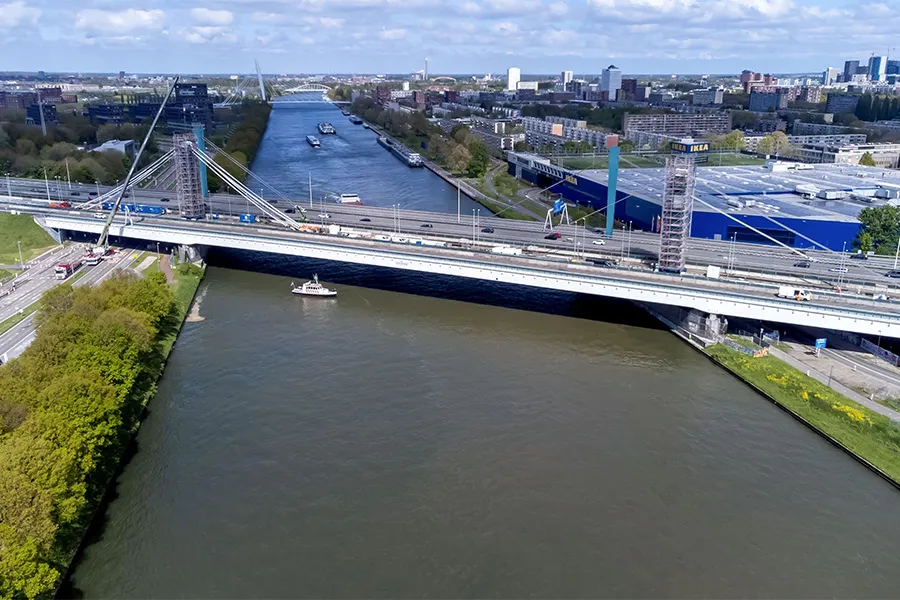
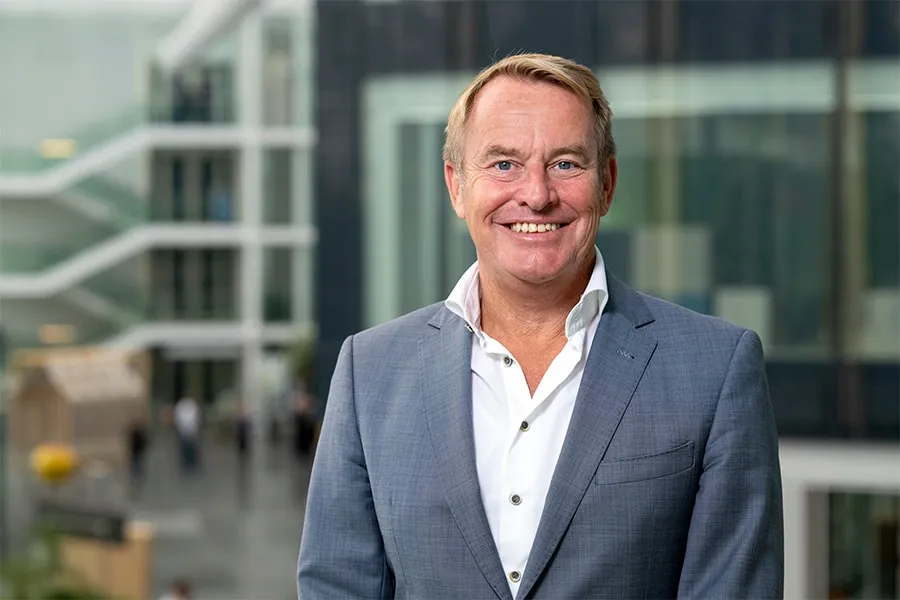
Keeping the Netherlands safe, liveable and accessible. That is Rijkswaterstaat’s mission in 2025, 2030, 2050 and beyond. Faced with challenges caused by climate change, working and innovating more sustainably and circularly is a key principle for Rijkswaterstaat. This calls for collaboration and a joint effort between the client (RWS) and the market, because that is the only way to develop, accelerate and scale up. Speaking is Roger Mol, Chief Engineer-Director (HID) for Sustainability and the Living Environment at Rijkswaterstaat.
To achieve its sustainability targets, Rijkswaterstaat is continuing to focus on reducing nitrogen emissions and particulate matter as much as possible, in other words, clean and zero-emission operations. “At Rijkswaterstaat, we really want to be a driving force by focusing specifically on sustainable innovations,” says Roger. “And we cannot do it alone. We need the entire supply chain, from contractors, engineering firms and fellow public authorities to knowledge institutions and civil society organisations. The sector is certainly not short of innovation capacity, as shown by the many innovations recently presented at InfraTech. As a client, we can help bring innovations to the point where they are ready for practical application, and also help scale them up so that investments can be recouped. We have a number of tools for this, such as the transition pathways, sustainable procurement and the frontrunner approach.”
Transition pathways
The transition pathways for structures, road surfacing, coastal management and navigation channel maintenance, and road, dike and rail equipment are driving the required change. “We looked at the areas where we could achieve the greatest CO2 reductions,” Roger continues. “These include the transition pathways, as well as making the equipment used on our projects more sustainable. For each of these pathways, we have worked with the sector to develop a roadmap with targets, setting out the route to climate-neutral and circular infrastructure. In practice, this means that we gradually tighten the requirements we set as a client, thereby incorporating more and more sustainability into projects.”
Sustainable procurement
In its tenders, Rijkswaterstaat uses the Environmental Cost Indicator (MKI) to express the environmental impact of projects in monetary terms. “Adding these environmental costs to the tender price can encourage sustainability in procurement,” says Roger. “In 2023, we awarded 36 civil engineering contracts with a total contract value of 1.3 billion euros. Of these, 16 projects, with a total contract value of 1.1 billion euros, were awarded on the basis of the best price-quality ratio (BPKV) with an MKI. This means that 85% of the total value of contracts awarded in 2023 was tendered using an MKI. In 2017, the figure was just 44%. The MKI procurement tool is therefore being used increasingly widely in tenders, both in terms of the number of projects and as a share of the total contract value awarded.”
Frontrunner approach
With its frontrunner approach, Rijkswaterstaat aims to reward the market for pioneering sustainability efforts. Roger says: “Our procurement already includes minimum sustainability requirements that everyone must meet. We call these peloton requirements. In addition, we have frontrunner projects, where companies that are able to do so can propose even more sustainable measures in tenders, implement them and be rewarded for doing so.”
Room to learn
Alongside working with peloton requirements and frontrunner projects, further innovation is crucial to making the challenge we all face achievable, Roger stresses. “For example, we need to learn to manage resources differently. To that end, we commission research and create so-called learning spaces within our projects, working with the market to take sustainable steps, including through innovation. This is a process in which the market, research, education and knowledge institutions often play a major role together. Rijkswaterstaat can support this by working together to lower barriers to developing the sustainable innovations that are so urgently needed. We also encourage market players to develop and support innovations more jointly wherever possible. This also prevents broadly similar ideas from being developed in different places.”
Innovations
Rijkswaterstaat challenges the market to come up with sustainable and circular solutions. This has produced some striking examples:
Flexible groyne in the IJssel near Kampen
Built from innovative Xstream blocks, this groyne helps manage the river sustainably, with less dredging and more space for nature.
Reuse of concrete beams
Rijkswaterstaat challenged the market to come up with new ideas for circular viaducts. One such idea is reusing beams in viaducts. This was tested on the A1 at Hoog Burel, resulting in a 97% reduction in CO2 emissions for each reused beam. Environmental costs per beam were reduced by 73%. Rijkswaterstaat is currently recovering around 360 beams from eleven different structures on the A9, for use in various projects, including the A44 and N20.
Reusability scan
Developed in collaboration with the market, this scan identifies reuse potential. It helps determine which components of structures scheduled for demolition could be reused. To date, the scan has been applied around 25 times to various structures, including bridges, viaducts, tunnels, locks, noise barriers and culverts.
Asphalt Recycling Train
The Asphalt Recycling Train is a series of maintenance machines that travel in a train formation over a damaged road surface, leaving behind a smooth, new surface course. The method’s main advantage is that almost all the old asphalt is recycled, making it nearly 100% circular. A pilot programme has now been launched to investigate the conditions under which this maintenance method can be used effectively. More about this technology on page 26.
More sustainable concrete mixes
Developing more sustainable concrete mixes requires a long-term commitment, because their long-term performance is uncertain. Rijkswaterstaat has therefore set up two test sites to trial these more sustainable concrete mixes under real-world conditions.
In this way, we are working on implementing circular and sustainable practices across the sector in a variety of ways, Roger concludes. “By working with fellow clients and market players, we set ambitious sustainability targets and request measures that we know are effective and feasible. This gives the market as much continuity as possible in the direction we are working towards together, enabling it to recoup the investments made in this context.”
Question about this story? Ask your question
Companies in this story
Keep following this
Get an email when a new story is published. No account needed.
- ThemeLower emissions and more reuse
- SubjectSustainability & innovation
- CompanyInfraTech