









WATERQUEST 2019: the next stage

In January this year, a competition was launched at Infratech: the Waterquest. Nering Bögel challenged TU students to come up with ideas to limit or prevent flooding in urban areas. The biggest challenge: be creative and, above all, do not let thoughts about technical or financial feasibility hold you back.
Is there already an idea for tackling urban flooding?
The golden idea
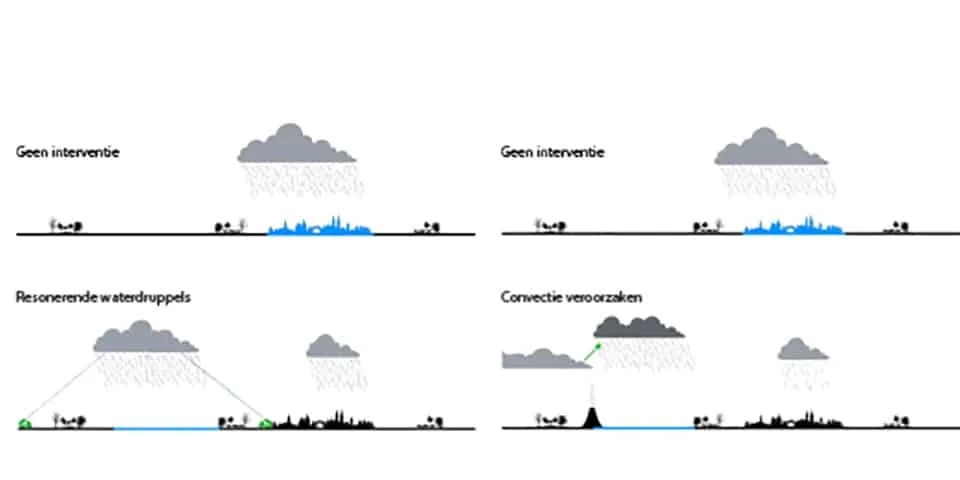
Following the launch at the end of March, a meeting was held in early July where students presented their ideas to Richard Janssen (owner of Nering Bögel and initiator of the competition) and Nick van de Giessen (an international authority on water-related issues). Despite some surprising approaches and clever, original ideas, the ‘golden idea’ had yet to emerge… Judged purely against the wording of the brief, there were a few entries that met it in part or in full. “The ideas that prevent rain from falling over urban areas are the closest match to the original question,” says Van de Giessen, a Waterquest jury member. “One example is the idea below about Resonance and Convection. It should be noted, however, that measures of this kind inevitably involve intervention in nature. We obviously need to investigate that carefully.” Janssen adds: “Ideas that both partly prevent water from falling over urban areas and still require water to be stored or infiltrated only partly meet the original brief, but offer a more realistic prospect in terms of feasibility.” Here are some of the entries:
Resonance and Convection
Preventing rainfall over urban areas by means of resonance and/or convection.
Hydrogen from rainwater
Electrolysis equipment installed in urban areas could convert rainwater into hydrogen. The hydrogen would be carried through the pipe network (currently used for natural gas, but potentially repurposed for hydrogen) to power plants running on hydrogen. Storage tanks for large quantities of hydrogen would also be located there.
APS
Aquifer Precipitation Storage (APS) collects water from building roofs. It is channelled from each area to an aquifer (an underground water-bearing layer). Further downstream, the water is pumped back out of the ground at the same flow rate and discharged into open water.
Discharging water at top speed
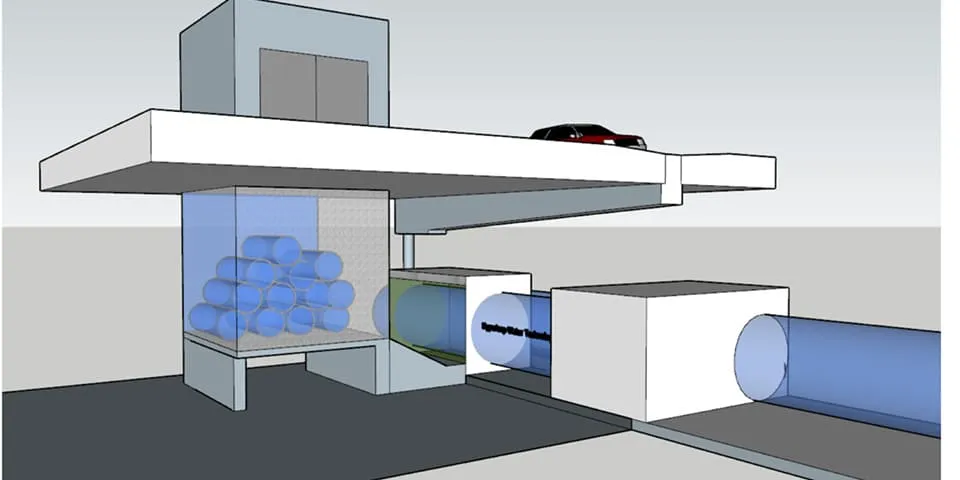
The hyperloop: a not-yet-operational mode of transport in which capsules containing rainwater travel at high speed (up to a maximum of 1,200 km/h) through a vacuum tube to a place where they will not cause flooding, increasing the sewer system’s discharge capacity.
The next stage
“Step by step, we will work towards an idea that can be investigated further, developed and possibly even implemented,” says Janssen. “The entrants have been asked to continue discussing their ideas with one another. They will draw up an action plan for the next stage, which will naturally involve bringing in other disciplines. To minimise potential barriers, Nering Bögel is making a research budget of €100,000 available, to cover any necessary external costs.” In September, the jury will assess whether the proposed research direction and action plan are sufficiently well justified and show enough promise to warrant taking the project further.
Why this initiative?
Nering Bögel believes that companies rely too heavily on established ways of thinking and working. In general, businesses have many obligations, which puts a brake on ‘experimenting in dreamland’. Independent free spirits can do this because their social lives do not depend on the outcome of the experiment. Van de Giessen has deliberately advised spending no more than 10% of your time on this, and focusing on exchanging ideas with one another and broadening the group to include perspectives beyond engineering. To be continued
Question about this story? Ask your question
Companies in this story

Keep following this
Get an email when a new story is published. No account needed.
- SubjectWater infrastructure
- CompanyInfraTech







