









The Netherlands’ most complex underground infrastructure area
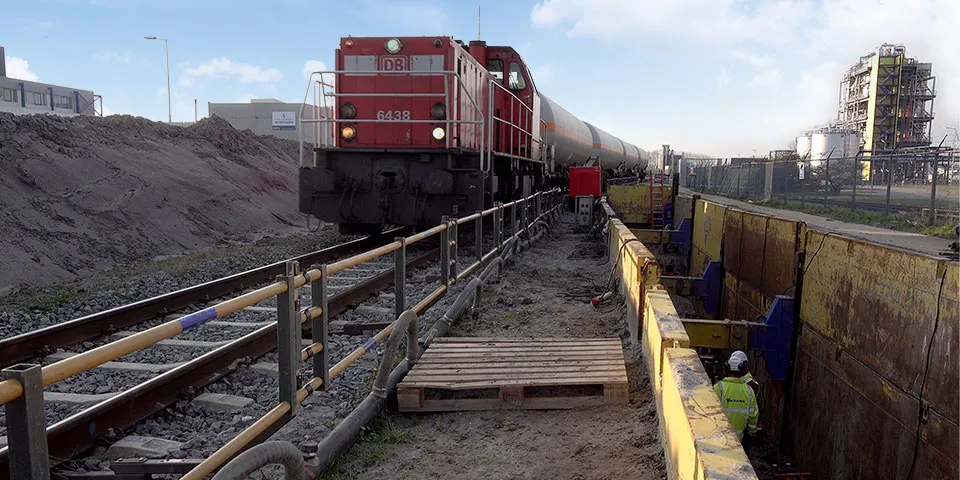
Construction of the 4-kilometre Theemsweg route, part of the Port Railway Line, is taking place in the Netherlands’ most complex underground infrastructure area: the Port of Rotterdam. Commissioned by network operator Stedin, SGS Roos+Bijl is overseeing the relocation and modification of a large number of critical underground cables and pipelines. We spoke to Ruud Straver, project director for complex projects at SGS Roos+Bijl, about the ingenious measures that have been taken.
The Port of Rotterdam is home to major companies and important connections run underground. “To prevent the existing cable and pipeline route from disappearing beneath the new asphalt when the new railway line was built, Stedin decided to move part of the route 20 metres into an existing cable and pipeline corridor,” Straver explains. “The corridor was not yet completely ‘full’. However, we had to put additional measures in place to keep heat dissipation from the cable bundle as a whole within limits, so that transmission capacity would not be compromised.”
Heat dissipation
According to Straver, one way to limit heat build-up is to improve the soil. “This involves using a type of sand that conducts heat more effectively and wrapping the entire package in root barrier fabric to prevent it from washing away. However, the Municipality of Rotterdam had had poor experiences with this solution at another location, so we came up with an alternative. We developed a plastic container that was installed in several places where additional heat build-up was expected. The container is filled with special sand that helps dissipate heat more effectively.” In addition to designing the new cable and pipeline route, SGS Roos+Bijl also coordinated with all stakeholders. “We coordinated between contractors, the Municipality of Rotterdam, the Port of Rotterdam Authority, ProRail and Stedin’s customers to ensure a smooth switchover from the old network to the new one.”
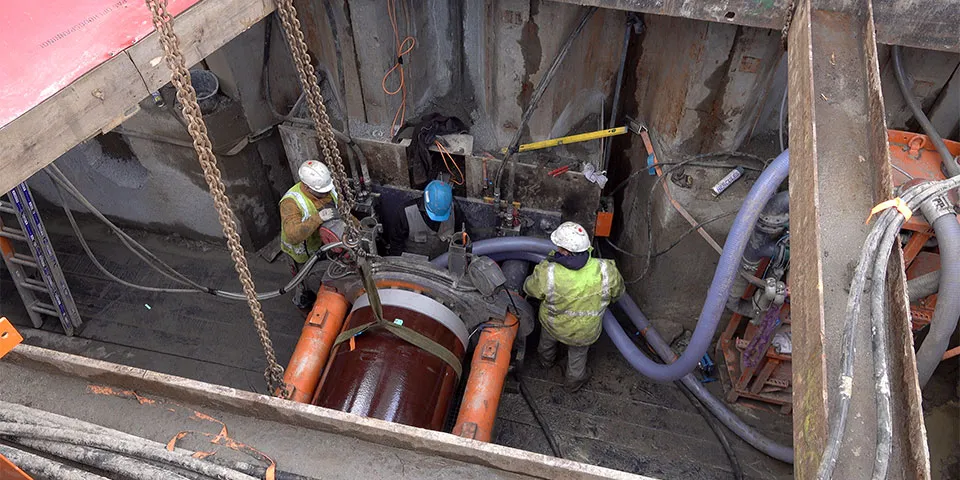
The engineering firm also undertook the design and coordination of five tunnel bores from the high-voltage substation, passing beneath the carriageway and railway line. “These are closed-face bores with an internal diameter of 80 centimetres,” Straver continues. “Because the bores were carried out so close to the existing railway line, extensive measures were taken to keep the track stable. For example, Europe’s longest-ever steel trench shoring was used over a length of 1 kilometre, just 1 metre from the railway line. The track had to remain in service for freight traffic throughout the works. In every respect, then, this is a unique project in the Netherlands’ most complex underground infrastructure area.”
Question about this story? Ask your question
Who worked on Theemswegtracé
- grid operatorStedinIn this story
- contract administratorSGS Roos+BijlIn this story

Keep following this
Get an email when a new story is published. No account needed.
- ProjectTheemswegtracé
- ThemeUnderground construction
- SubjectUnderground infrastructure
- CompanyStedin
- CompanySGS Roos+Bijl
- CompanyRoos Groep







