









A stable foundation thanks to 3,130 grout-injection anchor piles
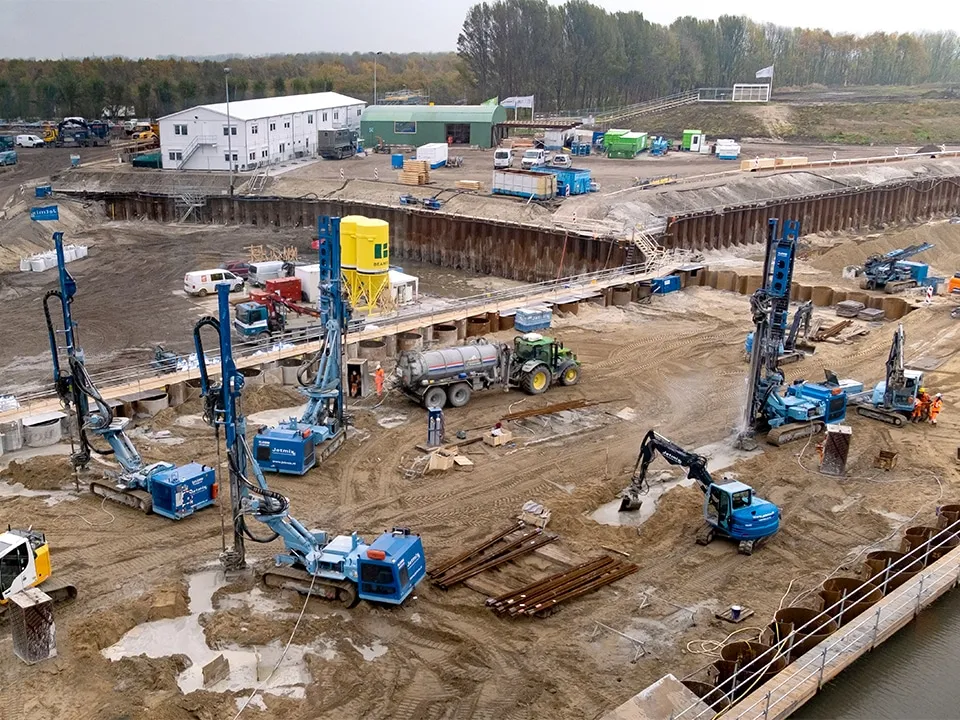
To provide access to the Maasdeltatunnel, which is being lowered onto the bed of the Scheur at a depth of around 26 metres, an approach road is being built on each side.
The foundation for the approach road on the north side was laid by Jetmix using its specialist self-drilling grout-injection anchor piles, which can take higher loads than the GEWI anchors on the south side.
Jetmix installed no fewer than 3,130 anchor piles along a 500-metre stretch, equivalent to 159 kilometres of drilling. “The approach road is being built as an embankment with a gradient of 4%,” explains Edwin Giljam, operations manager at Jetmix. “We installed the anchor piles at increasing depths below ground level, creating clear space for excavating the construction pit. At the deepest point, we reached a depth of minus 63 metres NAP (!), with the drill rods disconnected at minus 28 metres NAP, the depth to which the pit is being excavated.”
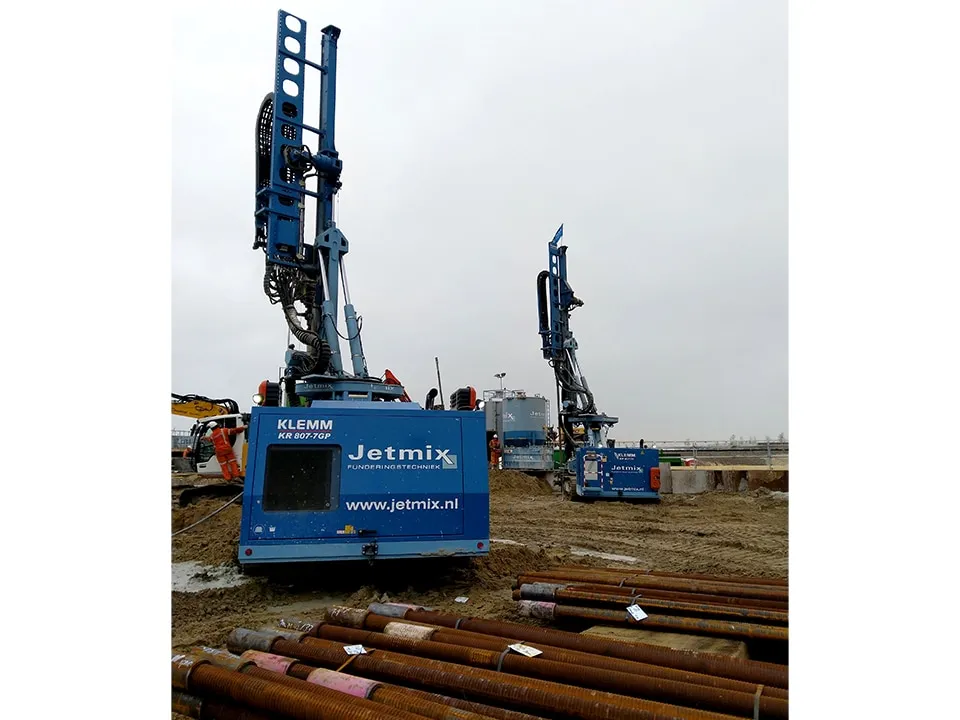
Jetmix anchor pile system
The self-drilling grout-injection anchor pile system was developed by Jetmix. The system is manufactured by Geotech Metals. “For the Blankenburgverbinding, we used several versions of the grout-injection anchor pile system, with diameters of 82.5, 101.6 and 114.3 millimetres and varying wall thicknesses ranging from 12.5 to 28 millimetres. The pile system essentially consists of 6-metre sections of hollow pipe, threaded on the outside, with a drill bit at the end. We feed the grout mixture to the drill bit through a rod inside the hollow pipe. The mixture lubricates the drill bit and carries the material back up through the pipe. Because of ammonium acid contamination in the ground, once the required depth has been reached, the borehole is filled with a mixture using a different mixing ratio that is more resistant to ingress. The extension rods are then disconnected from the anchor pile system via a bayonet coupling and pulled back up.”
When the construction pit is excavated, a plate assembly is fitted to the Jetmix pile system to connect it to the underwater concrete that will be installed later. Giljam: “In its final configuration, our pile system can therefore withstand both tension and compression. We spent around one year working full time to install the 3,130 anchor piles. We used five of our own KLEMM 807 drilling rigs. The final pile was installed just before the 2020 construction holiday. Looking back, it was an intensive but highly efficient project. This was due in no small part to the dedicated logistics centre we set up on site.”
Question about this story? Ask your question
Who worked on Maasdeltatunnel
- Immersion
 StruktonMentioned in A-team to carry out the Netherlands’ largest tunnel immersion operation
- ImmersionDEME Infra Marine Contractors (DIMCO)Mentioned in A-team to carry out the Netherlands’ largest tunnel immersion operation
- main contractor consortiumBAAKMentioned in A-team to carry out the Netherlands’ largest tunnel immersion operation
- anchor pile systemGeotech MetalsIn this story
Keep following this
Get an email when a new story is published. No account needed.
- ProjectMaasdeltatunnel
- ThemeMaterials and techniques for infrastructure
- SubjectUnderground infrastructure
- CompanyGeotech Metals







