









“We reused the locally recycled aggregate in the new cycle path”
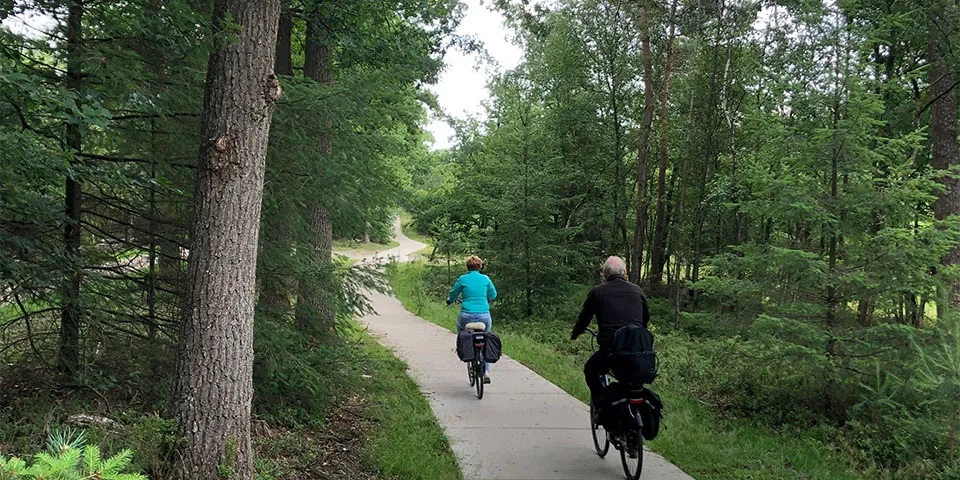
That is true both literally and figuratively. Not only has the new cycle path along Krimweg and Spoekweg in Hoenderloo…
Sustainable concrete cycle path enhances the municipality of Apeldoorn
That is true both literally and figuratively. The new cycle path along Krimweg and Spoekweg in Hoenderloo is not only looking great, it was also built using sustainable concrete. That is another feather in the cap of the municipality of Apeldoorn, a frontrunner in seeking sustainable solutions.
We spoke about this sustainable, circular cycle path with John Assink, roads and structures specialist at the municipality of Apeldoorn. “On behalf of the municipality, I can award contracts for this kind of work in my role as budget holder,” Assink begins.

Working group focuses on circularity
“Apeldoorn is always looking for sustainable options. Since last year, a working group has been focusing on circularity. In the broadest sense of the word, too: they are even looking at recycling workwear,” says Assink. The cycle path in question was previously made of asphalt and intended for recreational use. “In 2010, the recreational authority transferred this cycle path to the municipality of Apeldoorn. It needed renovating, which gave us a great opportunity to make it as sustainable as possible.”
At the time, a large quantity of concrete slabs became available from the De Parken project in Apeldoorn. “De Parken is a neighbourhood in the centre of Apeldoorn. The road there was made of concrete slabs, which were being pushed up by tree roots. A new road therefore had to be built. From a circularity perspective, we first looked at whether we could relay the old concrete slabs, but their undersides proved irregular. They were not flat enough to reuse, so we decided to crush and granulate them. We reused this aggregate in the new cycle path,” explains Assink.
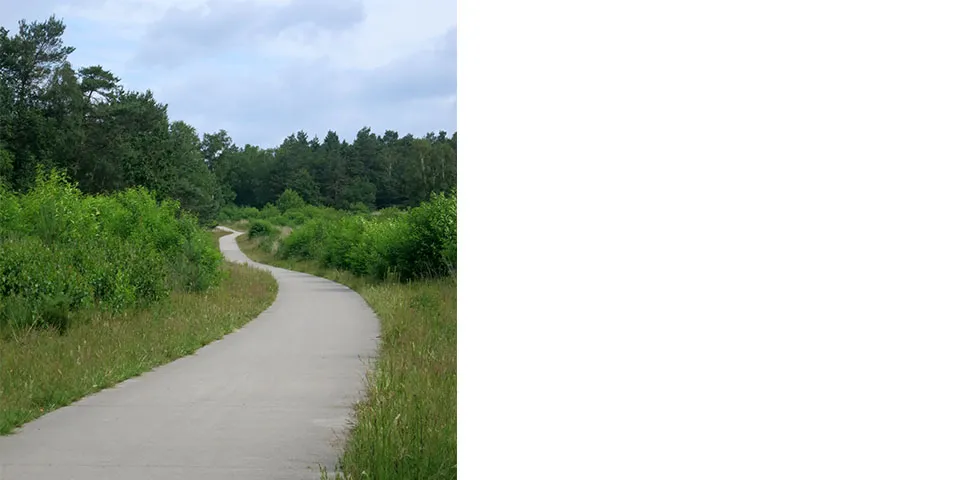
“We knew from the composition of the concrete mix that it would need more time to cure.”
Good communication within the construction team is half the battle
“The construction team for the cycle path comprised several companies. We knew from the composition of the concrete mix that it would need more time to cure. We wanted to finish before the main cycling season and knew that would mean a very tight schedule. Thanks to good communication within the construction team, we managed to deliver everything. The team also came up with additional measures to protect the uncured concrete from external influences, such as putting up electric fencing to keep wildlife away from the cycle path while it was still curing.”
The cycle path has been a valuable learning experience for the working group. “We will carry on in the same way,” says Assink. “We are now working on the Imbosweg cycle path, where we are also using as much recycled local concrete as possible. We do not yet know whether we can use 100% Apeldoorn concrete, but there will certainly be regionally recycled concrete. After all, we need to consider our CO2 footprint. We take a lot of concrete from demolition projects to the crusher, so that the material produced can genuinely be labelled ‘locally sourced’.”
Recycled concrete aggregate also used in paving slabs
The De Parken project also benefits from sustainable concrete, in the form of concrete paving slabs for footpaths containing Apeldoorn aggregate. “A local company buys these in for us, according to our requirements and specifications,” explains Assink. “We want to work in a way that is fit for the future. We are currently renovating a bridge. That raises the interesting question of how circular we can make the project. Can we use concrete, or should we use timber? The good thing about the discussion is that, within the municipality of Apeldoorn, it has become second nature to ask whether something can be done circularly. That is why we are carefully mapping the recyclable materials that become available across the municipality and region, so we can identify in good time where they can be used again. A good example is how we were able to reuse concrete paving blocks from a carriageway to build parking bays. Reuse matters just as much to us as recycling. We always assess whether to recycle or reuse materials from demolition, depending on their intended function.”
Materials passport
Assink and his team are currently developing a ‘materials passport’. He explains: “We document everything in advance, for example by recording the composition of asphalt beforehand. That way, we will know what materials it contains if it ever has to be demolished. This enables us to accurately map the materials present across our asset base. Recording them at the start of the chain makes it easier to manage them at the end.”
In this way, Apeldoorn is sending a positive message and showing that anything is possible. “As long as everyone is pulling in the same direction and you keep your eye on the goal, anything can be done. Apeldoorn is large enough to generate a substantial volume of raw materials itself, and small enough to manage that flow on its own terms,” Assink concludes.
Betonhuis
Betonhuis is the trade association for the cement and concrete industry, the construction sector’s largest supplier. By sharing knowledge and expertise, Betonhuis addresses current issues such as circular construction, climate adaptation and sustainable construction. Find out more at Betonhuis.nl
Question about this story? Ask your question
Who worked on Fietspad Krimweg en Spoekweg
- contractorSchagen InfraMentioned in Cycling was already good for you, now the cycle path itself is too!
- concrete designBruil Beton & MixMentioned in Cycling was already good for you, now the cycle path itself is too!
- municipalityApeldoorn municipalityMentioned in Cycling was already good for you, now the cycle path itself is too!
Keep following this
Get an email when a new story is published. No account needed.
- ProjectKrimweg and Spoekweg cycle path
- ThemeLower emissions and more reuse
- SubjectSpecials







