









Van Aalsburg: traditional expertise, modern working methods and the greatest possible sustainability.
The climate agreement is having a huge impact on housebuilding, commercial construction and the civil engineering sector. The ruling by the highest court at the end of May has brought the country to a standstill. Thousands of projects, and the businesses behind them, are being affected by the nitrogen crisis.
“Even we are feeling the effects,” says Dick burg, one of the six brothers who run the large and dynamic family business Van Aalsburg BV. “We are a distinctive willow or coppice-wood business that has been working hard for many years to reduce CO2 emissions and create a sustainable working environment.”
Timber in civil engineering
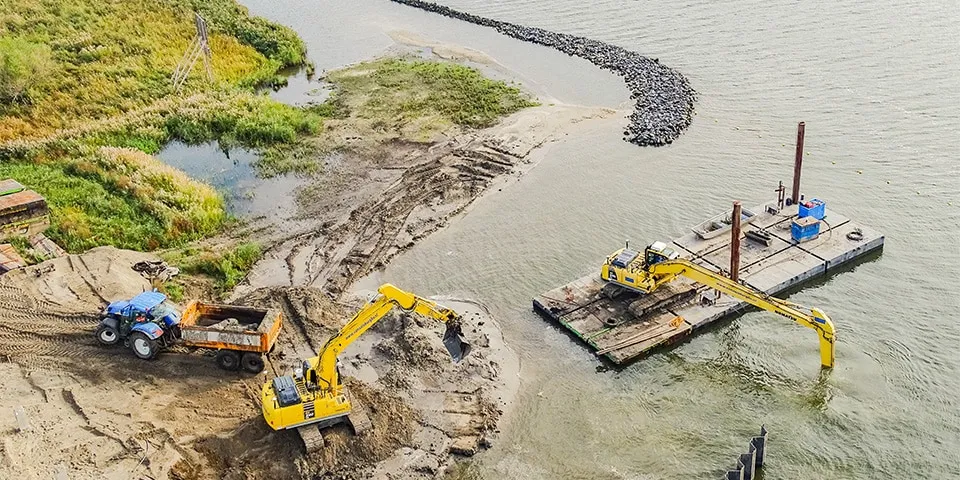
“By reusing available raw materials as efficiently and to as high a standard as possible, we reduce CO2 emissions. Timber and plastic are widely used in the civil engineering sector for fascine mattresses and revetments.” Van Aalsburg explains that willow is a good alternative to less environmentally friendly products in applications such as these. “We have also developed a patented system for building islands from willow branches and locally dredged material, in the form of floating reed margins. Only natural materials are used in the entire structure. A major advantage is that water authorities can combine dredging operations with the delivery of several policy objectives, as well as landscape development and recreational aims.”
Traditional skills
The timber used by Van Aalsburg is traditionally and sustainably grown in the Biesbosch and on its own 150 ha nursery. The craft of coppice work has been passed down from father to son. “We are renowned in the Netherlands and abroad for our knowledge and experience in fascine mattresses, groynes and revetments.” It is clear that traditional expertise, modern machinery and working methods go hand in hand at Van Aalsburg, in a socially responsible way.
Van Aalsburg: an impressive 4-hectare business site.
Abroad
“We are finding that we can also meet specific needs abroad. In Germany, France and Poland, for example, where we work in water engineering on strengthening dykes and protecting banks.” Van Aalsburg also attracts private-sector customers in Belgium and Germany. “This means we are not dependent on the Dutch market. The parties involved say they want to buy sustainably, but unfortunately procurement is still all too often based on the lowest price. Van Aalsburg is setting the trend in sustainability, and it really does not have to cost more. But everything is now on hold because of PAS and PFAS. There is very little we can do to fight that.”
Small footprint
Van Aalsburg does everything it can to keep its own footprint as small as possible: “The wood-burning stove, which runs on wood chips, heats the entire business. We generate electricity using the 550 solar panels on our roof. We use LED lighting and have an EV charging point. We also use low-emission fuel, and 25 of our 50 chainsaws are battery-powered. We are proud of the CO2 reductions we have achieved!” Nevertheless, Van Aalsburg believes that it may take a year or two for the water engineering sector to overcome the nitrogen crisis and PFAS. “That is, if we get clarity soon… but the uncertainty is destroying all confidence. When projects start moving again,
opportunities will soon follow, and we will be able to create great designs that can be delivered sustainably and benefit nature. But that means we need to make choices now. And sometimes that calls for flexibility from your employees. “Our people are the most important part of our business! We want to make sustainable use of their skills too, for example by making smarter use of new technologies such as the new high-tech contra winch system.”
New floating crane
“In November, we will put into service a new floating crane built especially for us. The custom-built crane is versatile, for example on nature development projects involving the construction of floating reed margins or islands, or for creating sheltered areas and restoring traditional reed plots.” Van Aalsburg mentions Giethoorn and the area around weerribben, where the crane can be used in the wieden, a wetland area. It can also be used for stripping vegetation from the reed beds in Alkmaar. The crane, with its long boom and special GPS system, can even be used as a reed cutter in the Biesbosch. “The crane can be transported by road on a low-loader without having to be dismantled. During water-based operations, its width can be adjusted hydraulically with ease and stability, allowing it to pass through marshland or narrow waterways. And thanks to the crane’s unique capabilities, we will disturb the bed and banks less, or not at all.”
Van Aalsburg concludes: “We invest in smart, sustainable machinery, as well as in our people and their expertise. This allows us to grow our turnover by deploying our own structures sustainably in projects. We are ready for a sustainable future with everyone!”
Van Aalsburg BV
Paalgraaf 11, 4174 LC Hellouw
T +31 418 729101
F +31 418 581167
www.vanaalsburgbv.nl
A business enquiry for Van Aalsburg BV? Get in touch
Companies in this story
Keep following this
Get an email when a new story is published. No account needed.
- SubjectSpecials
- CompanyVan Aalsburg BV







