









The energy transition in 3 dimensions
We received an invitation from Soltegro, based in Capelle aan den IJssel, to an event they were organising on 15 November, with this headline at the top of the message. Intrigued, we spoke to Hans de Man, managing director of Soltegro, ahead of the event.
“We all know that we need to make drastic changes for the energy transition to succeed. Businesses are pursuing all kinds of initiatives, each on their own. Often these are sector-specific, sometimes individual, but usually undertaken as a group. That in itself deserves praise, but the major concern we should all have is the lack of central direction. The absence of overarching agreements. The failure to share knowledge and join forces. The willingness to do good is there, but who will show the way?”, explains De Man.
The social, economic and technical aspects of the energy transition
“We believe it is right to bring various parties together at this event to network, learn from one another and share information in an integrated way. We are doing so with an impressive line-up of speakers. Soltegro has been saying this for some time, and now we are going to put it into practice”, continues Hans. “The three dimensions we have identified are the social, economic and technical aspects of the energy transition. These three form a unity and cannot be viewed in isolation. Everything affects everything else.”
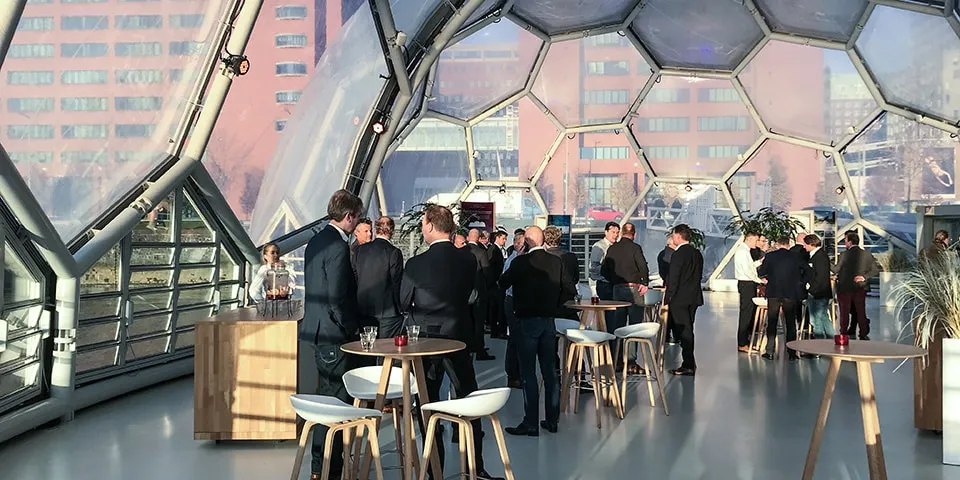
The event is being held at the Drijvend Paviljoen in Rotterdam. As food and drinks are served, the gathering grows ever larger. Attendees come from all parts of the infrastructure and energy sectors, as well as a diverse range of other industries. De Man opens the event with a speech, in which he says: “We are concerned about whether we can meet the 2030 targets set out in the Paris Agreement on energy, given what the government is currently doing. There is no direction, no master plan. At best, people make statements and everyone is left to figure things out for themselves.” Soltegro itself has achieved Level 5 on the CO2 Performance Ladder and takes care to minimise energy consumption in all its designs.
We all know that we need to make drastic changes for the energy transition to succeed.
The energy transition in the Delta
The next speaker is Jo-Annes de Bat, a member of the provincial executive of Zeeland. In his presentation, he takes the audience to his province, where the energy transition in the Delta is well under way. “The Borssele nuclear power plant is losing €100 million a year. Zeeland is a shareholder, with the added problem of nuclear waste. The plant is due to close in 2033, if the plans go ahead. So where do you start with the energy transition? Zeeland got started with €35 million to implement changes. The Tidal Technology Center is being built in Lake Grevelingen, and we are moving wind turbines offshore. Zeeland has developed a programme to train students as wind turbine maintenance technicians. Business initiatives are also making good sense. For example, heat generated by a chip factory is sent directly to a company that dries onions. The question now is how to bring households on board. One way is to build on circular principles: store materials from demolition, rethink their use and reuse them. We will put the agricultural sector to work storing CO2. Harvesting beets for a bio-based economy. Zeeland is ready and constantly innovating”, says Jo-Annes De Bat.
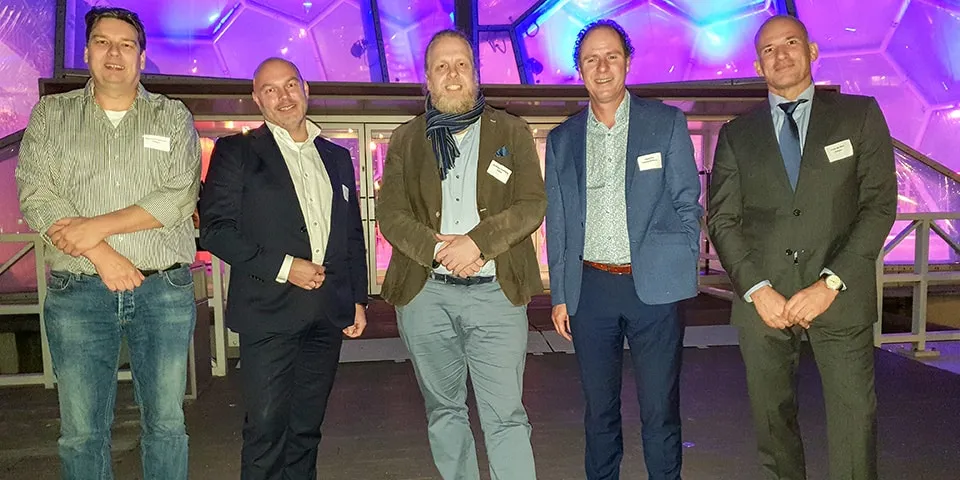
The speakers, from left to right: Bas van Duijnhoven, senior consultant reliable systems at Soltegro, Arend-Jan van der Vlugt aan, alderman for Innovation and Sustainability at the municipality of Goeree Overflakkee, Jan Peter Doomernik, Business Developer at Enexis, Hans Pos, senior technical project manager at Croonwolter&Dros, and Hans de Man, managing director of Soltegro.
The energy transition in our homes
Bas van Duijnhoven, senior consultant reliable systems at Soltegro, takes the floor: “The Paris Agreement aims to limit global warming to between 1.5˚ and 2˚ Celsius. In the Netherlands, however, we face other problems too, such as rising sea levels and land subsidence, not only in Groningen. We need to become less dependent on energy from abroad. The efficiency of the energy we buy at great expense is 50%. This is not down to industry, but primarily to households. It is a waste of expensive energy. CO2 emissions are not being reduced fast enough here. Renewable energy currently accounts for 7%, but needs to reach 14%. At this rate, we will miss the 2020 target.” Van Duijnhoven outlines what might work: layered energy systems, extensive electrification (for example, allowing electric cars to feed energy back into the grid), replacing energy from coal-fired power stations with solar and wind power, and rethinking alternative energy systems. “Homes need their own battery, rated at 10 to 15 kW per hour, for buffering. That would limit the amount of power each household takes from and feeds back into the grid to plus or minus 1 kW.”
The best solutions face no competition
“Can we come up with a solution so cheap that companies cannot compete with it?”, asks Jan Peter Doomernik. He is a Business Developer at Enexis and works on disruption in the energy market. “Suppose the right technology made cars self-aware, part of a ‘swarm’ and able to make their own purchases as a system, without human intervention. Cars that give one another energy, provide energy to society and only generate money. Money they do not need, which could be invested in ancillary services for people. Is that unimaginable? No. The system would resemble nature. Animals have no ownership, no identity and no money. They do not even have scarcity, our major problem artificially created by commercial interests.” Doomernik explains that we should take the fair rules of a natural ecosystem as our example. “Work together, share energy, work ‘anti-fragile’. Build an ‘energy commons’ (sharing without an owner, ed.). Aim for ‘abundancy’ (creating abundance, ed.) and let’s work towards an ‘Internet of Energy’.” Doomernik tells the audience about the ‘Nature 2.0’ group, which is voluntarily seeking solutions of this kind.
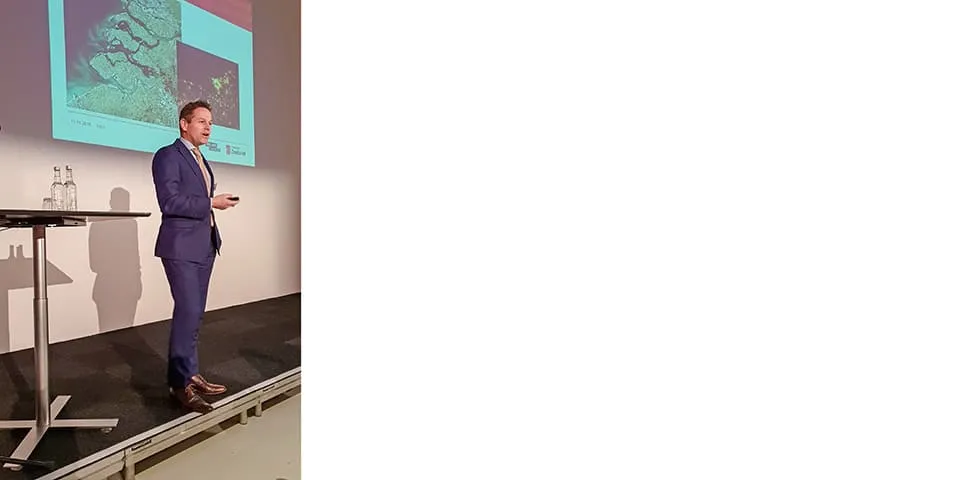
Jo-Annes de Bat, member of the provincial executive
of Zeeland.
An energy-neutral tunnel as a fine example of innovation
Hans Pos, senior technical project manager at Croonwolter&Dros, takes the stage. “Tunnels use a lot of energy. We are currently building an energy-neutral tunnel that saves and generates energy. To find solutions that make this possible, we keep asking ourselves ‘why?’. Why do we do what we do, and what would be a good solution?”, says Pos. “The opportunities we have identified are reducing energy use, materials use, wellbeing, spatial quality and accessibility. How can infrastructure do a better job in these areas? We need to move away from wasteful existing methods. Most of the equipment in a tunnel runs on direct current. It therefore makes sense for everything around the tunnel to run on direct current too. This saves energy and is more reliable. LED lighting and good reflective surfaces help limit energy use. We can bring sunlight into the tunnel by transmitting daylight through fibre-optic cables. A DC grid around the tunnel provides redundancy and is powered by 20,000 m2 of solar panels. The energy generated will need to be stored to account for the day-night cycle.” Croonwolter&Dros is using ‘proven technology’ to achieve all this. Pos says: “Regulations will need to change if we are to keep innovating. Rijkswaterstaat, for example, must be allowed to act as an energy supplier. We are already building the tunnel of the future.”
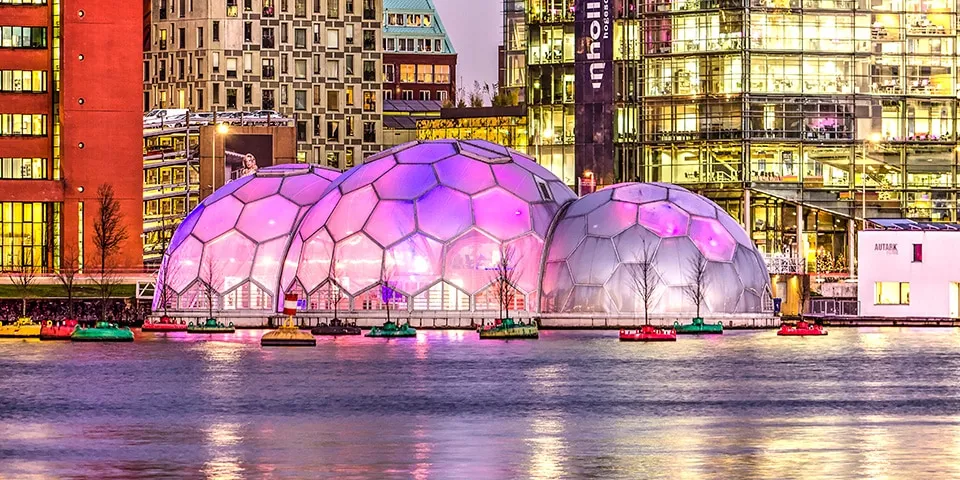
The Drijvend Paviljoen in Rotterdam provided a magnificent setting for the event.
Hooray for Goeree!
The final speaker is Arend-Jan van der Vlugt, alderman for Innovation and Sustainability at the municipality of Goeree Overflakkee. ‘Energy Island’ is now the nickname for Goeree Overflakkee, and with good reason, we learn. “The national government warned Goeree Overflakkee that things were not going well. An ageing population, disappearing jobs and young people moving away posed a serious risk. The municipality and local businesses joined forces to tackle the problem.”
Some of the priorities discussed include ‘Eilanditeit’, preserving the island’s character; ‘Maatschappelijke balans’, balancing tourism and residential life; and ‘Kwaliteit’, ensuring that tourists and new residents experience a higher quality of life on Goeree Overflakkee than where they came from. “Goeree Overflakkee has now won the Quality Coast Award in recognition of all the changes. These include good transport links, the water bus and access roads. We have a strong fibre-optic network, and businesses, municipalities and the government work well together. For example, we are promoting electric car-sharing in residential areas. We are investing in charging points. The filling station of the future is in Oude Tonge, with the fitting name GreenPoint. ‘Raising awareness is the key’, says Van der Vlugt. “This has gone so far that residents are proud of what has been achieved and are keen to do their bit. Goeree Overflakkee has signed the Hydrogen Covenant, with the support of local businesses. The municipality is investing in solar panels. By 2020, Goeree Overflakkee must be an energy-generating island.”
The event ended with a networking reception, where the speakers’ presentations were discussed with great enthusiasm. One thing is clear: where there’s a will, there’s a way to sustainability.
Question about this story? Ask your question
Companies in this story
Keep following this
Get an email when a new story is published. No account needed.
- SubjectSpecials
- CompanySoltegro
- CompanyCroonwolter&dros







