A guiding role for geospatial data specialist in climate-resilient (re)design of public spaces
Text Roel van Gils Image Fugro
Climate change is causing extreme dry and wet periods to alternate at an ever-faster pace. It is essential that we focus on climate-resilient area (re)design. The surrounding area and the subsurface are key. Mark de Kwaadsteniet, senior hydrology consultant at geospatial data specialist Fugro, explains. In keeping with this vision, Fugro recently proposed an alternative approach to water storage at Groote Haar business park in Gorinchem.
When developing a new site, the only things you can be certain of are the surrounding area and the subsurface. Yet they are not given enough consideration in practice when designing for climate resilience, Mark believes. “The result is that things often turn out differently than expected. People then resort to all sorts of makeshift measures to make the situation somewhat acceptable, but by that point all the ambitions set at the outset have long since fallen by the wayside. Driven by a genuine desire to take a different approach, we at Fugro have launched our ‘water and soil as guiding principles’ advisory service. Its aim is to assess the options for making an area or neighbourhood climate-resilient, starting from the subsurface and the surrounding area.”
The challenges
Fugro’s services for climate-resilient area (re)design focus on four categories. “First, we have developed a vision for homes built on shallow foundations. This is a societal problem that is too big for municipalities to tackle alone and requires a national approach,” Mark states firmly. “Many homes have subsided so much that there is very little scope to optimise public spaces and prevent flooding (NOS and Liwwadders, ed.). These homes are at the end of their service life.” The second area focuses on advice for major maintenance of public spaces in neighbourhoods. “The aim is to make the right choices so that the next maintenance cycle can be postponed. For example, by using different materials or types of planting. We work with municipalities on a trial street to explore the options for climate-resilient major maintenance in the neighbourhood.”
New surface water
Fugro’s ‘water and soil as guiding principles’ advisory service can also contribute to the design of new sites. “We do this, among other things, by carrying out a ‘quick scan’ followed by integrated advice, so that problems do not arise later as a result of raising the ground too quickly or allowing too little time for preloading,” Mark explains. The final pillar concerns advice on creating new surface water, which is exactly where Fugro has made a difference at the new Groote Haar business park in Gorinchem. Area development and site layout plans include the excavation of new surface water. However, given the soil conditions and the subsidence that has occurred, it is no longer a given in some parts of the Netherlands that watercourses can be created without the ground heaving. Climate change will increase the risk of heave during the service life of a watercourse, with consequences for water quality and quantity. In other words, the design must take this into account.

Watercourses
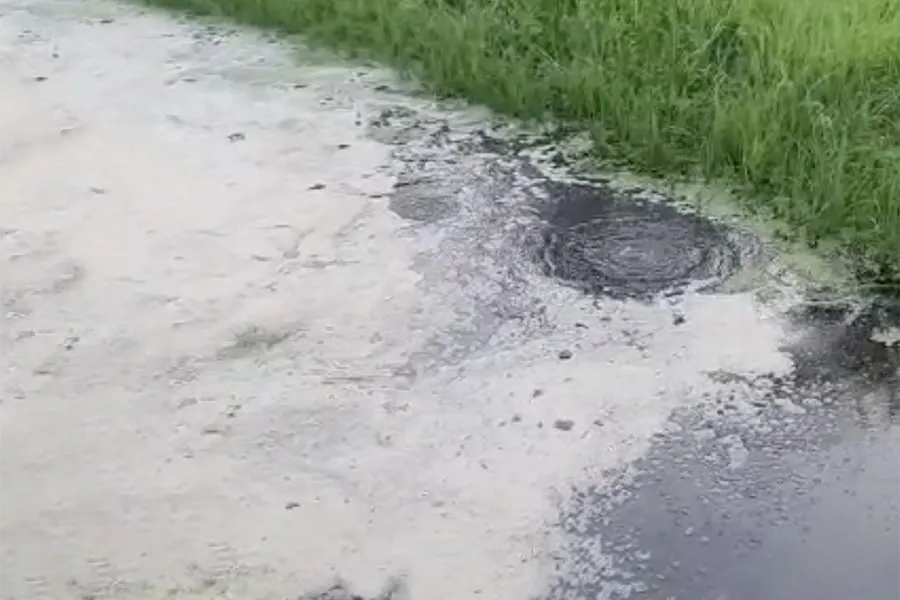
Watercourses can heave when the water pressure (piezometric head) in the underlying aquifer exceeds the weight of the overlying soil. This can make the bed unstable and cause it to rise, and/or lead to sand boils.
Heave creates a permanent connection between the groundwater in the underlying aquifer and the surface water. As a result, groundwater mixes with the open water, creating a permanent additional burden on the water board’s pumping capacity (and increasing CO2 emissions).
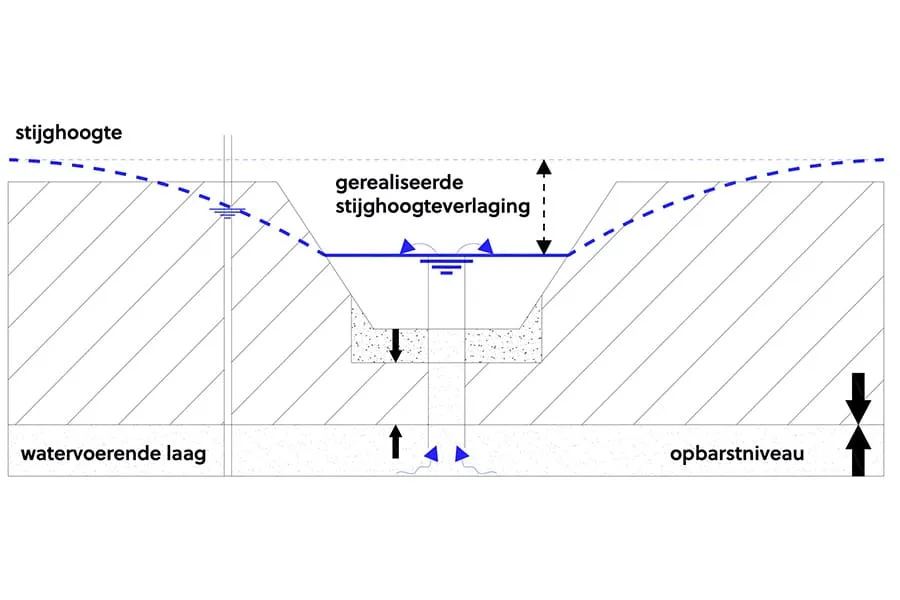
It can also cause deformation of the watercourse:
• The bed rises -> reduced flow cross-section
• Bank slippage
Groundwater has a different quality and composition, which can degrade surface water quality:
• Discolouration of surface water when the groundwater contains iron
• Salinisation of surface water when chloride levels are higher
This can have direct consequences for nature and ecology, as well as crop yields when farmland is irrigated from open water. Partly because of these risks, many water boards and municipalities have included a requirement in their policies that ‘new’ watercourses must not heave
Water compensation requirement
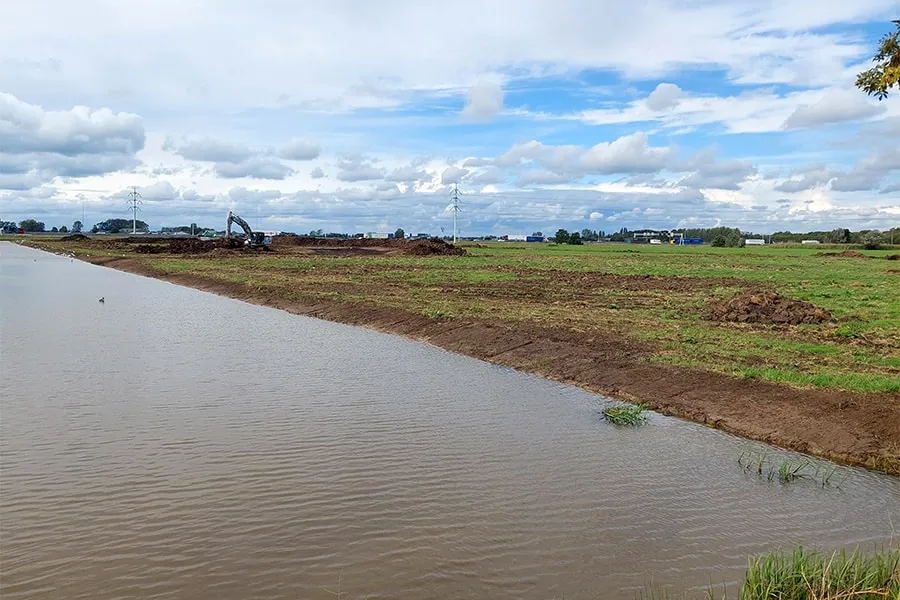
New watercourses are created to provide water compensation for the impermeable surface added when a new residential neighbourhood or business park is built. At Groote Haar business park, alongside the A27/A15, the water compensation requirement was 65,000 m2. “The original design included a water system with very wide watercourses,” Mark recalls. “Because of the risk of heave and sand boils, the design was changed to two parallel watercourses with bed reinforcement, for which the water board withdrew the permit. The municipality was at a loss. We then developed an alternative water storage system that prevents heave and sand boils while still meeting the water compensation requirement.”
The Giessenburg approach
Mark took inspiration for the water storage system at Groote Haar from a similar concept in a park in Giessenburg. “The solution has two parts. Instead of parallel watercourses, we opted for a single A-watercourse, or main watercourse, which the water board can manage and maintain from one side. We combined this with alternative water storage on the other side in the form of a shallow-water storage area, neatly integrated into the landscape design. The single A-watercourse is narrower and the shallow-water storage area is less deep, reducing the risk of heave. No measures to prevent heave are therefore needed at this site. Fugro’s proposal, hydraulically modelled by Advies- en Ingenieursbureau TAUW and incorporated into the site layout plan by Samenwerkende Architecten en Bouwadviseurs (SAB Adviseurs), has now been approved by the water board.”
The alternative proposal also benefits the municipality. Much less soil needs to be excavated, and the relatively narrow watercourse means there is no need for compensatory measures such as ballast layers. Mark estimates that the alternative design will save 1.5 million euros during construction, which can be used to fund the municipality’s management and maintenance of the water storage area. Less earthmoving and fewer transport movements will reduce CO2 emissions by approximately 63% in CO2 equivalents (=812 tonnes less CO2, equivalent to seven return intercontinental flights) and cut the Environmental Cost Indicator (MKI) value by 80%. Finally, this approach to water storage offers more opportunities to plant trees near the storage area and vegetation within it. This provides food and shelter for insects and birds, benefiting biodiversity.
A business enquiry for Fugro? Get in touch
Companies in this story

Keep following this
Get an email when a new story is published. No account needed.
- ThemeUnderground construction
- SubjectSurveying & geo-ICT
- CompanyFugro
- CompanyTAUW | Consultancy and engineering firm