The journey of an asset
Text Roel van Gils Images Unafact
Recording data on assets in the public realm
Reliable information is essential in the physical environment. Municipalities manage thousands of assets, from trees and streetlights to street furniture and works of art, all of which need to be recorded in an asset management system. Yet in practice, much of this valuable information is still lost. That is precisely the issue Unafact is tackling: improving the provision of information in the physical environment, so that data becomes genuinely valuable for design, construction and management.
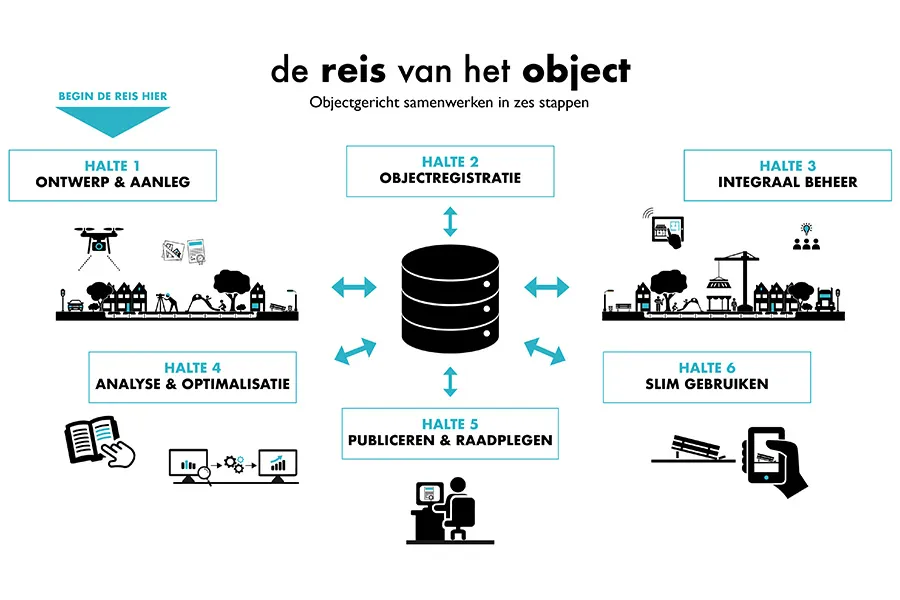
Since 2014, Jochem Mollema, founder of Unafact, has been the driving force behind the Information Model for Public Space Management (IMBOR), developed on behalf of CROW. “It is the national standard that sets out how we record assets in the Netherlands,” he says. “IMBOR provides the basis for asset-based working and integrated management. It is an approach in which information is not lost, but passed on like a relay baton. The same information must be reusable from the moment an asset is designed through to the point at which it is managed. The information, as it were, ‘travels’ with the asset throughout the entire chain, without data being lost or having to be entered again.”
The importance of coherence
In theory, Mollema says, 50% of the required information is already known at the design stage, and a further 30% can be added during construction. “Provided you use your ‘tools’ wisely,” he adds. “That would leave only 20% for the management phase. But that is the theory. In practice, more than 70% of the information is often lost, mainly because standards and systems are not sufficiently aligned. Not because suppliers are unwilling, but because clients often underestimate the importance of that alignment. This is not rocket science from a technological point of view. The tools are there to bring clients and contractors together and tackle this information loss. In my role, I help municipalities improve their information management, work on national standards and promote collaboration across the sector.”
Saving millions
The city of Utrecht shows what is possible when data is in order: a single reliable source of truth, with up-to-date, complete and consistent information at its heart. “With an information repository like that, a municipality can save millions. The city of Utrecht even calculated a 7% saving on project costs, simply because information does not have to be collected all over again each time,” says Mollema. His mission is clear. “To make sure municipalities know what they are responsible for, so that their surroundings remain clean, safe and in good condition, and that they can make decisions based on reliable data. Once every data owner records assets in the same way, in accordance with the IMBOR 2025 standard, you can also create filters for the Environment and Planning Act, WIBON, etc.”
Together with eight municipalities, with the city of Nijmegen as the commissioning authority, Unafact has created a minimum dataset of IMBOR 2025 data for asset managers across the Netherlands. “It is a tool for getting your data in order. Only when information is accurate can we manage our physical environment more intelligently and efficiently.”
Question about this story? Ask your question
Keep following this
Get an email when a new story is published. No account needed.
- SubjectSurveying & geo-ICT