









Smart piled embankment design through advanced automation
Text Roel van Gils Image CRUX Engineering
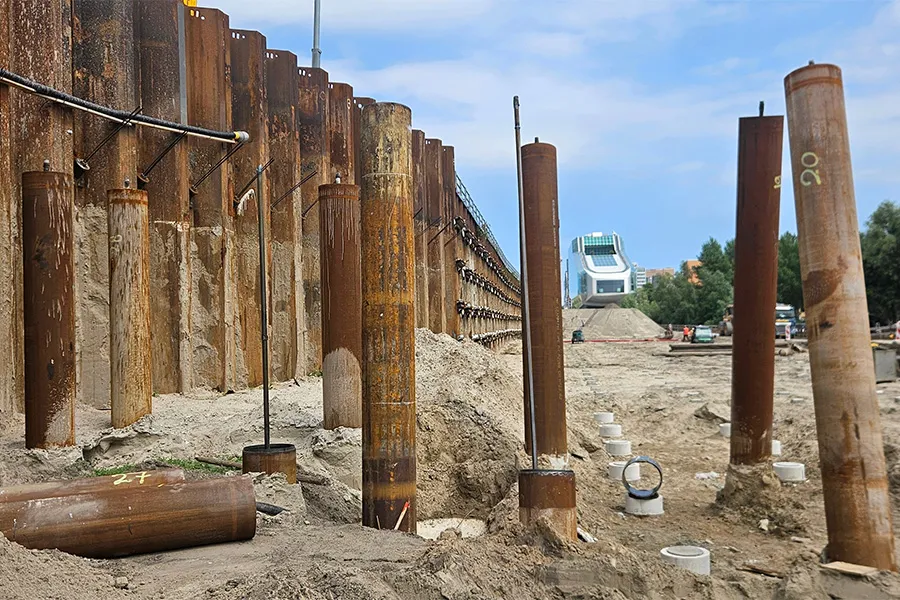
For the widening of the A10 at the De Nieuwe Meer interchange, construction consortium TriAX faced a complex challenge: building on a postage stamp, with little space and even less time. Traditional solutions, such as preloading with sand, were simply not possible. The decision was therefore made to support the A10 Zuid expansion on a piled embankment. CRUX Engineering was commissioned to design it and, thanks to extensive automation developed with its sister company CEMS, was able to deliver an optimised design.
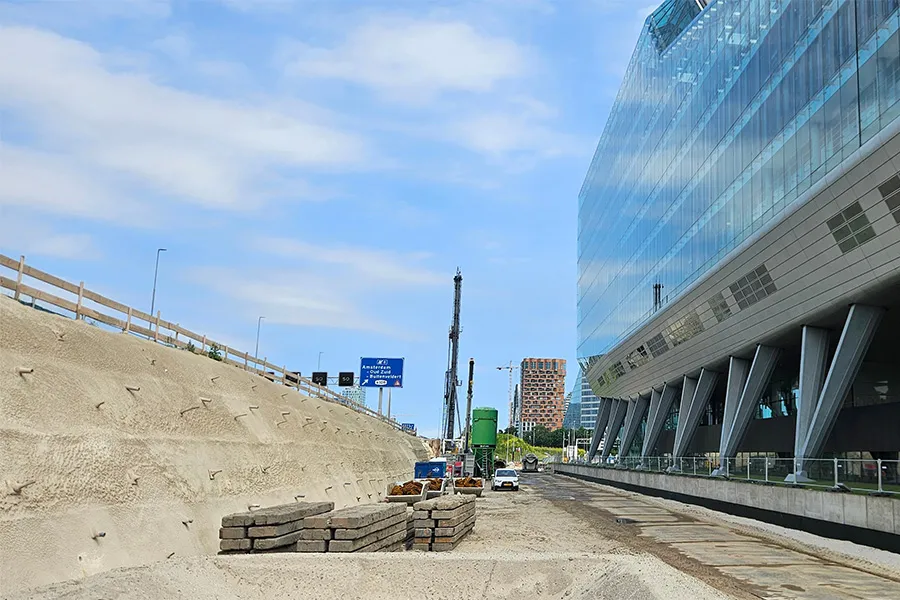
The piled embankment consists of foundation piles with diameters of 300 to 450 millimetres, topped with 1-metre-square concrete pile caps, explains Johan Zwaan, geotechnical specialist at CRUX. “A geogrid and a layer of granular material are placed on top, together forming a stable platform on which the road can be built.” Designing this type of structure is far from straightforward. “We had to take account of historical modifications to the A10 Zuid, construction phasing, interfaces between different disciplines, loads during construction and operation, pile lengths, the stability of the existing A10 Zuid and the impact on the surrounding area. The former ING building De Schoen, for example, is just 1.5 metres from the work area.”
Complex calculations
Using finite element analyses in Plaxis, CRUX modelled the entire subsoil, including the piled embankment and construction phasing. “This involves complex analyses in which all parameters are assessed at each stage, taking into account even information about the construction of the original A10 Zuid. These calculations are complex, typically time-consuming and highly repetitive,” says Zwaan. “Calculations are normally carried out for every 100 metres of road, but extensive automation enabled us to run many more calculations in less time. Here, we analysed a cross-section on average every 35 metres. This produced a bespoke solution, with a specific design and the required pile foundation for each cross-section.”
Optimising rather than modelling
“We linked Plaxis to the project data using Python scripts, allowing models to be generated largely automatically,” explains Pablo Vásconez, geotechnical specialist and software developer at CEMS. “Geometry, soil parameters, construction phasing and water levels were imported consistently and without errors. Instead of spending a great deal of time on repetitive modelling, engineers could focus on the quality of the results and on optimising the design.”
A lighter, more effective design
This approach had several advantages. First, work could be carried out more quickly and reliably because the basis of every model was correct and consistent. “Automation also made it possible to analyse far more scenarios and locations than usual, resulting in a lighter, more effective design. It also significantly reduced the risk of human error,” says Zwaan. “Pile lengths for the foundation were further optimised using PileCore, also a CEMS product. In total, around 3,500 piles were assessed along the 1.3-kilometre piled embankment.”
Vásconez advises that if you want to use smart automated tools, it is important to start automating at an early stage, as these are often bespoke solutions and therefore require development time before they can deliver results later in the project. Zwaan adds: “On many projects, this is only attempted at a late design stage and often comes to nothing as a result. TriAX showed courage by choosing this approach from the outset. The result is a more efficient and robust design within the project’s tight constraints on available space and design time.”
Question about this story? Ask your question
Keep following this
Get an email when a new story is published. No account needed.
- SubjectSpecials







