









Shore power trial for coastal vessels at Parkkade in Rotterdam
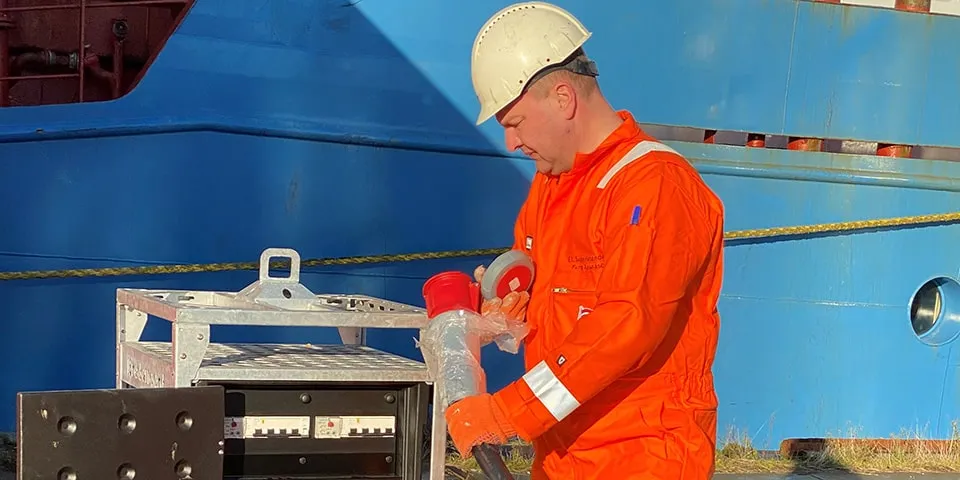
Rotterdam City Council and the Port of Rotterdam Authority will launch a trial on 13 December to supply small seagoing vessels at Parkkade with electricity. This means they will not need to run their diesel generators to generate power for use on board. This will reduce air pollution and noise. The trial will last around five months. Five different systems will be tested during this period. In terms of scale and scope, this trial is unique worldwide.
“Shore power kills two birds with one stone: it gives us cleaner air and lower CO2 emissions,” says Arno Bonte, alderman for Sustainability and Air Quality. “Our ambition is to connect all vessels to shore power, starting with quays close to residential areas. This trial is an important step towards achieving that.”
Allard Castelein, CEO of the Port of Rotterdam Authority: “We are continually taking shore power a step further. It has been compulsory for inland vessels for around 10 years. Stena Line has it in Hoek van Holland, and we will install it for Heerema at Rozenburg. In the coming decades, many more vessels will need to plug in. The larger the vessels, the more complex and expensive it becomes. So this will take time.”
Mobile
What makes the trial at Parkkade special is that it does not use a fixed power connection, but mobile systems. These can therefore be deployed wherever shore power is needed. The trial will look at various energy sources, including hydrogen, batteries, (bio)LNG and hybrid solutions. The latter combine different sources. The fuels mentioned require a generator on site to convert them into electricity.
The trial will focus primarily on technical and commercial feasibility, ease of use and environmental impact. Measurements will be taken to determine the noise and emissions from the systems, compared with those from the same vessel generating power with its own generators.
Many coastal vessels operated by shipping companies such as Wilson, Vertom and Wijnne&Barends call at Parkkade. In principle, any seagoing vessel that berths there can use the mobile shore power, but not all seagoing vessels are equipped with a shore power connection.
The trial will cost approximately €500,000. Most of the funding comes from central government through the National Air Quality Cooperation Agreement. Its aim is to improve air quality, particularly in urban areas.
After the mobile shore power trial at Parkkade, a second trial will start in 2020. This will focus on innovative shore power solutions for larger seagoing vessels. €1,500,000 has been made available for this.
High power consumption
Calculations by DNV GL and the Port of Rotterdam Authority indicate that the total energy demand of seagoing vessels in the port is around 750 to 850 GWh. That is equivalent to the consumption of approximately 200,000 households. There is therefore scope to improve air quality, liveability and the climate.
Shore power is relatively easiest to install and make commercially viable for inland vessels and ferries. The former consume relatively little energy, while the latter operate on fixed routes, meaning that, apart from the vessels themselves, facilities are needed at only a few ports.
Shore power for seagoing vessels is more complex because of their higher power consumption and the fact that vessels call at many different ports. This requires cooperation between ports, terminals and shipping companies. Another important consideration is that large seagoing vessels consume far more electricity. Cruise ships, for example, use as much electricity as a small town, with their thousands of passengers and crew members.
Five trials, five companies, five months
The five companies whose shore power systems will be tested over the next five months are:
- ENGIE Ventures & Integrated Solutions B.V.: Hybrid system with a Big Battery Box, integrated with a biofuel-powered (HVO) engine-generator;
- PON Power & sister companies: Hybrid container with a battery combined with a generator running on blue diesel (HVO), housed in a 20ft container, with solar panels on the roof;
- Aggreko Benelux: LNG-powered gas engine in a 20ft container;
- Mobiele Stroom BV: Bio-LNG-powered turbine in a 20ft container;
- JP-Energiesystemen B.V: Hydrogen fuel cell generator set combined with a small battery.
Question about this story? Ask your question
Keep following this
Get an email when a new story is published. No account needed.
- SubjectSpecials







