Ensuring a load-bearing and accessible construction site
Text Roel van Gils Image Aboma
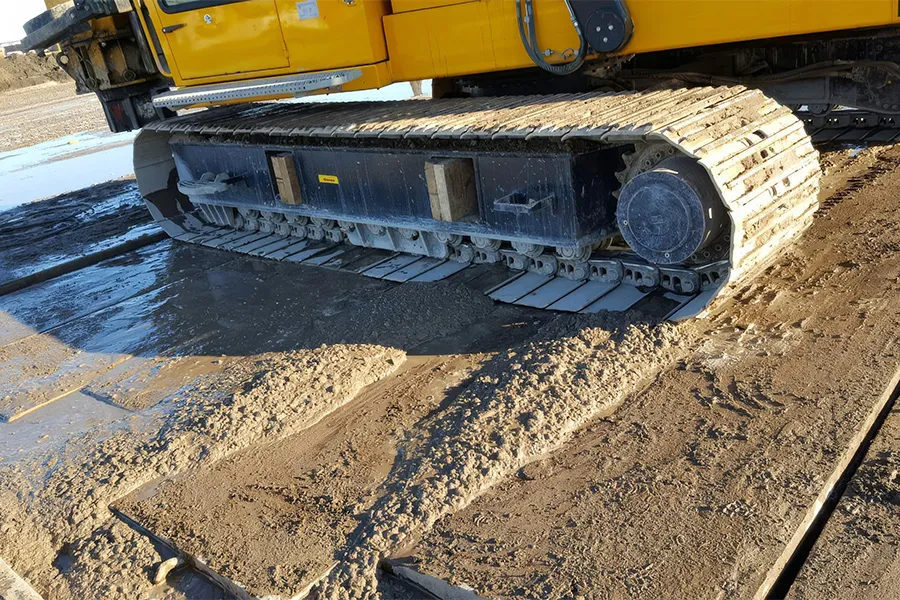
The Dutch Working Conditions Act requires the principal contractor to ensure that the construction site is load-bearing and accessible for all the work to be carried out. During the design phase, the choice of machinery to be used must take into account whether the ground has sufficient bearing capacity. A construction site certificate is not (yet) mandatory, but according to the experts at Aboma Inspections it would help raise awareness. In practice, attention to the condition of the construction site is still inadequate.
In the United Kingdom, no project gets under way until it has been demonstrated that the construction site has sufficient bearing capacity, says Pieter Bakker, operations manager at Aboma Inspections. “A construction site certificate like this is not mandatory in the Netherlands, but you must be able to show that the site meets the requirements. For that reason, we are called in to carry out site investigations, measurements and calculations to assess whether the ground has sufficient bearing capacity for the machinery that will be working on it. It is quite common for the machine and method to have already been chosen, only for the calculations to show that the choice was not the right one. Requiring more evidence of adequate bearing capacity in advance would only increase awareness among clients.”
Safe operation on site
Aboma is an accredited conformity assessment body (CAB) and also inspects, among other things, mobile cranes, tower cranes, passenger and goods hoists, and foundation equipment in accordance with the Dutch Machinery Commodities Act Decree. “This also includes inspections and foundation calculations to ensure safe operation on site,” says Sander Cornelissen, operations manager at Aboma Inspections. “When a tower crane is inspected in its erected position, the foundation calculation often turns out not to match the actual site conditions. If this is not checked, the consequences can be serious. Checking it requires the necessary expertise.”
The NVAF has set up a working group to revise the construction site certificate. Aboma is contributing by sharing its findings, because all machinery benefits from a construction site that is load-bearing and accessible. The idea that this is only about large, heavy machinery is mistaken: what ultimately matters is the ground pressure per m2. “Instruction manuals and the lifting and capacity charts for machines explicitly state that the ground must have sufficient bearing capacity for safe operation,” says Pieter. “It is effectively the first question you should ask your client: show that the ground has sufficient bearing capacity. The principal contractor is responsible and liable for this.”
If calculations show that the ground does not have sufficient bearing capacity, measures will need to be taken. These could include ground improvement, laying crane mats and/or installing drainage to remove groundwater and rainwater, Pieter explains by way of example. Sander says: “It is therefore quite remarkable that this issue receives so little attention, because considering it during the design process enables you to make much better choices and even to consider different methods or using different machinery. Often the machines are already on site when it becomes clear that the ground does not have enough bearing capacity. By then, it is far too late.”
Question about this story? Ask your question
Keep following this
Get an email when a new story is published. No account needed.
- ThemeUnderground construction
- SubjectSafety