









Reserve pipeline for sewer at a depth of 66 m
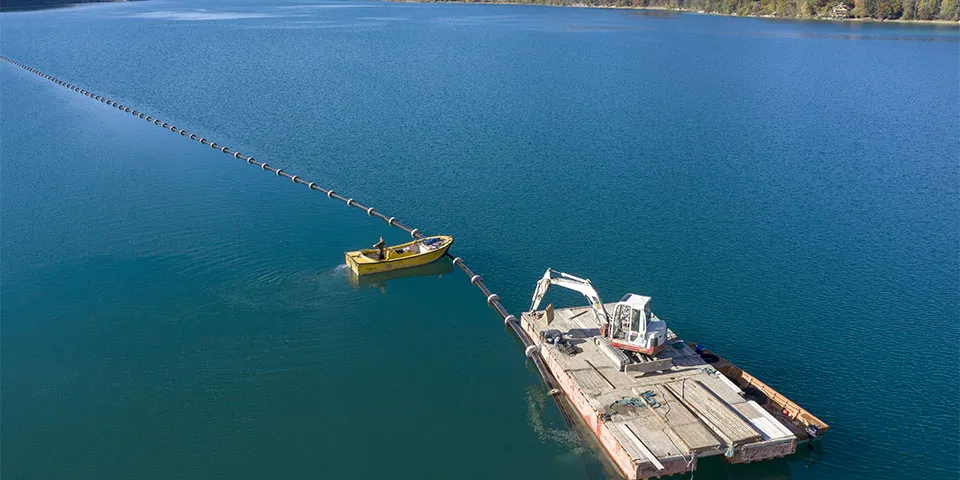
Since the early 1970s, wastewater pressure pipelines have been installed in several lakes in Austria. This is also the case at Fuschlsee in Salzburg, where a PE sewer pipeline has been in operation on the lake bed since 1975. As its calculated service life of 50 years is about to be reached, a parallel 4,200 m-long sewer pressure pipeline needs to be installed. This will serve as a reserve pipeline, ready to be brought into operation immediately if problems arise with the old pipeline. AGRU Kunststofftechnik is supplying the components needed for the underwater pressure pipeline, made from high-tech, stress-crack-resistant PE 100-RC.
Underwater pressure pipelines can be installed quickly, while leaving the coastal areas, which are often protected nature reserves, undisturbed during installation. They can also be laid in straight lines, saving on pipe length. As a result, they require lower investment than a pipeline laid on land. However, because a pipeline in deep water is difficult to access in the event of damage, a replacement pipeline must always be available. For this reason, the Fuschlsee-Thalgau water treatment association is investing in a new parallel underwater pressure pipeline made from PE 100-RC. The pipeline will run the full length of the crystal-clear mountain lake, whose water is so pure it is drinkable, and carry wastewater from the municipality of Fuschl am See. It will transport between 600 and 900 cubic metres of wastewater a day from one side of the lake to the other, where it will be routed via a collector to the wastewater treatment plant.
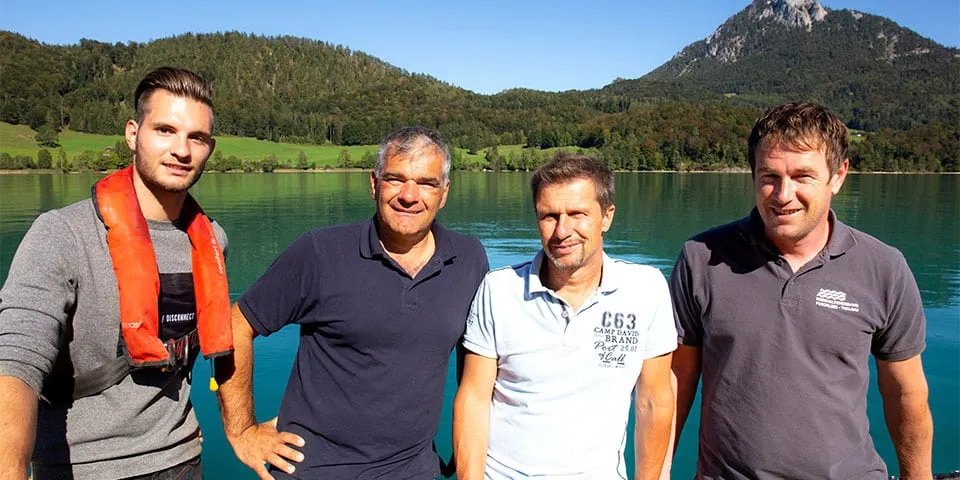
Ing. Erich Peer (second from left) and his son Manuel (far left) were responsible for the installation. Ir. Martin Roither (third from left) planned the underwater pressure pipeline. Christian Winkler (right) is the director of the water treatment association.
AGRU Kunststofftechnik had previously supplied 4,248 linear metres of polyethylene pipe with an OD of 280 mm and SDR 17 (16 mm wall thickness, maximum pressure of 10 bar), as well as fittings and a CNC-controlled butt-fusion welding machine. The black PE 100-RC pipes, with brown axial stripes to clearly identify their intended use for wastewater, offer exceptional resistance to point loading and stress cracking. The pipeline system therefore provides additional safety during decades of operation on the stony lake bed, at a depth of 66 m, where the temperature remains just 4°C throughout the year due to the temperature gradient in the water. The material also offers very good resistance to the chemicals found in domestic wastewater, such as alkalis and surfactants.
PEER WASSERBAU GmbH. & Co. KG. is a recognised specialist in hydraulic engineering, building services and civil engineering, with extensive experience in the professional installation of underwater pressure pipelines. To complete the more than 4 km-long pressure pipeline, engineer Erich Peer and his team have to weld together 18-metre-long pipes and lower them into the pipeline route within a short period of around two months. The AGRULINE pipes are welded using the AGRU ST CNC 2.0 butt-fusion welding machine. Its latest control technology keeps all parameters, including pressure, temperature and time, under constant control. The machine records the parameters for every individual weld, as well as the welder’s name. Only an experienced, certified welder may make the joints. As the individual pipe sections are joined using only the pipe material, they form a monolithic, continuous and corrosion-resistant pipeline system.
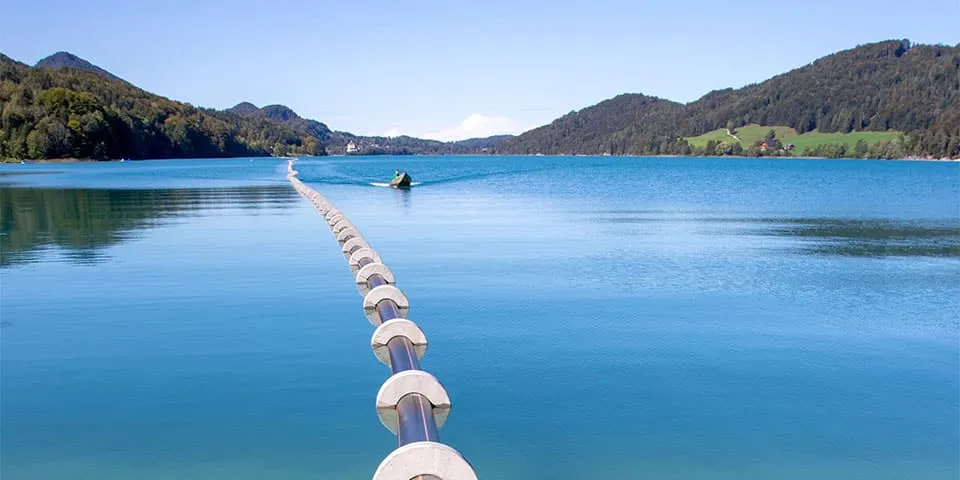
The spacing between the weights was calculated so that exactly half of the empty pipe would be submerged.
Weight also plays an important role in underwater pressure pipelines. Concrete weights must prevent the pipeline system from floating, a problem that can be compounded by the possible formation of fermentation gases in the pipeline. The weights also stabilise the pipeline on the lake bed, ensuring it remains in the same position decades later. PEER uses prefabricated concrete elements made in two halves, which are placed around the plastic pipe like rings. The two halves of each ring are then permanently fastened together with stainless steel bolts. A foam rubber insert is clamped between the pipe and the concrete to protect the pipe and provide extra security against slipping. These concrete collars, fitted every 3 metres, counteract around 50% of the buoyancy. Once the pipe is filled with water, the concrete weights will pull it down to the lake bed.
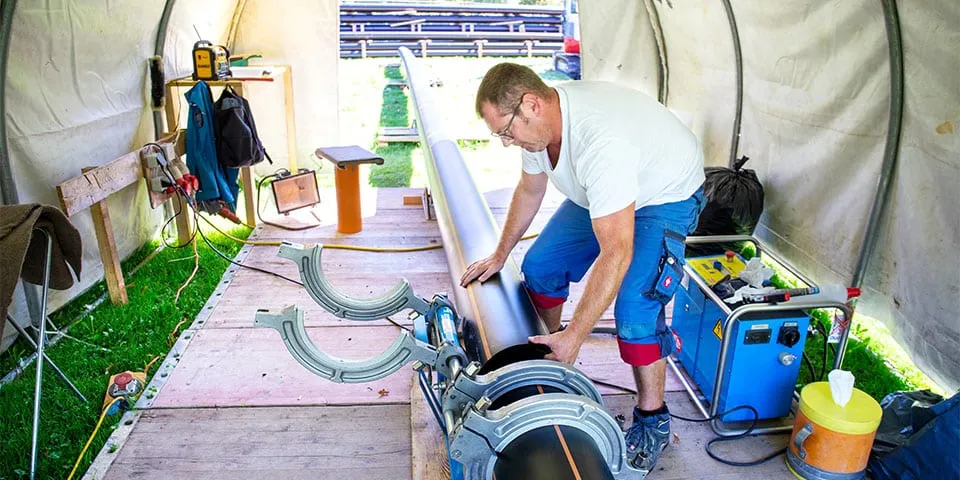
AGRU Kunststofftechnik supplied the pipes, fittings and welding machines for the new underwater pressure pipeline in Fuschlsee.
Around 200 linear metres of ready-to-use pipeline are pushed into the lake from the shore each day. The kilometres-long floating pipeline could drift in the wind, so PEER anchors and tensions it every day. After around two months of work in all kinds of weather, it is time to lower the 4.2 km-long pressure pipeline to the lake bed. Several requirements must be met before this process can begin. The lake bed along the pipeline route must be mapped in detail, and the exact position must also be established using GPS coordinates. The lowering process can then begin. The pressure pipeline is carefully filled with lake water at one end and compressed air at the other. The rate at which the pipeline sinks is crucial, as it must not exceed a certain bending angle. The future sewer will cross the entire length of the lake, including its deepest point at 66 m. The lowering process therefore takes several hours. Once the pipeline has been successfully lowered, the entire pressure pipeline is pressure-tested.
The Steinbacher + Steinbacher ZT GMBH office in Thalgau has many years of experience in municipal water engineering and has successfully completed several projects with the Fuschlsee-Thalgau water treatment association. For this reason, Ir. Martin Roither of the Steinbacher office was commissioned to plan the overall concept. This included a study of options, planning, tendering and site supervision for the upstream retention basin, the pumping station and underwater pipeline II through Fuschlsee.
Christian Winkler is director of the Reinhalteverband Fuschlsee-Thalgau: “The water in Fuschlsee is of drinking-water quality, and it must stay that way. The new underwater pressure pipeline serves as a reserve and gives us added security, as it can be brought into operation within minutes in an emergency. In consultation with Mr Martin Roither (planning and site supervision), we therefore also opted for a plastic pipeline made from AGRU’s PE 100-RC, as studies have shown that a PE pipeline of this quality can last up to 80 years. We are satisfied with AGRU’s planning and delivery, as well as the quality of the pipeline. I would also like to thank PEER for the professional and careful installation.”
Question about this story? Ask your question
Wie aan Reservepijpleiding voor riool op 66 m waterdiepte werkte
- ir. Martin RoitherSteinbacher + Steinbacher ZT GMBHMentioned in Reserve pipeline for sewer at a water depth of 66 m
- pipes, fittings and welding machinesAGRU KunststofftechnikIn this story
- installationPEER WASSERBAU GmbH. & Co. KG.In this story
Keep following this
Get an email when a new story is published. No account needed.
- ProjectReservepijpleiding voor riool op 66 m waterdiepte
- SubjectSpecials
- CompanyAGRU Kunststofftechnik
- CompanyPEER WASSERBAU GmbH. & Co. KG.







