









Questions over service life and circularity in civil engineering
to reduce consumption. The use of timber in civil engineering can play an important role in this. ‘Service life’ or ‘circularity’ are…
To meet our climate and circularity targets, we need to take urgent action. Major
changes, investment and fundamental choices are needed to make our work genuinely sustainable, circular and
bio-based, and thereby limit CO2 emissions and reduce the use of raw
materials. The use of timber in civil engineering can play an important role in this. ‘Service life’ or ‘circularity’ are often used as arguments against choosing timber, but research shows that the situation is sometimes rather different from what people think.
Timber sheet piles and bank protection have a longer service life
Timber sheet piles have been used in the Netherlands since Roman times. The use of tropical hardwood for walkways took off in the 1960s. There is therefore extensive experience with this material. In practice, a service life of 25 years is often assumed for timber sheet piles, even though many projects are known to be much older. To gain a better understanding of the service life of timber sheet piles in practice, a recent study was commissioned by Centrum Hout/VVNH1). Using its asset management system, the engineering consultancy analysed the underlying records for 2,390 projects, with a combined length of more than 445 kilometres, and determined their average service life. The conclusion is that sheet piles and bank protection made from timber species with natural durability class 1 (NEN-EN 335) have an average service life of 36.6 years. This is well above the 30-year design life required by many clients. There is certainly some variation, and some projects perform less well, but projects up to 60 years old were also identified. This also demonstrates that the average service life of 25 years often cited colloquially should be revised upwards.
The study also examined the factors that affect service life. A significantly longer service life can be achieved through good detailing and the use of a capping beam, it found. This increases the average service life to 43 years. Geographical location, soil type and water quality do not appear to have a significant effect on service life. The impact of verge management would need further investigation, as these data are not part of the asset management system.
Save the forest
Another reason timber is not used is that buyers, policymakers and advisers often do not know where the timber comes from or whether its use contributes to deforestation. This concern is understandable, but unfounded. Sustainable timber procurement rules have in fact been drawn up for (semi-)government projects, and when they are applied, forests, particularly in the tropics, benefit from the use of timber sourced from them. Timber certified by FSC, PEFC, Keurhout or STIP comes from sustainably managed forests and is monitored ‘from felling to shelf’. These certifications meet the Dutch government’s sustainable procurement criteria (TPAC). In the Netherlands, more than 86% of all imported timber carries these certifications and therefore comes from sustainably managed forests. Forests not covered by sustainable forest management are at high risk of being destroyed. This is because they generate little or no income. Agricultural crops such as soya, palm oil and cocoa generate much higher returns in hard currency, and more quickly. If we want tropical forests to survive and biodiversity to be maintained, it makes sense to use sustainably produced timber from these forests, as this generates the income needed to carry out forest management, combat poaching and support local communities: ‘Save the forest, buy sustainably produced timber’.
Get started with CirculairPlus
A key way to achieve environmental benefits, prevent scarcity and waste, and thereby contribute to climate targets is circularity. The national programme ‘A Circular Netherlands by 2050’’ sets out the objectives for achieving a circular economy. Rijkswaterstaat, the Ministry of I&W and CB23 are working hard with civil society organisations to make the circularity of projects and buildings measurable. The main focus is on fossil and mineral raw materials, as these have the greatest environmental impact and are most at risk of becoming scarce. The emphasis is on reuse, recycling, retaining value and design for disassembly. Bio-based materials from sustainably managed sources are renewable and, on that basis, do not become scarce. They are also already part of a closed (bio)cycle because they are biodegradable, and are therefore already circular. In addition, timber applications in civil engineering also fit into the technical cycle of ‘hard’ materials, as they can often be reused and recycled, and ultimately are also suitable for energy recovery (bio-refining, thermal recycling). They can also often be fully disassembled. Sheet piles, for example, are already widely reused by shortening them and/or reinstalling them upside down, or by sawing them up and using them again at the waterline in combination with a softwood lower section. Bridges are dismantled and their components used to build new bridges, as in Westervoort, Almere and Nijmegen. Mooring piles are in strong demand for use in the B&U sector, for example as columns or cladding. Timber can therefore be part of both the biological and the technical cycle, making it, in a sense, CirculairPlus.
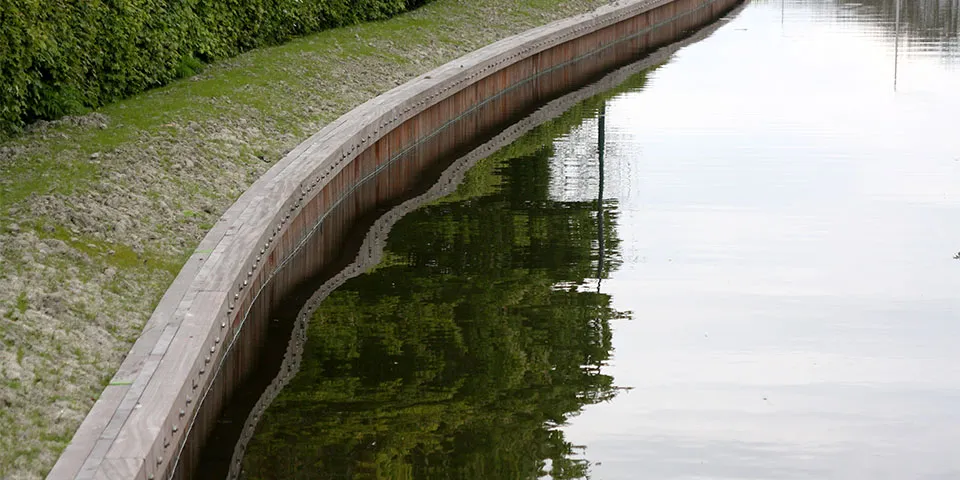
Timber sheet piles have an average service life of well over 30 years. Photo: Centrum Hout/EdM.
Timber bridges can also be modular
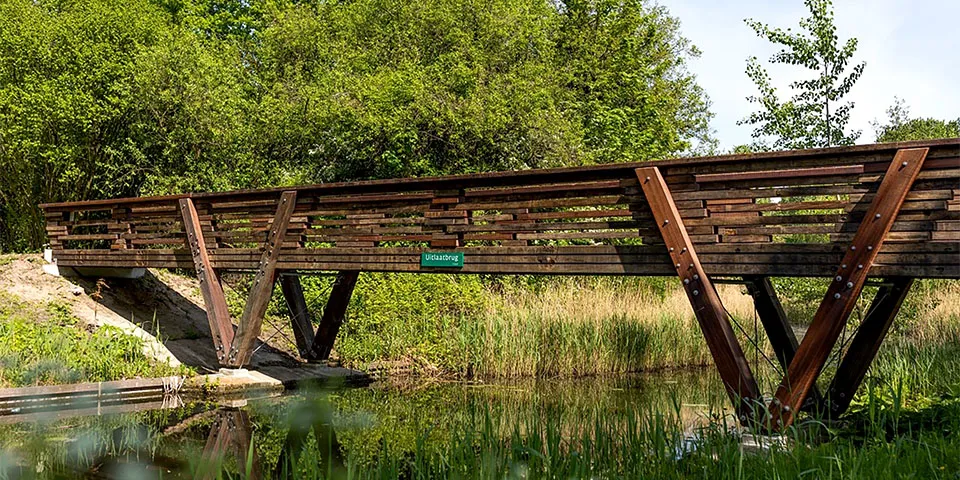
Extending service life is another way to contribute to circularity. Making structures modular can help, as it makes them easier to maintain and replace, and less tied to a specific location. This also applies to timber bridges: research into modular timber bridges shows that they offer many possibilities. Two students from Hogeschool Windesheim analysed the dimensions of Dutch timber bridges as part of their graduation project, which they carried out at engineering consultancy Westenberg. They also spoke to various municipalities and other stakeholders, including contractors and Centrum Hout. After identifying the critical factors, they designed a standard timber bridge. They put together a construction kit with solutions for components including spacers and a click-fit system for the deck elements. The students expect that, thanks to the detailing and preservation treatment, a standard modular timber bridge will have an average service life of 60 years, compared with 40 years today. Further research is needed to test whether the modular concept works well in practice.
Environmental performance is about more than circularity
A structure may have many circular properties, but if its overall environmental impact is high, it does not contribute to climate goals or to the management of raw materials and waste, and therefore does not support circularity targets. This is why, alongside circularity criteria, it is important to consider environmental impacts (MKI). Life cycle assessment (LCA) (1) helps establish circularity (Modules C and D in MPG and DuboCalc), but also provides a better picture of overall environmental impact. For this reason, the timber sector has also commissioned LCAs (2) of sheet piles, bank protection, decking, guardrails and road portals. These can be found at www.houtindegww.nl.
1) The study into the service life of sheet piles was funded by the Ministry of Agriculture, Nature and Food Quality as part of the policy-supporting research theme ‘Climate Envelope: Climate-smart Forests, Nature and Timber’.
2) The LCA study of bank protection, decking, guardrails and road portals was carried out in collaboration with Rijkswaterstaat.
Question about this story? Ask your question
Keep following this
Get an email when a new story is published. No account needed.
- SubjectSpecials







