









Optical emission spectrometer (OES): the detective among measuring instruments
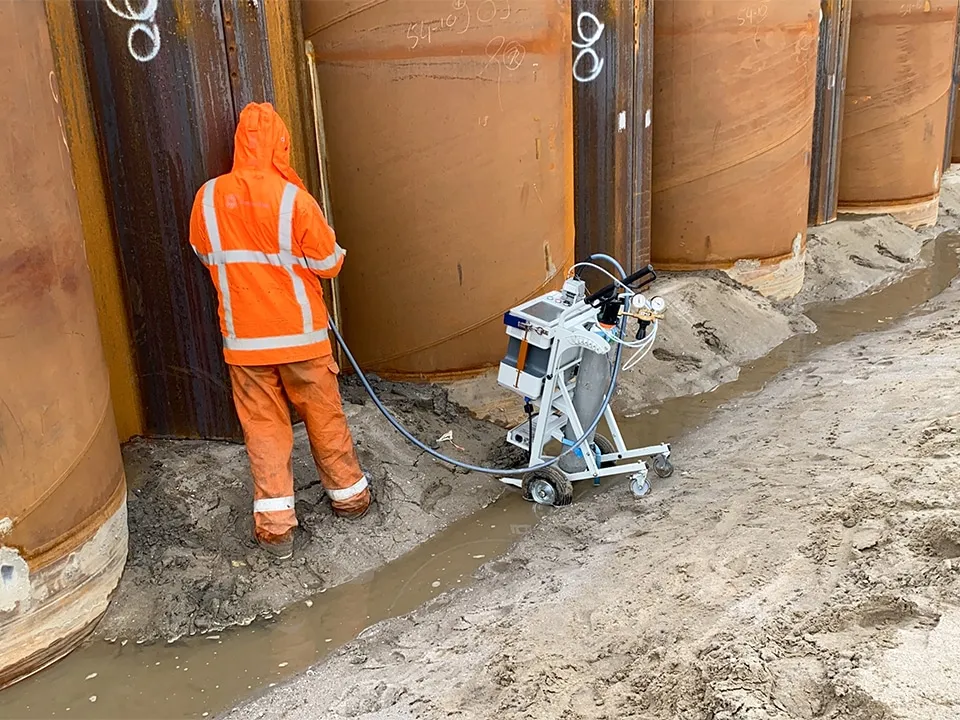
There are situations where the chemical composition of a metal needs to be determined, but the location makes this difficult. In such cases, Inspecto Visio Group can help. Founded in 2014, the company specialises in carrying out inspections and measurements, and now also operates in the civil engineering sector. With its latest addition, the PMI-MASTER Smart, Inspecto Visio Group can carry out non-destructive testing quickly and efficiently.
Wolter van der Zee, owner of Inspecto Visio Group, explains: “The PMI-MASTER Smart is an optical emission spectrometer. It enables us to collect a wealth of information quickly and efficiently for a range of applications. With the right preparations, we can take many measurements in a short time. The built-in battery allows us to carry out up to 450 measurements on site. The PMI-Master Smart is portable thanks to its compact design.”
Measuring carbon equivalent
Inspecto Visio Group was called in by a construction consortium in Rotterdam that wanted to know the carbon equivalent of a sheet pile that was to be welded. Wolter says: “Rijkswaterstaat required the consortium to carry out the test. If the carbon equivalent value we measure is too high, additional precautions must be taken before welding. This might involve preheating the metal, for example. Inspecto Visio Group carried out no fewer than 600 OES measurements on the sheet pile. We put the PMI-Master Smart on a trolley and wheeled it along the sheet pile.”
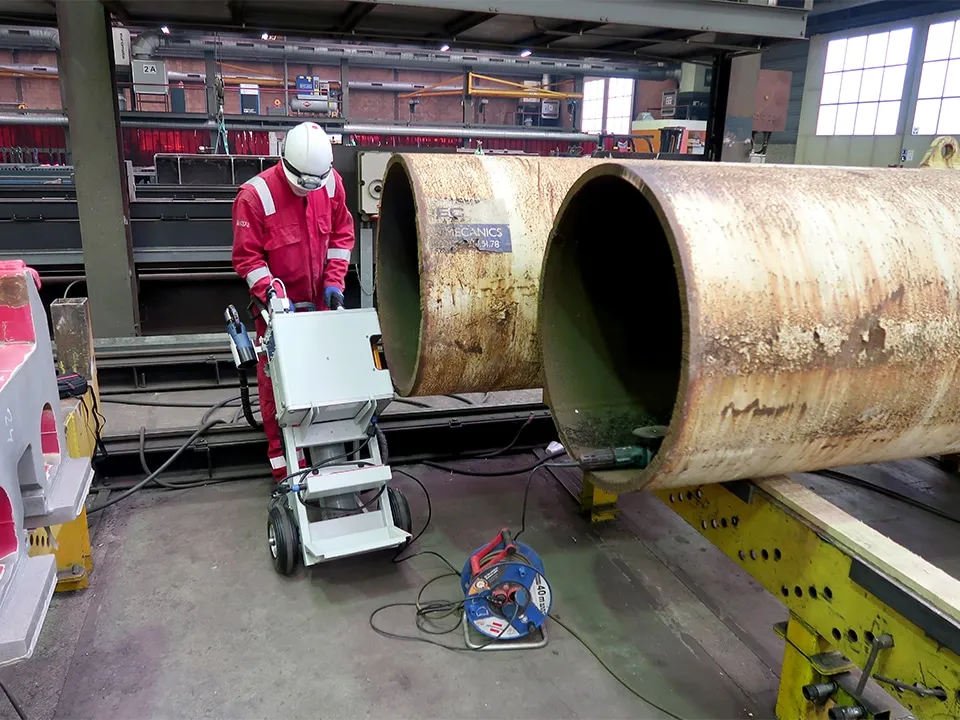
In principle, the PMI-MASTER Smart can measure any element. “These include C, Si, Mn, Cr, Mo, Ni, Al, Co, Cu, Mg, Nb, Ti, V, W, Zr, Pb and Fe. Accuracy depends on various factors, but is always more than sufficient for the applications for which measurements are taken. The measurement data are used to analyse ferrous and non-ferrous metals, such as aluminium-, nickel-, chromium- and copper-based alloys. The advantage of OES is that it can determine the carbon content and all the essential elements needed to calculate the carbon equivalent (CE) in carbon-containing steel grades. The formula for calculating the carbon equivalent is as follows: CE= %C + ( %Mn / 6 ) + ( (%Cr+%Mo+%V) / 5 ) + ( (%Cu+%Ni) / 15 ). If the result of this calculation is high, the material is more susceptible to through-hardening, which can lead to cracking. The value determines whether preheating is needed for welding and, if so, how high the temperature should be. A material certificate does not always state the metal’s composition, but we address that by providing a validated report after taking measurements. We can then tell you everything about the component in question,” says Wolter.
How does an OES measurement work?
Wolter explains the principle behind OES: “The technique brings atoms into an excited state. An excited atom emits electromagnetic radiation, a process known as emission. This radiation is released in the form of a photon and sometimes falls within the visible light spectrum. A spectrometer measures the photons released. Based on the frequencies and quantities of the photons, a spectrometer can determine both qualitatively and quantitatively the presence of specific atoms and materials.”
For Inspecto Visio Group, the focus in the civil engineering sector is primarily on new projects and assessing existing structures, such as bridges. Wolter is a QA/QC (quality assurance/quality control) engineer himself. He concludes: “We also supervise procedures to ensure they are carried out correctly, for example during welding or when acting as a third party for inspections. The general problem in the sector is, and remains, demonstrating compliance. Contractors are increasingly being asked to obtain EN 1090 certification. With its experience, Inspecto Visio Group is well placed to help with this.”
Question about this story? Ask your question
Keep following this
Get an email when a new story is published. No account needed.
- SubjectSpecials







