









On the road to autonomous outdoor forklifts
Linde and Aschaffenburg University present results of KAnIS research project
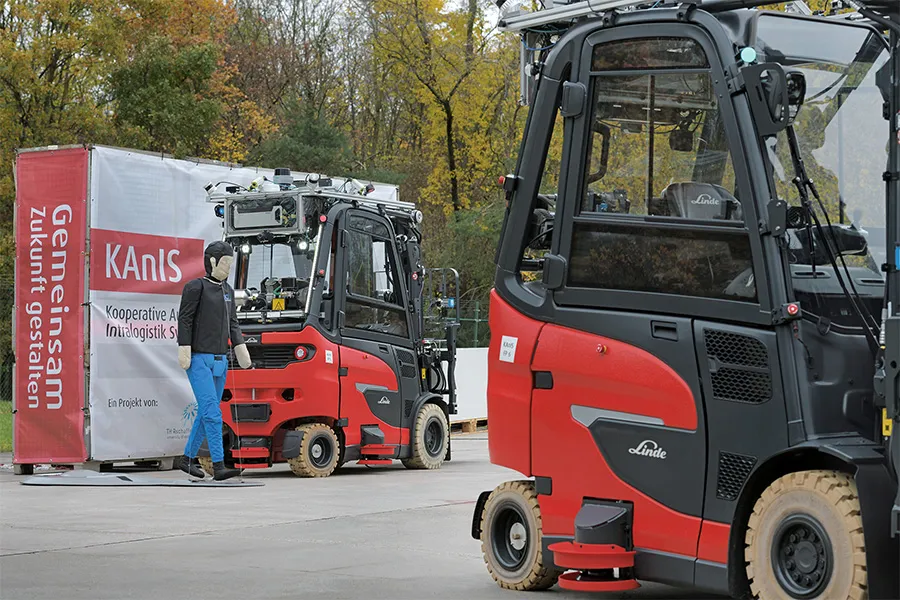
Intralogistics specialist Linde Material Handling (MH) and Aschaffenburg University of Applied Sciences (UAS) presented the results of the “KAnIS: Cooperative Autonomous Intralogistics Systems” research project at the end of 2023, with live demonstrations at the test site beside the Linde factory in Aschaffenburg. Several subprojects developed solutions for the demanding applications of autonomous forklifts transporting loads both indoors and outdoors. The focus was on the trucks’ ability to work together, exchanging information in real time over a 5G network and edge server, and warning one another about obstacles to avoid collisions.
“Autonomous trucks will gradually take on more and more transport tasks,” predicts Stefan Prokosch, who initiated the KAnIS project at Linde MH. As a technology leader in the industry, the intralogistics specialist aims to make the benefits of autonomous trucks available to customers who use forklifts to transport goods or load and unload heavy lorries. “However, the demands on forklifts operating outdoors are much greater than those on trucks used only indoors. They need the power to climb slopes, operate closer to more people and other traffic, and work in a range of weather conditions and temperatures,” explains Prokosch. “The joint research with Aschaffenburg UAS has enabled us to develop viable solutions to these complex requirements. Once the project is complete, its findings will provide an essential basis for further development projects.” The collaboration also brought clear benefits for the university, said project manager Prof. Dr. Hans-Georg Stark: “For us, the KAnIS project was a highly complex, interdisciplinary research project. Ten professors and numerous research assistants and students were involved. Both project partners benefited greatly from the intensive exchange between the scientific research at Aschaffenburg UAS and Linde MH’s many years of expertise in intralogistics and truck development.”
Practical test scenarios under realistic conditions
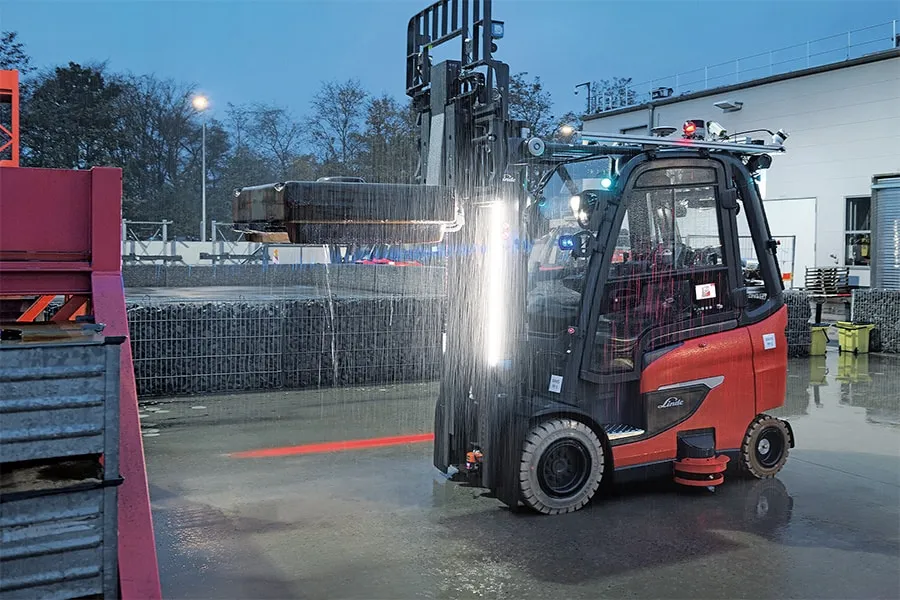
Four Linde E20, E25 and E30 electric forklifts, with lifting capacities of 2.0 to 3.0 tonnes, were automated and equipped with electrohydraulic steering (Linde Steer Control), the Linde Safety Pilot assistance system with electronic load diagram, and an integrated fork positioner. “The practical implementation of the research findings was important to both Linde MH and Aschaffenburg UAS,” stressed Mark Hanke, Head of Pre-Development at Linde MH. From next year, the trucks will be further developed and tested so that they can carry out four specific materials-handling tasks in future. These include transporting mesh box pallets and battery pallets, as well as moving truck frames and protective covers on special load carriers from the pre-processing line to the main assembly lines.
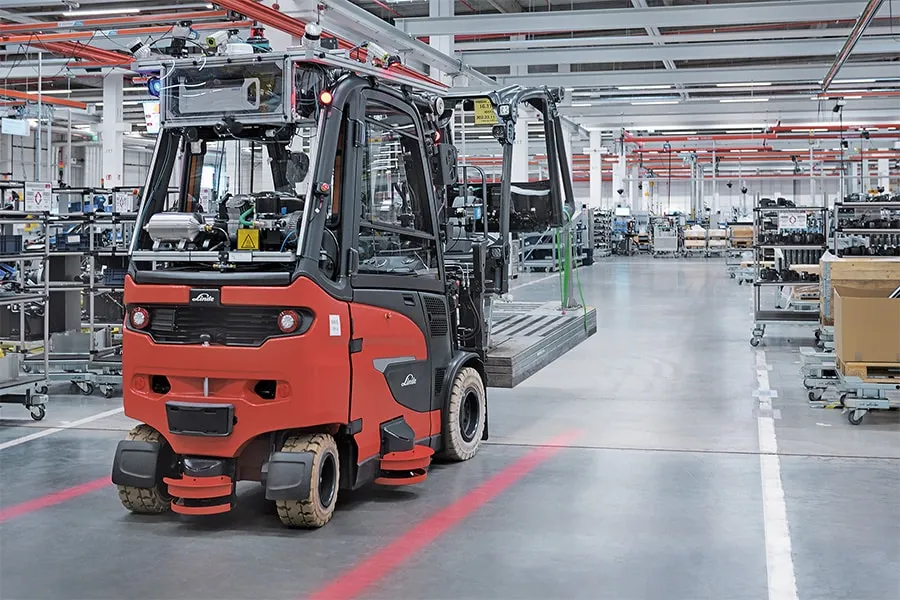
The first two applications are entirely outdoors, while the other two require the trucks to operate both indoors and between the halls. They must negotiate slopes of 8 per cent, and other AGVs and manually operated trucks are also present in the halls. To ensure the four KAnIS forklifts can safely pick up pallets, mesh box pallets and metal frames, even when they are not precisely aligned with the floor, they are equipped with a mobile camera mounted between the forks. It measures the lowering of the fork carriage so that the forks can be positioned correctly using the side shift. The truck frame, battery cover and counterweight were also modified. “Our aim was to integrate the safety scanners, cameras and sensors into the truck’s contours as far as possible, keeping its dimensions as close as possible to those of the standard version,” says Hanke. Indoors, the trucks locate themselves using laser scanners; outdoors, they use differential GPS (Global Positioning System), a method for improving GPS accuracy. They also have additional sensors to manage the transition between indoor and outdoor areas. Unlike their manually operated counterparts, the automated forklifts always travel in reverse along their designated routes to prevent loads from slipping off the forks during an emergency stop.
Real-time communication with trucks and infrastructure
A key focus of the research project was the automated forklifts’ perception of their surroundings, to ensure reliable interaction with other road users. To this end, the trucks were equipped with 3D scanners and HD cameras, in addition to the sensors in their personnel protection systems. Camera data provide the basis for detecting and classifying objects using AI algorithms, and locating them so the truck can adjust its speed and brake to a stop. But that is not all. Another important issue was how to handle critical situations in which people enter areas that the forklift’s sensors cannot detect and approach its path of travel. This is where cooperation between forklifts comes into play: if another forklift is nearby, it can pass on relevant information. This requires the perception data to be transmitted in real time. Linde therefore set up a private 5G network at its factory in Aschaffenburg. Perception data are sent from the forklifts to an edge server, which uses the locally detected objects to create a global list of all detected objects and sends it back to the forklifts.
The test involved a crash-test dummy that suddenly emerges from behind a wall and “runs” into the forklift’s path. Without cooperation with other trucks, the automated forklift cannot stop in time and hits the dummy. However, if it receives real-time information from a nearby forklift, it can anticipate the danger and brake in time. Since it cannot always be assumed that a second forklift will be nearby, eight fixed 3D laser scanners were installed at junctions and access gates along the routes that the KAnIS forklifts will use in future. The object lists from the fixed laser scanners are also combined on the edge server, and the information is made available to all vehicles.
“Fast wireless networks are essential for autonomous forklifts to work together outdoors and respond in real time to unforeseen traffic situations,” stressed Prof. Dr. Klaus Zindler, Vice President for Research and Transfer at Aschaffenburg UAS. “Our aim is to develop universal standards and algorithms using AI methods, which can then be applied flexibly to different trucks and applications and continue to learn.”
Sensor cleaning system, robot charges batteries
Another project team investigated how optical sensors close to the ground could be cleaned if they became dirty from water splashes in the rain or from wet road surfaces. This is crucial because, if reliable object detection is no longer possible, the driver protection system brings the truck safely to a stop automatically. To prevent this, the project team developed a cleaning system that uses compressed air to blow away dirty water droplets that have collected on the laser scanners.
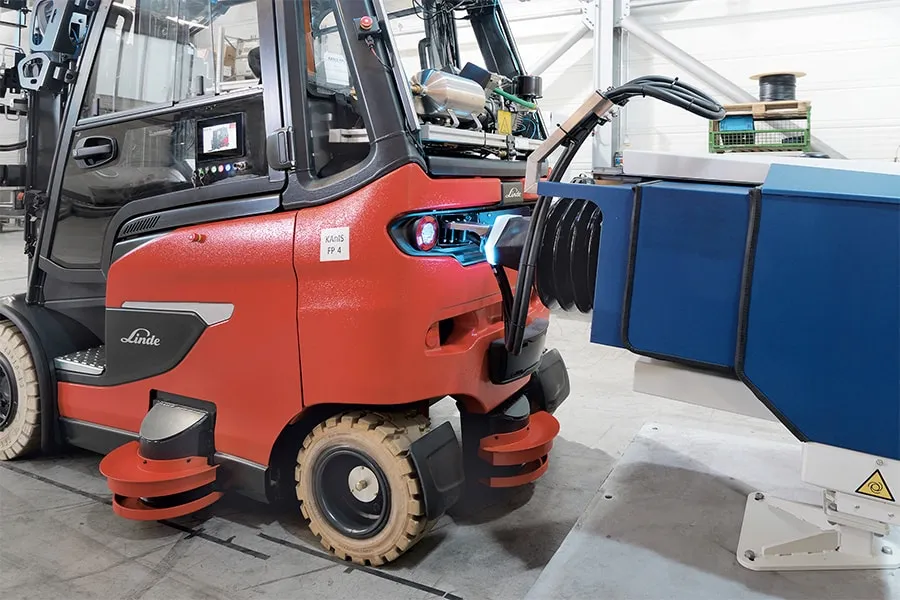
A further project team explored possible solutions for autonomously charging forklift batteries. The result was an AI-based robot that connects the charging plug to the forklift’s charging station. The rear of the forklift was modified for this purpose, and an automatically operated charging flap was added to protect the charging system from dirt and splashes.
Motrac
Motrac has been a leading one-stop provider of intralogistics solutions since 1954 and is the exclusive importer of Linde forklifts and warehouse trucks. The trucks from the innovative premium brand Linde meet the highest standards. Motrac takes care of everything, offering a 24/7 maintenance service as well as expertise and engineering for the complete fit-out of automated warehouses.
More information: www.motrac.nl
Question about this story? Ask your question
Keep following this
Get an email when a new story is published. No account needed.
- SubjectSpecials







