









New tank terminal in Rotterdam: making the impossible possible
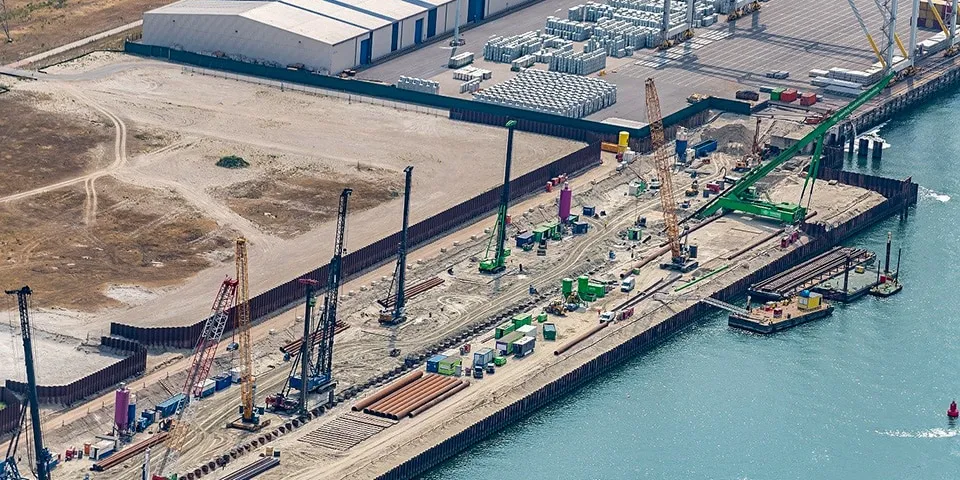
Commissioned by the Port of Rotterdam Authority, a 1,230-metre-long deep-sea quay and a 1,080-metre-long inland shipping quay are being built on the Maasvlakte, where even the largest ocean-going tankers can moor. Construction of the terminal began in early 2018, and it is expected to be operational by the end of 2019.
The main contractor, a joint venture comprising Mobilis, Van Hattum en Blankevoort & Boskalis, asked Voorbij Funderingstechniek and Volker & Staal Funderingen to install the foundations. They in turn awarded High 5 Solutions the contract to install the specialist anchoring elements. The company specialises in installing and removing anchors in complex structures using its unique sonic drilling technique.
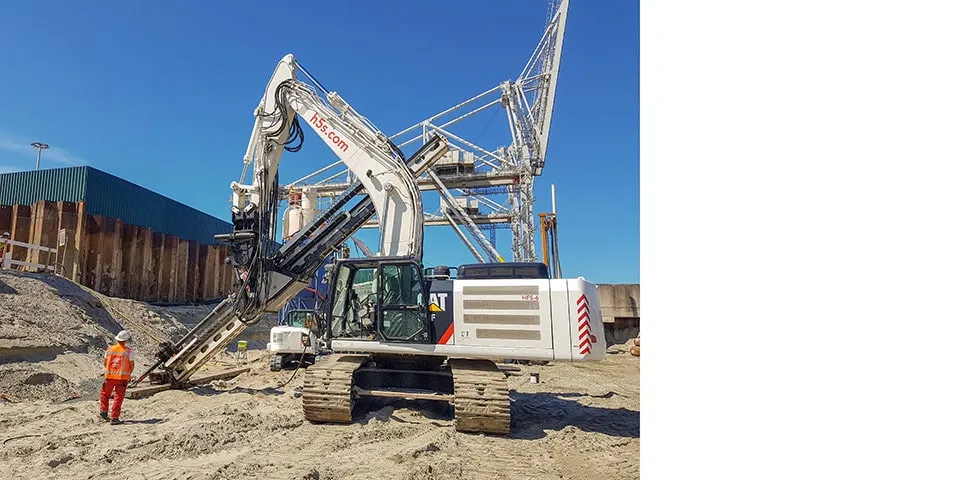
High 5 Solutions sonic anchor drilling rig.
Conventional anchoring cannot withstand the loads
Peter Bongers, director at H5S, explains: “For the deep-sea quay, H5S installed no fewer than 56 GI (Grout Injection) anchors, with an average length of 50 metres and a maximum load capacity of 3,200 kN. Voorbij Funderingstechniek was responsible for installing 314 MV piles, with an average length of 52.5 metres. Together, the anchors and MV piles secure the quay.
The deep-sea quay is subjected to such high loads, due to the deep water in front of it and the loads above, that conventional anchoring cannot withstand them. The inland shipping quay is structurally unlike the 1,230-metre-long deep-sea quay, but it also has a combi-wall. This combi-wall is anchored with 360 GI anchors installed by H5S, with an average length of 47 metres and a maximum load capacity of 2,800 kN.”
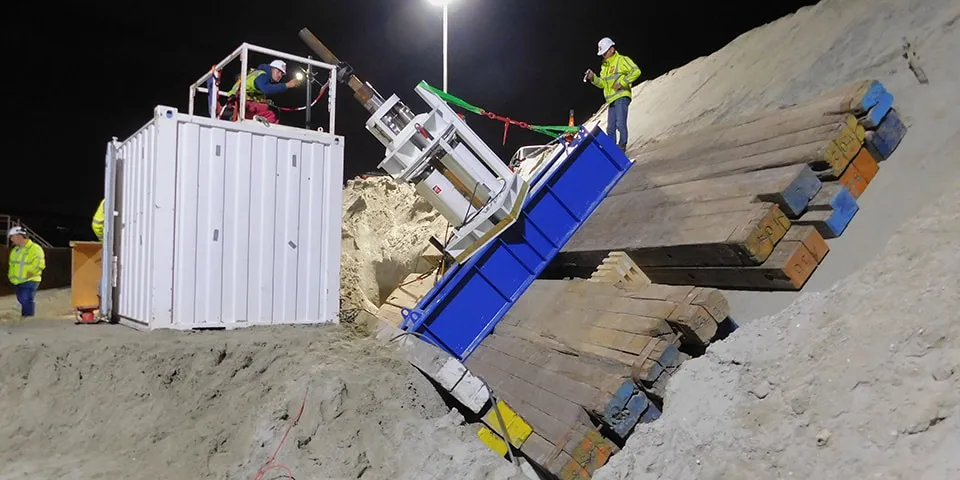
The bespoke test jack used for failure tests. (Image: Jaap Hof)
A specialist project calls for tailored solutions
“We carried out our own design calculations for all the anchors to be installed. The SI anchors are the largest and heaviest ever made and tested. After installation, all anchors are checked in all three directions (X, Y, Z) using a so-called SAAF measurement. Given the heavy ground conditions and high loads, we also developed the drill bits ourselves,” Peter continues. “To demonstrate the holding capacity of the GI anchors, failure tests were carried out in advance on the anchors for the deep-sea quay. The maximum test load for these test anchors had to meet 1.5 times the estimated geotechnical failure load of 5,100 kN. This target was comfortably exceeded. To test the anchors, we developed our own test rig with four jacks, each capable of generating 1,300 kN. The rig is fitted with calibrated pressure cells to measure and record the force generated. The installed anchors were drilled using our self-developed CAT 336 machine, equipped with a sonic drilling motor (up to 180 Hz). This specialist technique is ideally suited to the project, with its heavy anchors and challenging ground conditions. Modifications to the drill bits also make it possible to reach the required depth despite any obstructions.”
High 5 Solutions has engineered and manufactured a total of four machines with sonic drill heads, each of which can be transported in one piece on a low-loader. The technology is patented and is independent of brand and type. “We can install any type of anchor available on the market, or remove it in one piece. Sonic drilling is suitable for any project you can think of, from major infrastructure schemes to construction projects in urban areas,” Peter concludes.
Have a business enquiry for Mobilis? Get in touch
Companies in this story

Keep following this
Get an email when a new story is published. No account needed.
- SubjectSpecials
- CompanyVoorbij Funderingstechniek
- CompanyMobilis
- CompanyBoskalis Nederland







