









New Lock Terneuzen put through its paces at scale
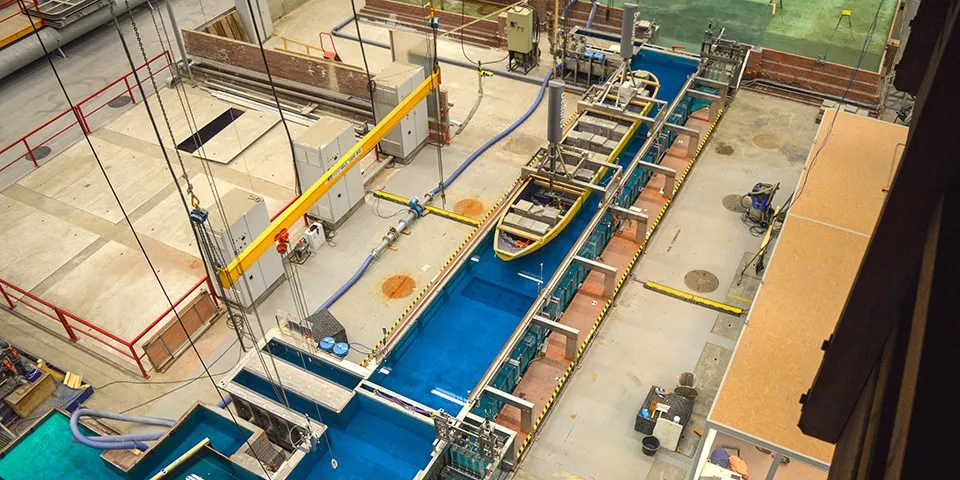
In today’s world of digital solutions, we are sometimes inclined to think that everything is best done on a computer. In civil engineering too, everything can be simulated, surely? Many things can, but not everything. The operation of a lock complex is influenced by so many natural forces that a computer model can never capture every aspect. As a country with extensive expertise in water management, we are fortunate to have test facilities such as those at Deltares in Delft.
Deltares is a Major Technological Institute specialising in water, the subsurface and infrastructure. The institute focuses mainly on river deltas, coastal regions, river areas and offshore. So it will come as no surprise that an exact scale replica of New Lock Terneuzen is currently undergoing extensive testing in Delft. We speak to Wim Kortlever, senior hydraulic engineering adviser at Rijkswaterstaat’s national Major Projects and Maintenance department and a member of the Flemish Dutch Scheldt Commission (VNSC), about the testing procedure.
In the picture well before the tender phase
“I have been working on the New Lock Terneuzen project since the planning phase, together with our Flemish colleagues within the VNSC organisation,” Kortlever begins. “During that phase, a number of studies were carried out to assess the feasibility of the lock’s initial design. After that, the same VNSC team began preparing the contract for the construction of New Lock Terneuzen. During contract preparation, Deltares had already tested the initial design of the filling and emptying system in a scale model, in two separate studies. For this, we used the scale model of the New Sea Lock at IJmuiden. Following the example of that new sea lock, the idea had emerged of filling and emptying the lock through culverts fitted with gates in the lock doors. This also seemed feasible for Terneuzen and was the most cost-effective option compared with the more complex systems using culverts running alongside the lock chamber. The preliminary tests using door culverts in the adapted IJmuiden model showed conclusively that, with this type of filling and emptying system, large forces on the vessel could only be avoided by significantly increasing the levelling times. There were two reasons for this. Terneuzen has different conditions. The difference in level there is from around two metres above NAP in the canal to two metres below NAP outside the lock at low tide. That is a four-metre difference twice a day, compared with IJmuiden, where the daily difference in level is no more than 1.4 metres. The other reason is that at IJmuiden the lock is generally filled with salt water, whereas at Terneuzen it is more often filled with the fresher water from the canal, resulting in higher forces. Following the tests, it was decided not to fill and empty the lock through the doors. A different, more complex solution using culverts alongside the lock chamber was therefore needed,” says Kortlever.
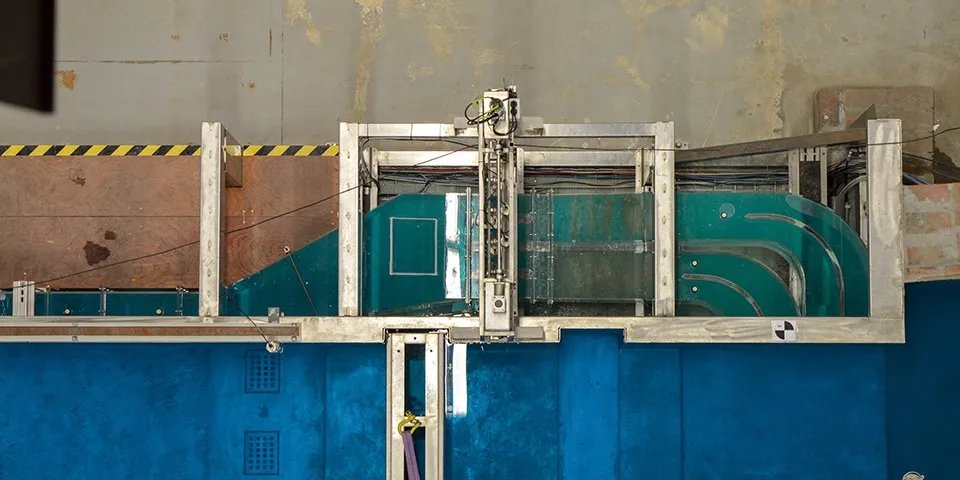
New Lock is emptied and filled on the model of the West Lock.
Short bypass culverts also fail the test
“Another option was to see whether bypass culverts could be used for New Lock Terneuzen, running only around the doors and with filling openings in the lock chamber wall close to the doors. However, the scale model tests at Deltares showed that the forces on the vessel would also be too high with this system, causing its mooring lines to break. The scale model in Delft is ideally suited to replicating the combined process of filling the lock chamber, including the transition from salt to fresh water, and measuring the resulting forces on the moored vessel. Computer simulations are not yet able to account for all the relevant physical processes at once,” Kortlever explains. “The final solution was found by taking a close look at the West Lock in Terneuzen. It fills at about 1/4 and 3/4 of the length of the lock chamber, through grilles in the floor of the chamber. Water is fed to the grilles through a large culvert running along the entire western side of the chamber. By filling from two points in the floor of the chamber rather than from one end by the doors, the water flow is distributed more evenly and the forces on the vessel are reduced. That is the solution we chose: New Lock is emptied and filled on the model of the West Lock. We then amended the construction contract requirements accordingly.”
New computer simulations provide the blueprint for the current scale model
The key dimensions of the filling and emptying system were then determined by comparison with other locks. “A few system characteristics are specified in the contract,” Kortlever continues. “The time it takes to fill the lock chamber depends on the system’s capacity. The contract therefore also specifies the capacity, as well as the need for the water flow to be distributed evenly across the filling points. As with the design of the door filling system at IJmuiden, the tender phase had already called for computer simulations and calculations demonstrating compliance with all the contract requirements. Following the tender, the contractor was required to provide new evidence through new computer simulations. The filling and emptying system being tested in the current scale model is based on the contractor’s final computer simulations.”

The scale model in Delft is ideally suited to replicating the combined process of filling the lock chamber, including the transition from salt to fresh water, and measuring the resulting forces on the moored vessel.
And then the moment arrives…
The contract was awarded to the Sassevaart contractor consortium in the summer of 2017. Preparations for the current scale model began slightly ahead of the award. “The team in Delft arranged for an exact scale model of New Lock Terneuzen to be built. We oversaw the preparations and carefully reviewed the development of the scale model. We were ready in September 2017 to convert the IJmuiden scale model to represent Terneuzen. Deltares faithfully reproduced in the scale model the design of the filling and emptying system, which Sassevaart had adapted on the basis of its final computer simulations. We began testing in the summer of 2018, after the scale model was completed in July of that year. It is always an exciting and memorable moment when water is first introduced into the model. Deltares completed the tests after the summer, and we established the final system characteristics, which could then be passed on to Sassevaart.”
Finding solutions within the geometry
“The tests are ongoing. If they reveal any surprises, we look for solutions within the geometry of the design. To reiterate, what happens at Deltares cannot be simulated in a computer model. Bear in mind that New Lock is located at the transition from fresh to salt water. This means there is a difference in density and therefore so-called density currents. Simulating density currents as the lock chamber is filled is also not straightforward with a computer model. Density currents exert different forces on a vessel than when only fresh water or only salt water is involved. Only the scale model can show what happens in those conditions. Deltares has both fresh and salt water tanks, and we fill the stainless steel lock chamber with both types of water, depending on which door is open at the time. The entire testing procedure is an extremely dynamic process,” Kortlever concludes.
Question about this story? Ask your question
Keep following this
Get an email when a new story is published. No account needed.
- SubjectSpecials







