









Monitoring stations for water, air and ground data
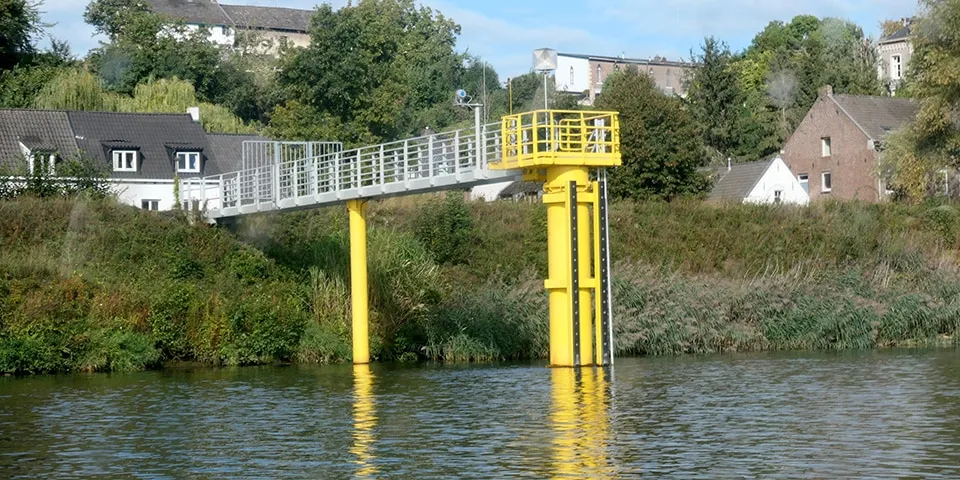
Monitoring stations in the Netherlands’ inland waterways and along the coast are equipped with instruments that generate important data. This includes information on water levels, ground subsidence and water salinity. The steel tubular piles have a platform fitted with monitoring equipment. This measures water levels, wave heights, wind, water salinity and ground subsidence. The data collected is continuously and automatically transmitted to a Rijkswaterstaat (RWS) data centre, where it is monitored and used for various purposes.
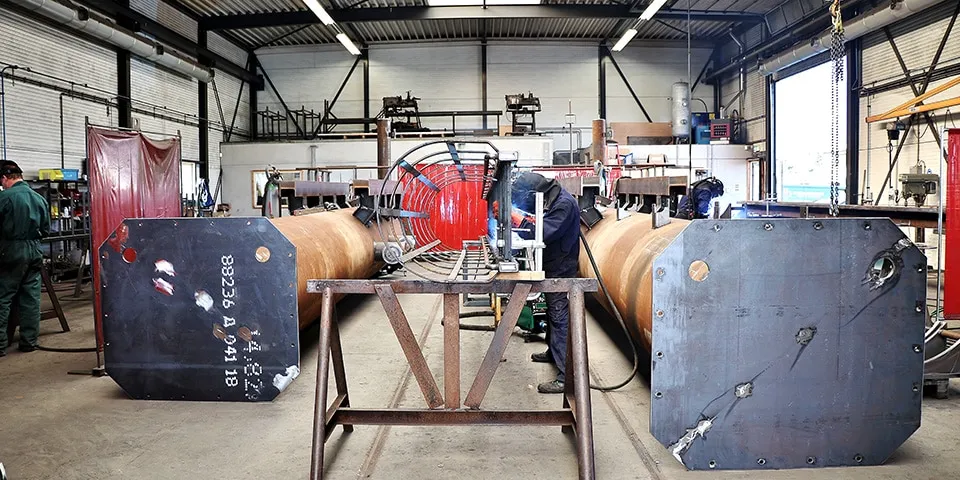
Construction of monitoring stations in the steel workshop at De Boer & De Groot.
Monitoring station specialist
Family business De Boer & De Groot Civiele Werken BV, based in Harlingen, supplies and installs these monitoring stations. The company knows better than anyone the many ways steel, timber and concrete can be used for civil engineering works in and around water, for example in marinas and for bridges, lock gates and sheet piling. The company has built up many years of experience in manufacturing, repairing and installing monitoring stations. Herke de Groot, director of De Boer & De Groot, says: “In 2010, we took part in an RWS tender to repair and replace the sections above water level of ten monitoring stations in the North Sea, north of Vlieland, Texel and Terschelling, and off the coast at Petten and Cadzand. We carried out the work in 2010 and 2011. We can now certainly call ourselves specialists, as contracts followed in quick succession.”
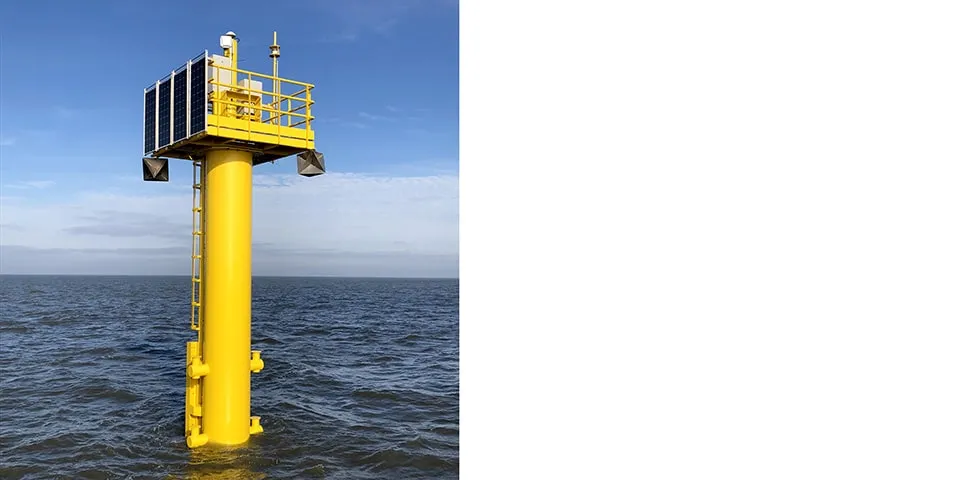
Monitoring station in the Wadden Sea.
A few examples
For example, in 2015 the company received a contract from BAM Infra Verkeerstechniek, which is responsible for the long-term maintenance of the National Water Monitoring Network. This is the RWS network of fixed monitoring points for real-time monitoring of water quantity, water quality and meteorological conditions, supporting water management and shipping traffic management. The work involved replacing monitoring stations, and De Boer & De Groot was approached to carry it out. Working with BAM and DEKIMO, the company delivered the stations in 2016 under a design-and-build arrangement. “We installed a new monitoring station in the Meuse at Maastricht and one in the Rhine at Lobith. We also replaced stations at several other locations,” says De Groot. “In Maastricht, for example, we drove a new 25-metre-long steel tubular pile into the ground and fitted it with a platform. We also built an access bridge to make maintenance and inspection easier.”
In 2018, the company was commissioned to build and install two permanent and five temporary monitoring stations in the Wadden Sea. “Working in a design team, we developed the monitoring system design into a Detailed Design and a Construction Design,” says Henk Dokter, design lead at De Boer & De Groot. The work resulted in permanent steel monitoring stations with a diameter of Ø 1.106 millimetres and a length of 33 metres. They were installed with their pile tips at 25 metres below NAP in the Pleistocene sand layer and fitted with a GPS monitoring system and a direct G4 telecommunications connection, enabling data to be collected and transmitted 24/7. The temporary monitoring points were made from steel tubular sections of Ø 559*10, with their pile tips also at 25 metres below NAP. They are temporary because data is collected during a one-week monitoring cycle each year. “It was a remarkable project,” De Groot adds. “On the tidal flats, with all their distinctive flora and fauna, we had to avoid causing any disturbance or environmental impact, and we also had to contend with the tides. A challenge!”
Question about this story? Ask your question
Keep following this
Get an email when a new story is published. No account needed.
- SubjectSpecials







