









Leeuwarden aqueduct first to feature composite edge elements
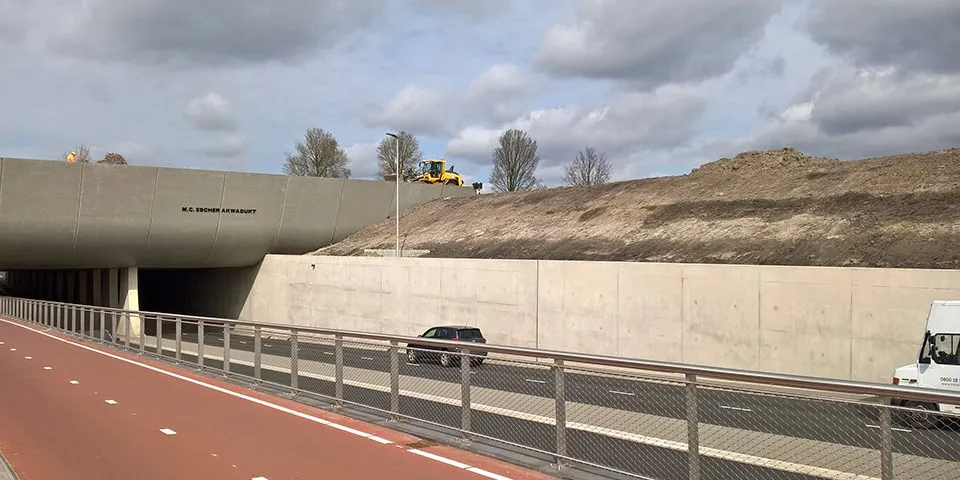
To improve access to Leeuwarden, the ‘M.C. Escher Akwadukt’ was built beneath the Van Harinxmakanaal. Composite edge elements were used for the first time. For the aqueduct on Drachtsterweg, Advantage Composite BV is supplying composite edge elements to enhance the appearance of the approach roads. The company specialises in custom-made composite products for the civil engineering, industrial and construction sectors, with a focus on roads and waterways.
Advantage Composite not only devised composite solutions for the project, but also took responsibility for concept development, engineering, manufacture and installation. Managing director and owner Henk Duijn says: “Our strength lies in being able to deliver a project like this ourselves, from start to finish. Thanks to our knowledge and expertise, Heijmans Infra, which is carrying out the work on behalf of Provincie Fryslân, awarded us the contract.”
Wide range of applications
Composite is a fibre-reinforced plastic with a wide range of applications. This is due to its positive properties, including high strength, load-bearing capacity and stiffness, low weight, insulating and conductive properties, design flexibility and a very low CO2 footprint. This makes composite durable and virtually maintenance-free. Its design flexibility allows a wide range of designs to be created. Composite also combines well with materials such as wood and steel, making installation easier.
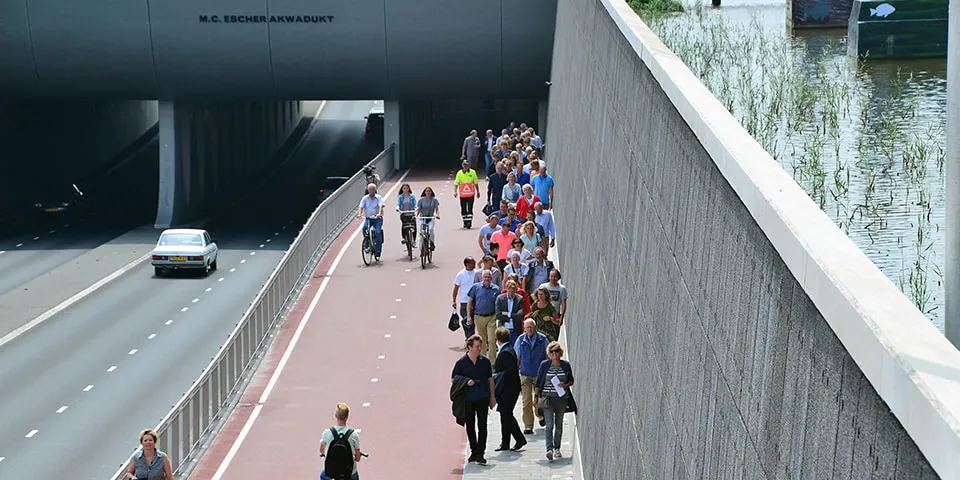
Final works on the M.C. Escher Akwadukt.
Unique in the Netherlands
Using the material for the edge elements of an aqueduct is a first in the Netherlands. The total external surface area of 640 m² is divided across 19 edge elements, 13 on the south side and 6 on the north side. Advantage Composite had a great deal of work to do. Duijn says: “The initial drawings showed everything in concrete. But the largest element is 53 m² and weighs 2 tonnes. In concrete, it would weigh 63 tonnes, making it difficult to transport and lift into position. Forming half-parabolas in concrete is also quite difficult. In the end, we chose composite, which is much lighter and offers complete design freedom, and we carried out the engineering.”
Strength and stiffness calculations then had to be carried out in relation to the suspension structure, made of stainless steel and hot-dip galvanised steel. Working with Solico, we calculated whether all the connections and assemblies were strong enough to withstand wind, snow and ground loads, as well as their own weight. We also considered the choice of materials and suspension structures for fixing the composite to the aqueduct’s concrete structure. The edge elements and steel suspension structure were then manufactured and installed, including drilling the anchor holes. “Finally, we also handled the engineering, supply and installation of the stainless-steel railing, complete with LED lighting along the cycle path, and the stainless-steel handrails on the edge elements,” says Duijn. “We worked on the project for almost a year.”
Fire-resistant composite
As an aqueduct is considered a tunnel, the edge elements must meet the fire-resistance requirements of the hydrocarbon fire curve. This required a special formulation of the composite laminate that can withstand a temperature of 1100-1200 degrees for one hour. “This fire resistance, together with all the other benefits, makes composite an exceptionally suitable material for use in an aqueduct,” Duijn concludes.
Question about this story? Ask your question
Who worked on it
M.C. Escher Akwadukt in Leeuwarden
- composite edge elementsAdvantage Composite BV
Keep following this
Get an email when a new story is published. No account needed.
- ProjectM.C. Escher Akwadukt
- SubjectSpecials
- CompanyAdvantage Composite BV







