









Integrated area development delivers impressive innovations
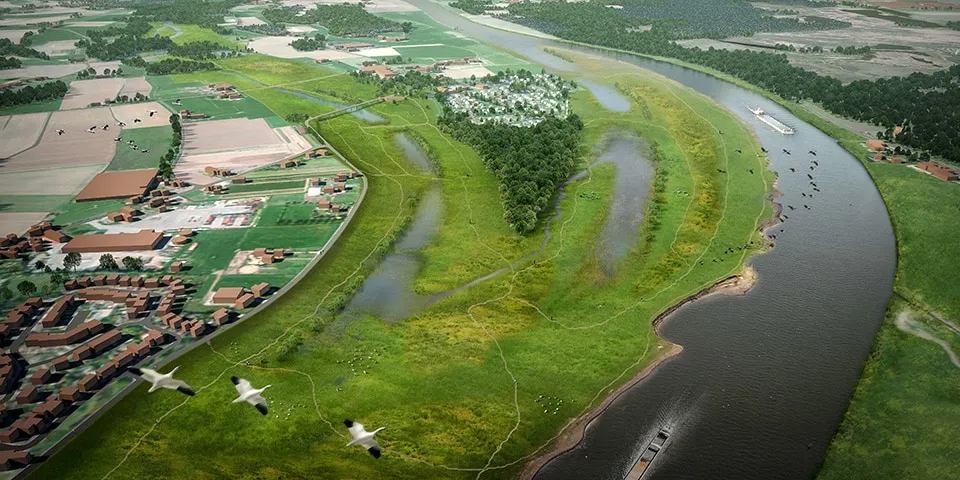
In 1993 and 1995, Limburg was hit by two major floods on the Meuse. The resulting and economic damage was enormous. Emergency measures were taken at speed, with a view to more sustainable development in the future. That development is now under way and is more far-reaching than initially anticipated. This is why the project has been designated an area development project. Across an area of no less than 60 km2, the Mooder Maas consortium is tackling the flood risk, including with dikes that are unique in the Netherlands.
According to environmental manager Keesjan van den Herik of the client, Projectbureau Ooijen, Wanssum, the area development has two aims. “We are tackling the flood risk with a permanent solution, both by building new dikes and by creating more room for the Meuse. A thorough preliminary study showed that the impact on the surrounding area would be so far-reaching that the project became an integrated area development. After all, you only get one chance to do it properly. The aim is to bring flood protection behind the embankments up to a level of one flood in 250 years. We are also aiming to lower water levels by 37 centimetres during high-water periods, with a peak discharge of 3,275 m3 of water per second.”
Mooder Maas visualisation of the new dike types.
Innovative dikes
The large-scale project has been divided into six sub-projects and includes the construction of new dikes, a flood channel at Ooijen and Wanssum, the restoration of the Oude Maasarm and a new bypass, complete with the necessary structures. “The strength of the project lies in treating it as one integrated task,” says Keesjan. “The objectives are also integrated: there is a single budget and one design in which everything has been designed as a whole. This has led to some impressive innovations, including a new type of dike for the Netherlands.” Rody Kusters, construction manager for Mooder Maas, a consortium of Dura Vermeer and Ploegam, agrees: “We have introduced two new types of dike for this project, the high earth embankment and the steep-edge dike. Both are built using locally sourced soil, excavated while deepening the two channels, and serve as an extension of the landscape. During the tender process, we already knew that we would need to commission large-scale research to make all this possible. Immediately after the project was awarded, we made arrangements with two universities in Germany to carry out the research. A full-scale dike was built using clay from the project area and tested successfully. This will enable us to achieve major savings in terms of sustainability and CO2 emissions.”
Mooder Maas Bridge at Ooijen over the inlet to the Oude Maasarm.
The Ooijen flood channel and the Meuse are on the left.
World’s longest girders
The new bypass around Wanssum is another major sub-project. Kusters says: “This is a 4-kilometre road with three roundabouts, two underpasses and a 69-metre-long bridge, 10 metres above the harbour. We are building the abutments on site, while the eight 69-metre girders are being delivered as precast units. They are the longest precast girders in the world. They will be lifted into place around mid-2020. Also unique is the 1-kilometre stretch leading to and from the bridge, which will be built with vertical concrete walls to a high aesthetic standard. These elements cover a total area of 12,000 m2. On the existing N270, we are replacing a culvert with an 80-metre-long architect-designed bridge, which we are building right alongside it to minimise disruption to the 10,000 vehicle movements per day. We are also building two more bridges over the Oude Maasarm, which is being restored, so that residents of Ooijen can reach the hinterland during high water. In addition, we are building 2.5 kilometres of new quay walls in the village and industrial harbours of Wanssum, as well as at several bespoke locations.”
Work began in late 2017 and the entire project will be completed in 2020. “As well as providing flood protection, the area development will support the development of nature and the landscape, and improve liveability and the local economy,” Keesjan concludes. The 540 hectares of natural area will be developed as one contiguous area and will largely maintain ‘itself’ through the introduction of a particular breed of cattle and horses.
Question about this story? Ask your question
Who worked on Mooder Maas
- clientProjectbureau Ooijen: WanssumIn this story
- FSC-certified GroenhartHupkes Houthandel DierenMentioned in Exotic FSC-certified Greenheart timber for fendering
Keep following this
Get an email when a new story is published. No account needed.
- ProjectMooder Maas
- SubjectSpecials
- CompanyProjectbureau Ooijen – Wanssum







