









How ultra-high-performance concrete can solve structural problems
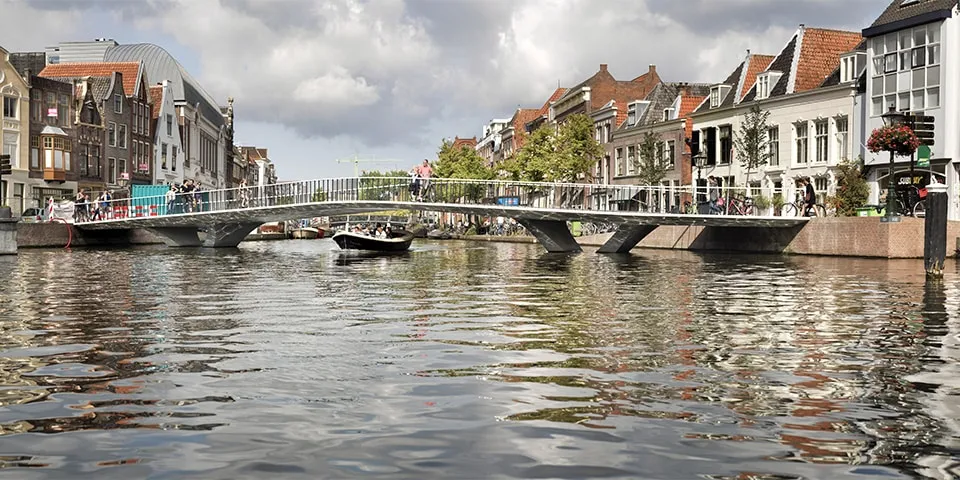
Fibre-reinforced ultra-high-performance concrete (FRUHPC) is already used regularly. Well-known examples include very slender balconies, aesthetic features and stairs in forms that are impossible or difficult to achieve with traditional types of concrete. The use of FRUHPC in civil engineering structures is still in its infancy, although several very slender bridges made from FRUHPC have now been built in the Netherlands using a minimal amount of structural material.
In recent years, various research projects, including graduation projects, have investigated the material properties and behaviour of FRUHPC. These studies clearly show that FRUHPC performs better than traditional types of concrete. Its potential applications in civil engineering structures are promising. Iv-Infra is investigating which civil engineering structures, or parts of them, can benefit from the high performance of FRUHPC.
What is FRUHPC?
Fibre-reinforced ultra-high-performance concrete is an extremely strong and durable type of concrete in which steel fibres replace some or all of the mild steel reinforcement. At first glance, the material looks much like traditional types of concrete. However, there are significant differences in its compressive strength, tensile strength and deformability. These differences have a major impact on the material’s performance and are explained below.
FRUHPC must have a minimum cylinder compressive strength of 150 MPa, compared with 30 to 50 MPa for many commonly used traditional types of concrete. To achieve this high compressive strength, FRUHPC is made from a carefully balanced mix of cement, water, aggregates, fillers and admixtures. This mix produces a refined, dense particle structure in which virtually all voids are filled. Because these voids are filled, forces in FRUHPC are transferred through both the aggregates and the cement paste, unlike in traditional concrete. As well as optimising load transfer, the dense particle structure gives the material low permeability and therefore high resistance to the ingress of water and other harmful substances, even with concrete cover of just 10 to 25 mm, depending on the exposure class of the structure.

Figure 1: Stress-strain diagram for cylinder compressive strength.
Mild steel reinforcement is activated once the concrete section has cracked. In FRUHPC, small fibres are used to increase the tensile strength of the concrete section before it cracks. Because of their size, the small fibres (10 to 20 mm) are tensioned relatively quickly and bridge the microcracks that give the material its higher tensile strength. FRUHPC has a tensile strength of 7 to 15 MPa, compared with just 1.5 to 3.0 MPa for traditional types of concrete.
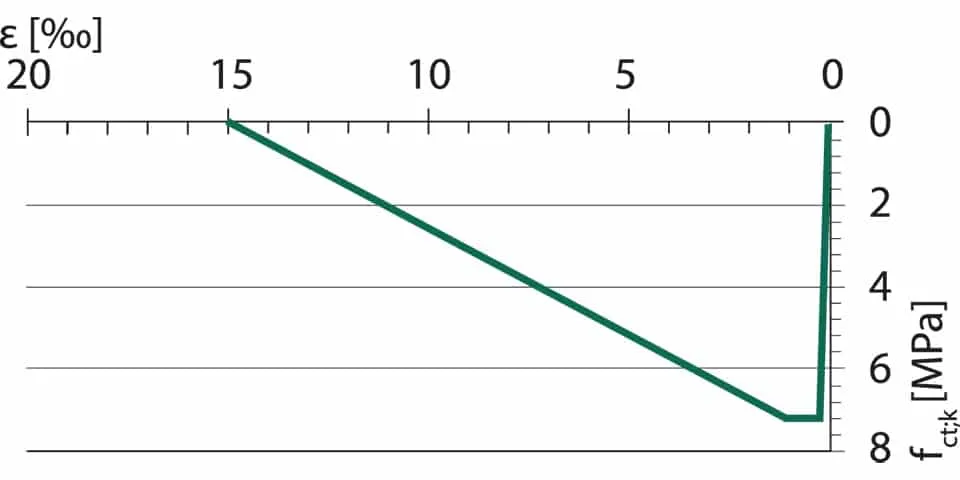
Figure 2: Stress-strain diagram for flexural tensile strength.
By bridging microcracks, the formation of the first macrocrack is delayed. Once the tensile strength is exceeded, the microcracks develop into macrocracks. The concrete is considered cracked from the moment the first macrocrack forms. Cracking always occurs at the weakest point in the material. In traditional concrete, this is the cement paste. In FRUHPC, the cement paste is the strongest component in the particle structure, so cracking occurs through the aggregate.
Long fibres (30 to 60 mm) are used to give the material sufficient deformability and further increase its tensile strength. They become active after the first macrocrack forms. Whereas traditional concrete behaves in a brittle manner and, if unreinforced or insufficiently reinforced, fails without warning, the addition of these long fibres allows FRUHPC to deform to some extent before failure, providing warning beforehand.
Another important property of the long fibres is that they distribute macrocracking finely across the section. This is because the fibres are present ‘everywhere’ in the section, whereas mild steel reinforcement is only effective locally because of the spacing between reinforcing bars.
How do you design with this material?
Since the introduction of the Building Decree 2012, the Eurocodes have been the applicable European standards for producing structurally safe and sound designs. Each country’s standards include additional requirements, parameters, explanatory notes and recommendations set out in national annexes. In the Netherlands, civil concrete structures must meet the requirements of Eurocode 2.
To date, structures made from FRUHPC have fallen partly outside the scope of Eurocode 2, as the standard applies to concrete strength classes up to C90/105 and contains no provisions for reinforcement with steel fibres. Model Code 2020 is currently being drafted, and proposals for designing with FRUHPC will be included. Once verified, these proposals are expected to be incorporated into a new version of the Eurocode, or added to Eurocode 2. Until this new Eurocode is available, the most practical way to design with FRUHPC is to use Eurocode 2, supplemented by recommendations and guidelines where necessary.
As well as differences in standards and regulations, FRUHPC calls for a different design process. A case study and parametric study carried out by Iv-Infra show that, in civil engineering structures made from FRUHPC, different design criteria govern than in structures made from traditional types of concrete. For traditional concrete, crack width is usually the governing criterion because of the 0.2 mm crack-width limit for exposure classes involving de-icing salts.
In the FRUHPC case study, by contrast, the moment capacity proved to be the governing criterion, rather than the crack-width limit. This is due to the fibres’ ability to bridge microcracks and distribute the macrocrack pattern more finely across the concrete surface.
However, compared with traditional types of concrete, greater attention must be paid to comfort requirements relating to vibration and deflection. These requirements rarely cause problems in practice for solid sections made from traditional concrete. In FRUHPC structures, this criterion proves to be one of the most decisive factors in the design.
Figure 3: Relevance of design criteria.
Where does the material offer opportunities?
Although FRUHPC offers improved performance over traditional types of concrete in almost all material properties, it will not replace them entirely. One of the main reasons is cost. In addition to the fibres required, often around 2.5% by volume, and the high cement content, the other additions needed to achieve a balanced mix are expensive. Careful attention is also required in the design, mixing, processing, transport and construction, as well as in the mix composition.
Structural overlays are one civil engineering application in which the material’s high performance can be put to good use. Overlays are a common measure for increasing the load-bearing capacity of existing structures. Thanks to the material’s high performance and the lower concrete cover required, a relatively thin FRUHPC overlay can deliver a substantial increase in capacity. A thin overlay also limits the increase in permanent load on the existing foundation. In addition, an FRUHPC overlay is a durable, wear-resistant solution. The dense particle structure virtually prevents the ingress of de-icing salts and chlorides. The overlay also requires no asphalt or wearing course. All this makes it a durable solution requiring little or no future maintenance.
Question about this story? Ask your question
Keep following this
Get an email when a new story is published. No account needed.
- ThemeMaterials and techniques for infrastructure
- SubjectSpecials







