









Getting to the bottom of things
Text Lieke BousemaImage Vestigia BV
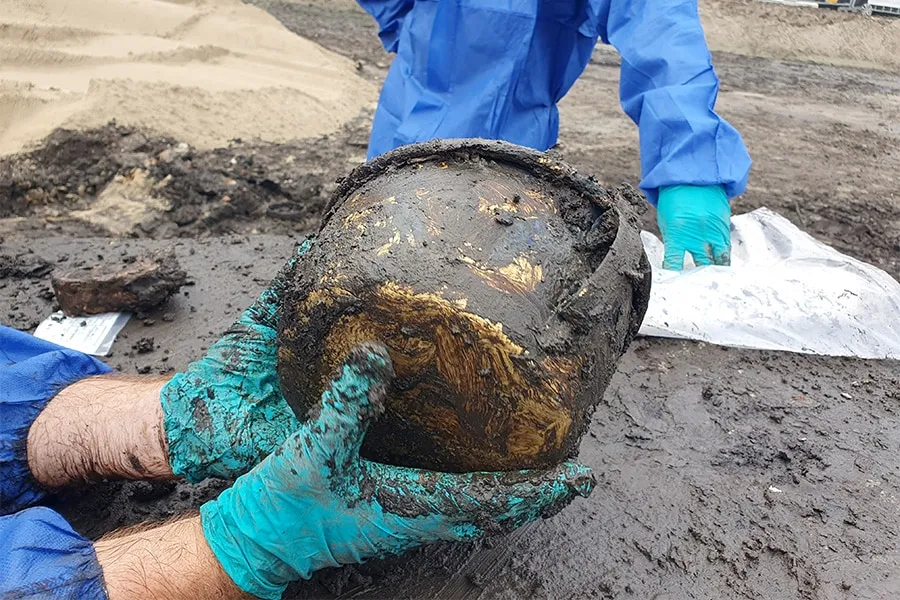
Working below ground can uncover remarkable finds and fascinating stories
The advisers, project managers, researchers and other specialists at consultancy and research firm Vestigia Archeologie & Cultuurhistorie are happy to get their hands dirty. Literally: working below ground can uncover remarkable finds and fascinating stories. This is particularly true on urban sites and in former industrial areas, where history has left clear, tangible traces.
‘Interventions’ in urban areas often involve contaminated soil, foundations of former buildings and other obstructions, such as cables and pipes, which make excavation or soil remediation necessary. These areas have also often been inhabited for centuries, meaning archaeological investigation is required, as Wilfried Hessing and Jeroen Flamman, who jointly run Vestigia, know well. “We help clients coordinate archaeological investigation with other workstreams during site preparation, which can significantly reduce disruption, time and costs.”
Reducing disruption and costs
“We often see an archaeologist brought in only once the ground is being excavated for soil remediation or earthworks,” says Jeroen. “In that case, there is a good chance that workstreams will clash. This is especially true on urban sites, where the challenge is substantial but space is limited. Digging in one location twice and setting the soil aside twice causes too much disruption and costs too much. Both can easily be reduced by planning the process properly from the outset.” To help both clients and contractors with this, Vestigia is keen to join discussions as early as the tendering and planning stages.
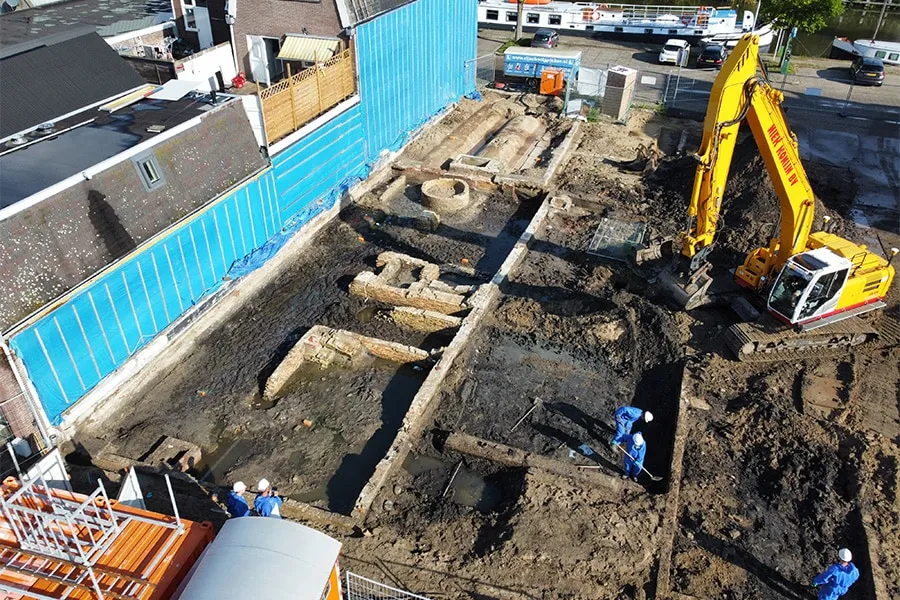
Solving the chicken-and-egg problem
“During the preparatory phase, we use historical data or boreholes to determine with a reasonable degree of certainty whether archaeological remains are present in the ground,” says Wilfried. “If so, we assess whether they are significant enough to warrant documentation. The excavations required for this often take place at sites that are also contaminated. This can quickly create a chicken-and-egg problem. Which comes first? Depending on the specific project, we address this by facilitating either remediation with archaeological supervision or excavation under remediation conditions.”
Discovery of an old brewery
Vestigia recently made the news for this service. At the future site of the De Vijfhoek new-build project in central Purmerend, an almost complete foundation of a former brewery dating from 1640 was uncovered. “We knew that the De Dubbele Arent brewery had existed, but now we also know exactly where it stood,” says Jeroen. “The excavation uncovered the complete foundation. Household items were also found stored in the vaulted cellars, which were carefully documented.”
The unique find attracted considerable interest, including from local residents, who gained a better understanding of the work. “That is exactly the point,” says Wilfried. “By coordinating soil remediation or earthworks with archaeology, developers can give something back to the local community. This is especially true when the ‘roots of the neighbourhood’ are given a prominent place in the new development. An information board or a visible section of the old foundation in the public space can also give a new-build project an extra dimension and identity.”
Question about this story? Ask your question
Keep following this
Get an email when a new story is published. No account needed.
- SubjectSpecials







