Foundations / Site investigation
Foundation repairs for subsiding homes
More and more homes are experiencing foundation problems, reports the Kennis Centrum Aanpak Funderingsproblematiek. Climate change is causing greater fluctuations in groundwater levels throughout the year, with all the consequences that entails. But specific works, such as replacing sewer systems, which can involve temporarily lowering the groundwater level, may also lead to serious problems later on as the ground consolidates. DYWIDAG has developed an interesting method for tackling foundation problems, with minimal economic impact.
DYWIDAG’s prestressing systems have long provided stability for infrastructure structures. But there is much more to infrastructure work. Geotechnical specialists have also been turning to the renowned company for some time. “It started with a project in Amstenrade, Limburg, where we ‘saved’ a number of homes from further subsidence using a unique method,” says Robert Jansen of DYWIDAG. “The damage, cracks caused by subsidence, could be traced back to past mining activities. Several solutions were proposed, but they would have been quite disruptive for residents. They would have caused considerable inconvenience, and there were also doubts about whether the proposed methods would deliver the right results. We were asked to simplify the approach, which led to a completely different method.”
Reducing stress
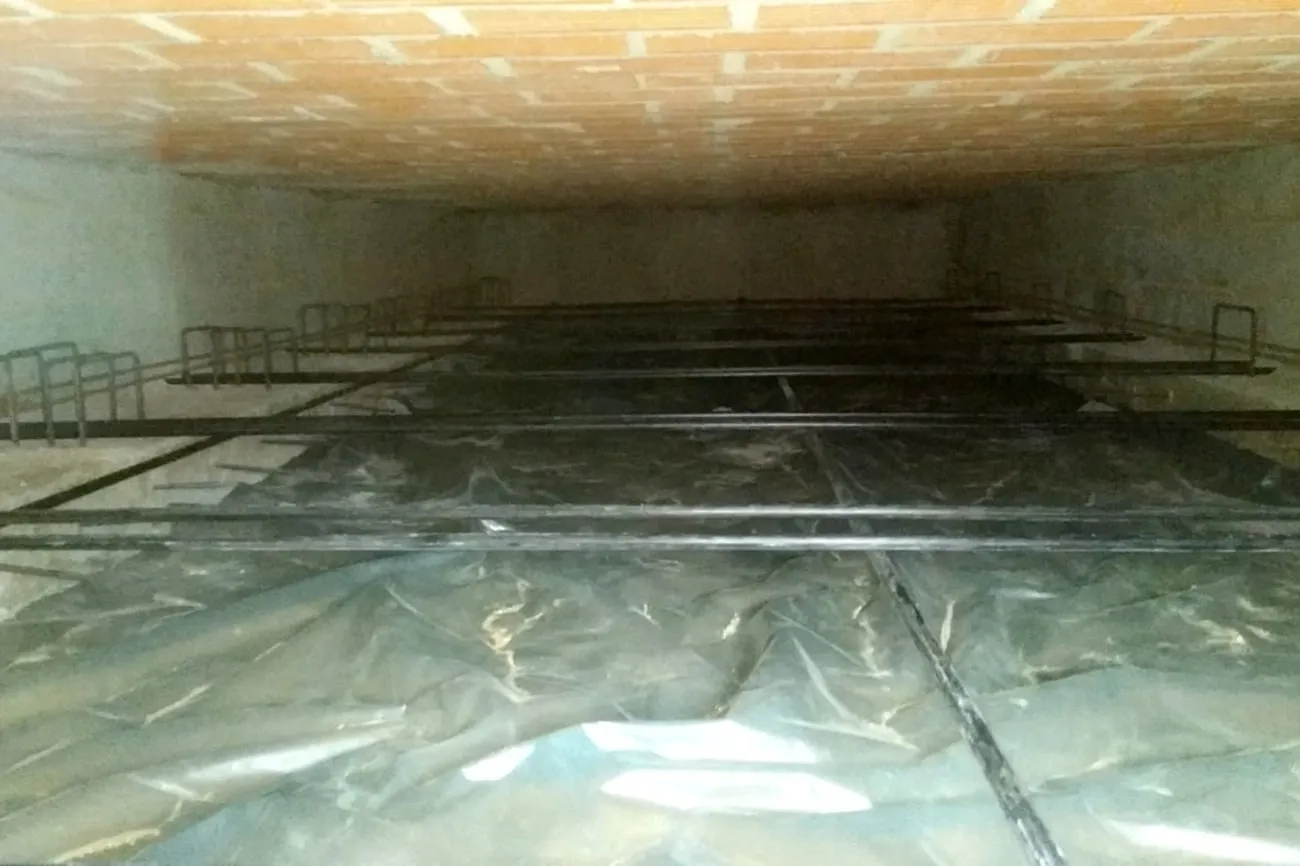
DYWIDAG’s method is suitable for repairing the foundations of terraced homes built on shallow foundations and with a crawl space. It works by reducing the stress beneath the foundation. “We do this by increasing the foundation area, in other words by partially filling the crawl space with concrete and prestressing it with the DYWIDAG single-strand VZA system,” explains Jansen. “This creates a much larger area, considerably reducing the ground pressure, while adding very little mass in proportion. If local settlement occurs again, the foundations beneath the homes act as one large slab, making cracking highly unlikely. The loads are now distributed over a much larger area. The first project in Amstenrade was assessed geotechnically by Geonius. The conclusion was that ground pressure had fallen sufficiently to create a stable row of homes. Localised settlement has no impact.”
Stable perimeter beam
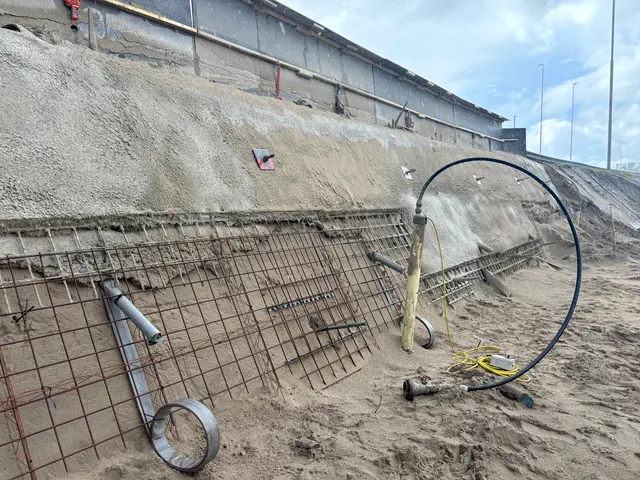
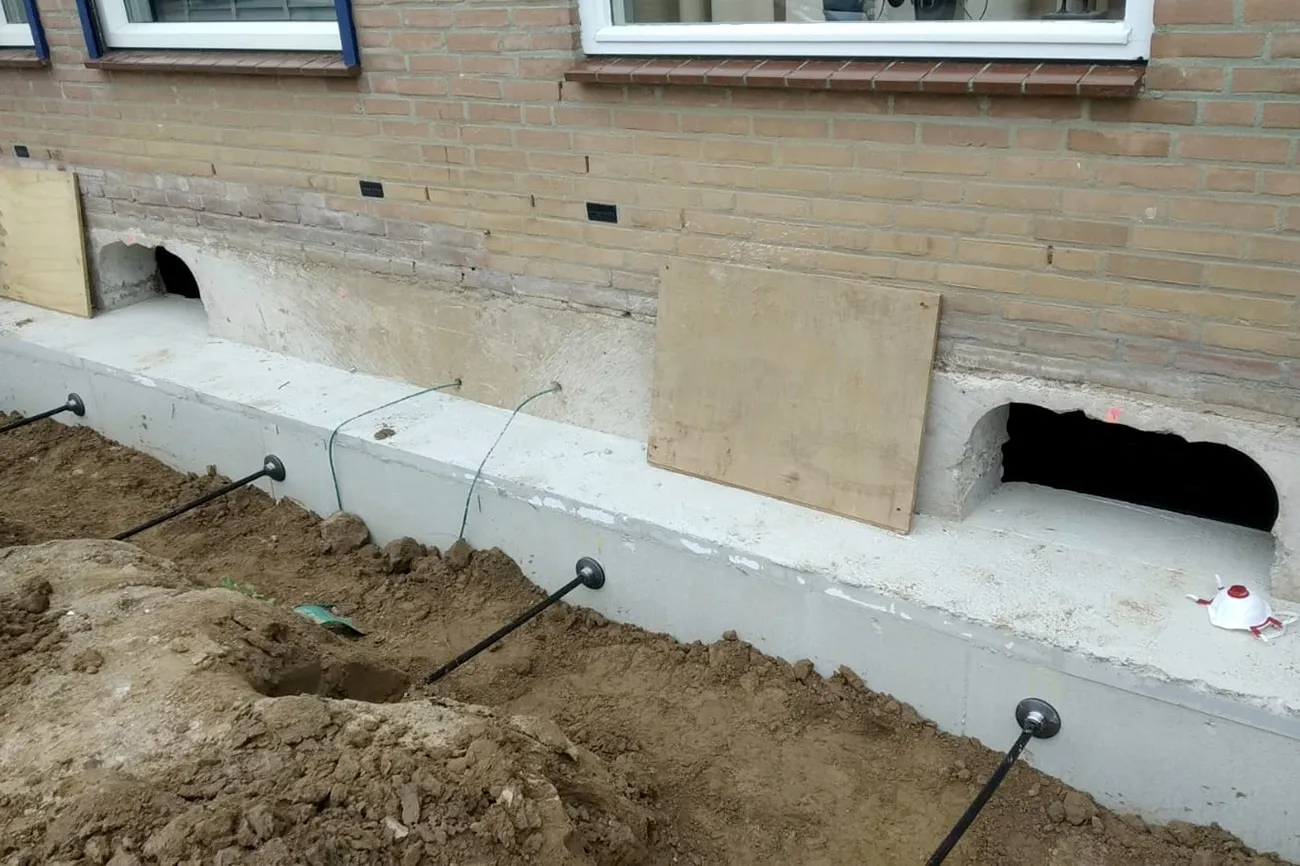
DYWIDAG has now strengthened several rows of terraced houses in Amstenrade. The solution has been officially recognised by the Stichting Calamiteitenfonds Mijnwaterschade. It has also attracted attention in the market. “We are currently strengthening 81 terraced homes in the municipality of Rhoden, Drenthe. The groundwater level was temporarily lowered to install a high-pressure pipeline. It was expected to return to its former level, but that did not happen, causing the ground to consolidate and resulting in subsidence and cracking. We are using the same method here. We dig a trench around the homes and make openings in the masonry to access the crawl space from outside. We then fill the crawl space to a certain height, so that residents can still access it. Next, we pour concrete into the trench to create a stable perimeter beam, which anchors the old strip foundation and the new floor.”
Apart from having to walk along planks to reach their front doors, residents are not inconvenienced by the work. “We can repair subsided foundations with minimal economic impact, and we are now also a ‘partner’ of the Kennis Centrum Aanpak Funderingsproblematiek. The government is currently focused on building 900,000 homes, but alongside that, 700,000 homes also need to be repaired because of changing groundwater levels.”
Question about this story? Ask your question
Keep following this
Get an email when a new story is published. No account needed.
- ThemeUnderground construction
- SubjectFoundations / Site investigation