Foundations / Site investigation
Flexible piling with zero emissions
Text Armand LandmanImage Dieseko Group
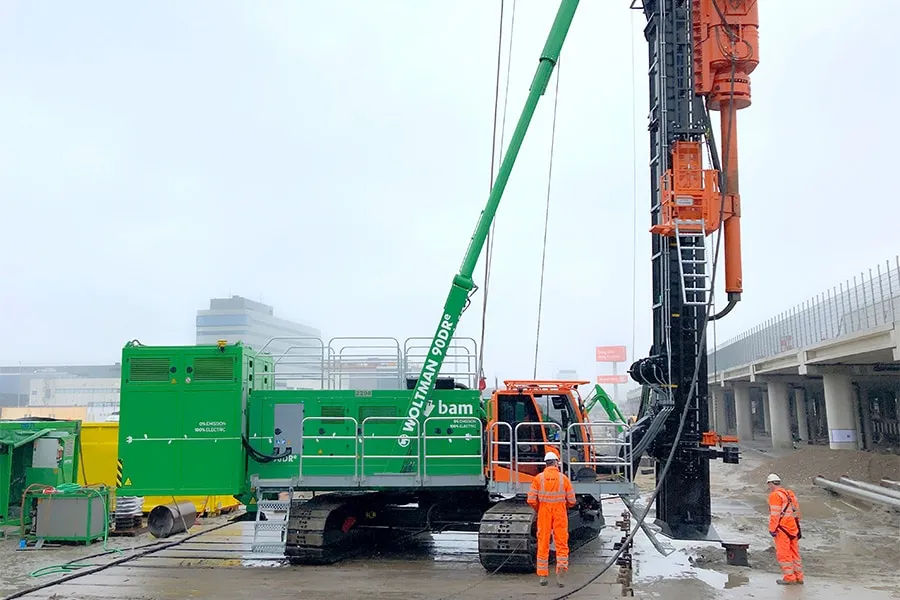
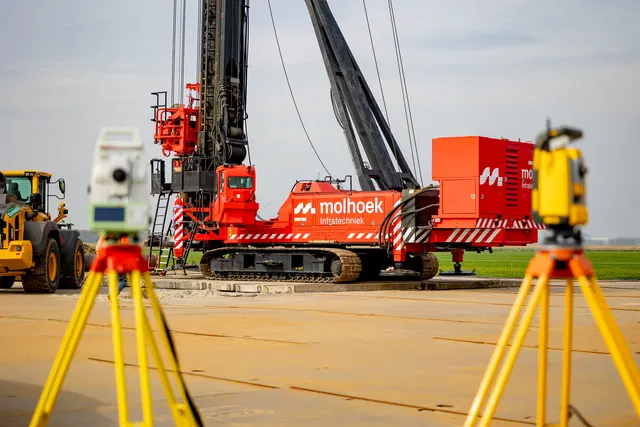
“Dieseko Group aims to be a leading supplier of environmentally friendly, circular foundation solutions that have a positive impact on the world,” says Douwe Feenstra, marketing manager at the foundation specialist based in Sliedrecht. “The electrically powered Woltman 90DR-e piling rig, developed with BAM Infra Nederland, is one example.”
And what an example. The conventional, diesel-powered 90DR has long been Woltman’s best-selling piling rig. Woltman has been part of Dieseko Group since 2016. “However, our customers are increasingly facing stricter requirements on emissions, noise and vibration,” Douwe explains. “We found a launching customer in BAM, which was prepared to invest in an electric machine.”
“That’s right,” says Jan Kardux, manager of Foundation Engineering at BAM Infra Nederland. “Clients are increasingly requiring us to work emission-free at more and more sites. But there was no electric piling rig with the same capabilities as Woltman’s 90DR. So we sat down together to develop one.”
BAM’s main requirement was an electrically powered piling rig capable of doing at least as much as the conventional machine. “And it had to be operational within a year,” Jan adds. “We wanted to use it on a project at Schiphol, and we made it. This spring, the 90DR-e worked there to our complete satisfaction, and we are now using it on a project in Rotterdam. There, too, the requirement was to carry out piling works without emissions.”
More power
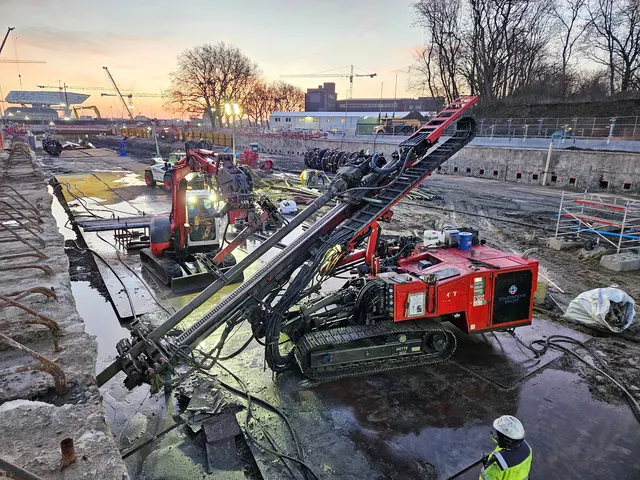
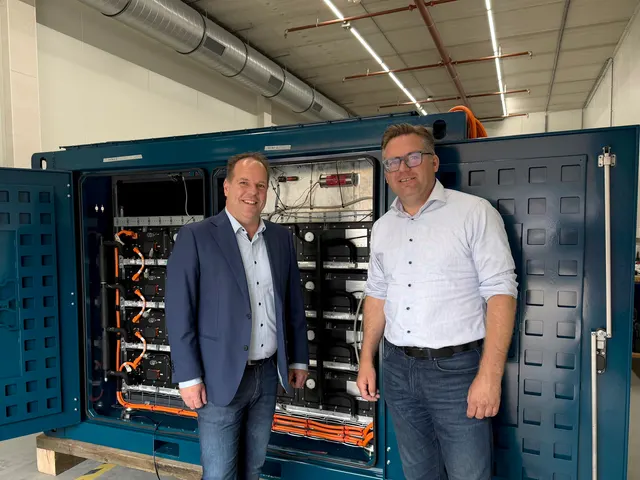
The Woltman 90DR-e, built in close collaboration with BAM in just under 12 months, actually has more power than the traditional Woltman DR90: 615 kW compared with 560 kW. The crane has a built-in 200 kWh battery and a separate 1.0 MWh battery pack mounted at the rear. The built-in battery enables the crane to manoeuvre independently and raise its mast. The large battery pack at the rear supplies power to the hydraulic drive for the drilling motor and also serves as a 15-tonne counterweight. “It saves us around 500 litres of diesel a day,” says Jan. “That adds up to a saving of no less than 212,000 kilograms of CO2 a year.”
The drilling motor on the Woltman 90DR-e is still hydraulically powered because BAM wanted it to be interchangeable with other existing foundation tools, such as a vibratory hammer. This fits with the philosophy of both BAM and Dieseko: to develop solutions that allow equipment that has not yet reached the end of its service life to be used without emissions. One idea is to equip a conventional crane with an electro-hydraulic power unit.
According to Jan, BAM is very satisfied with the Woltman DR90-e. “BAM aims to work entirely emission-free by 2030. This machine is a major step towards that goal. I therefore expect it certainly won’t be BAM’s last electric piling rig. Operators also tell me it is very pleasant to work with. Apart from the tracks and the beeping travel alarm, you can hardly hear a thing. The comfort of low noise and no emissions makes the working environment much healthier for our people, and means we can also use the machine in urban areas. And given the fuel savings, the extra cost over its entire service life is manageable. The same applies to the price premium for using this electric machine on a project: the difference between a 90DR and a 90DR-e is much smaller than many people think beforehand.”
Foundations of the future
Dieseko’s investment in developing zero-emission solutions for the heaviest applications, while retaining maximum flexibility in tool interchange, energy sources and investment, is part of its ‘Founding the Future’ strategy. Douwe says: “The strategy focuses on five areas: noise reduction, low-vibration or vibration-free piling, remote control, offshore foundations and zero emissions. These are the challenges our customers are working with and addressing.”
Power units
The 100% emission-free Woltman 90DR-e still requires a substantial investment, which may deter many companies, particularly in today’s uncertain market. Moreover, many piling rigs on the market are nowhere near the end of their technical service life, which can stand in the way of switching to emission-free operations.
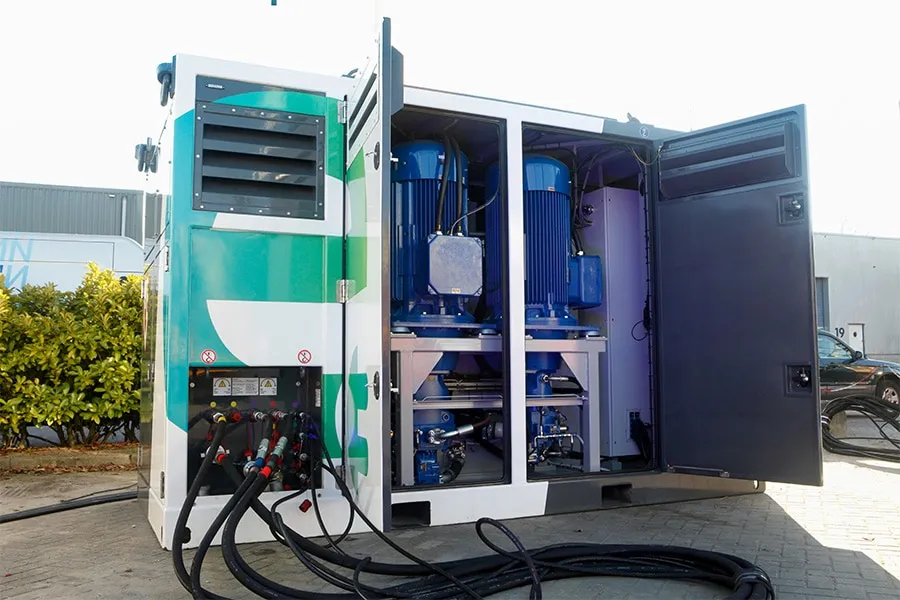
For this reason, Dieseko has developed a range of Electric Hydraulic Power Units (EHPUs). These can power existing hydraulic machines without emissions. Several models are available, and they are not just for Dieseko’s foundation tools. “It’s plug and play,” Douwe explains. “A power unit consists of a container housing electric motors and pumps that drive the hydraulic system of, for example, a pile driver, a vibratory hammer or even a crane. The units can be powered from the grid or, where there is no connection, by battery containers. We deliberately chose standard connections so anyone can use them.” The power units can also be linked together to provide extra power.
In time, the attachments used with drilling and piling rigs will also go electric. In 2024, Dieseko will launch its first electric vibratory hammer, the 24VMe. Dieseko expects it to deliver energy savings of up to 25% compared with a hydraulic vibratory hammer. Special asynchronous, liquid-cooled, high-frequency (250 Hz) electric motors with carbon-reinforced windings have been developed to withstand the enormous G-forces to which the motors are subjected. A prototype will be displayed at the forthcoming Matexpo.
World first
At Matexpo, Dieseko will showcase not only the electric 24VMe vibratory hammer, but also a completely new, patent-pending Pile Lifting Device. This handy tool makes it easy to pick up horizontal pipes and lift them beneath the vibratory hammer, without using an additional crane. This saves time, energy and money. The PLD 100T is mounted on the outer end of the vibratory hammer, with the pipe attached to two chains. Once lifted and hanging freely, the vibratory hammer’s jaws are positioned precisely around the pipe by extending the hydraulic cylinders. Within minutes, the pipe is perfectly positioned and ready to be driven into the ground by vibration. The system clearly makes pipe installation much more efficient.
Making equipment more sustainable
BAM is continually looking for ways to make a positive environmental impact in the areas where it works and help build a better Netherlands. Its investment in further electrifying construction machinery is in line with BAM’s ‘Building a sustainable tomorrow’ strategy, which centres on sustainability, digitalisation and industrialisation. In December 2022, for example, BAM deployed the first fully emission-free large asphalt paving train, comprising an electric roller, electric asphalt paver, electric tandem roller, electric small roller, hybrid tack coat sprayer and electric site cabin. In September 2022, it also unveiled the first asphalt paver powered by a hydrogen combustion engine.
A business enquiry for Dieseko Group? Get in touch
Companies in this story
Keep following this
Get an email when a new story is published. No account needed.
- ThemeUnderground construction
- SubjectFoundations / Site investigation
- CompanyDieseko Group