Foundations / Site investigation
Controlled lifting of foundations and concrete structures with minimal disruption
For almost thirty years, URETEK has been restoring settled foundations and concrete structures to their original position. Its injection method is unique and ideally suited to controlled lifting in a short time and with minimal disruption, for example of a settled railway crossing, Harmelen slabs, tram tracks or bridge and viaduct approach slabs. We spoke to Arend Knufman, Technical Manager at URETEK Benelux, about the unique injection technique.
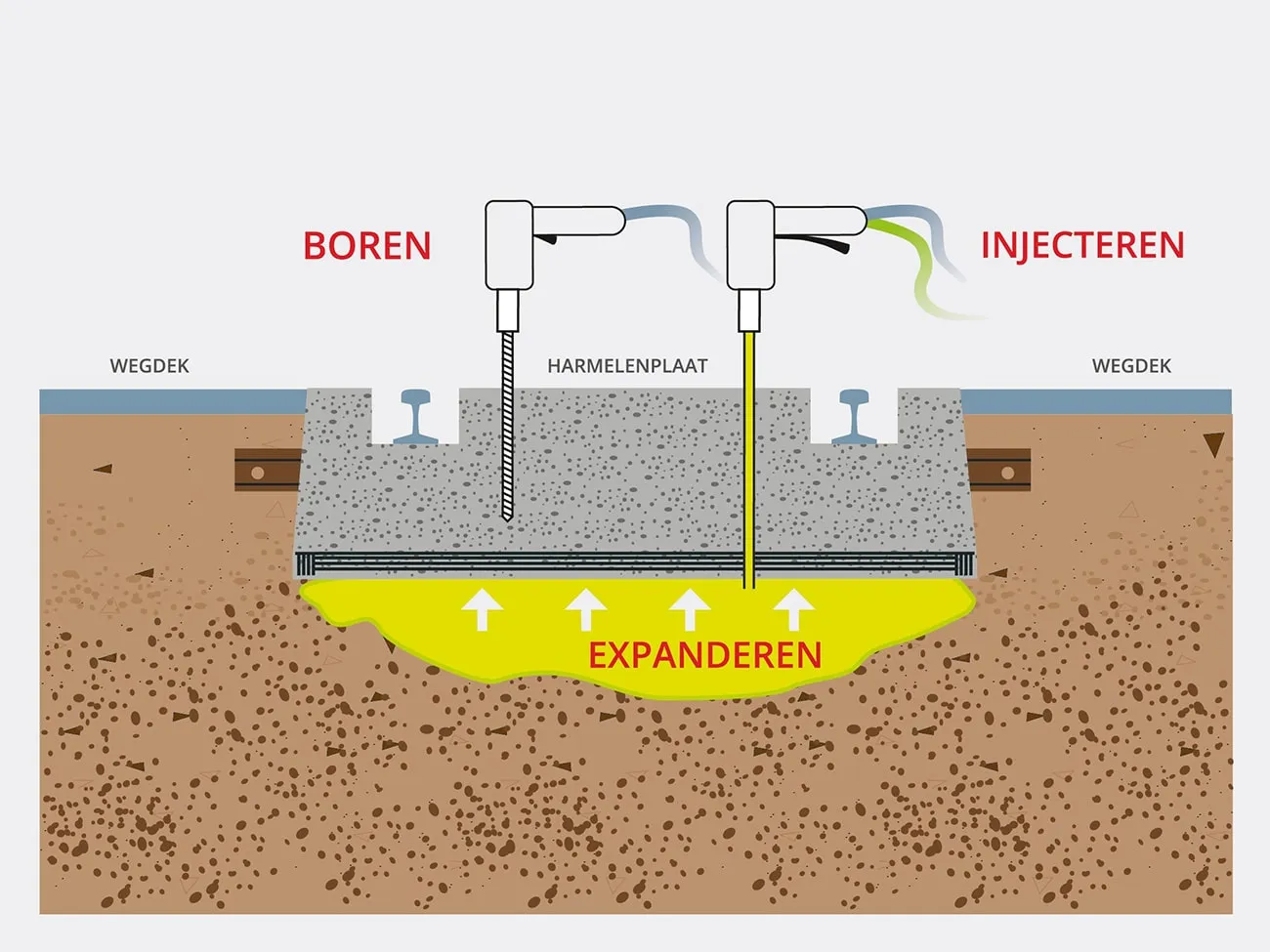
The revolutionary method for lifting settled foundations and concrete structures is based on injection technology using an expansive two-component resin. This resin is the ‘secret of the trade’. “Within just fifteen seconds, the resin expands to 33 times its original volume. Thanks to this enormous expansive force, we can lift structures carrying up to 50 tonnes/m2. It would take a lot for us not to succeed,” says Knufman. “Our vehicles are equipped with two injection guns, enabling us to correct the tilt of a foundation or concrete structure quickly and in a controlled manner on site.”
Three variants
URETEK distinguishes between three variants: deepinjection, powerpile and floorlift. “The first was specifically developed to stabilise settled foundations of structures founded on shallow footings, while the powerpile method is primarily aimed at correcting settled and unstable foundations on soft clay and peat soils,” Knufman explains. “The floorlift method, meanwhile, has a wide range of applications and is suitable for remedying settlement in concrete structures. These include commercial and other floors, stabilising joints and expansion joints, machine foundations, road pavements and railways. By applying the injection resin directly beneath the concrete structures, they are stabilised or lifted back to their original level. The latter is a particularly popular application in the infrastructure sector. Infrastructure contractors make good use of our fast and effective injection techniques.”

Years of expertise
With the floorlift method, URETEK Benelux drills small holes, just 12 millimetres in diameter, through the concrete structure in a specific pattern. “The pattern naturally depends on the nature of the settlement,” Knufman continues. “We inject our expansive two-component resin through these holes. Any voids beneath the concrete structure are filled, the ground below is compacted and the structure is then raised in a controlled manner. Depending on the size of the project, it takes just a few hours to restore, for example, Harmelen slabs at a railway crossing to their original position. Bear in mind that these are substantial weights. Harmelen slabs are often 2.5 metres wide, 6 or 9 metres long and 60 centimetres thick. Lifting these structures takes considerable expertise and experience, but our people are more than capable. We correct the tilt to an accuracy of half a millimetre. By the time we have packed away our equipment, the resin has already cured by 90%. The lifted structure can be trafficked almost immediately.”
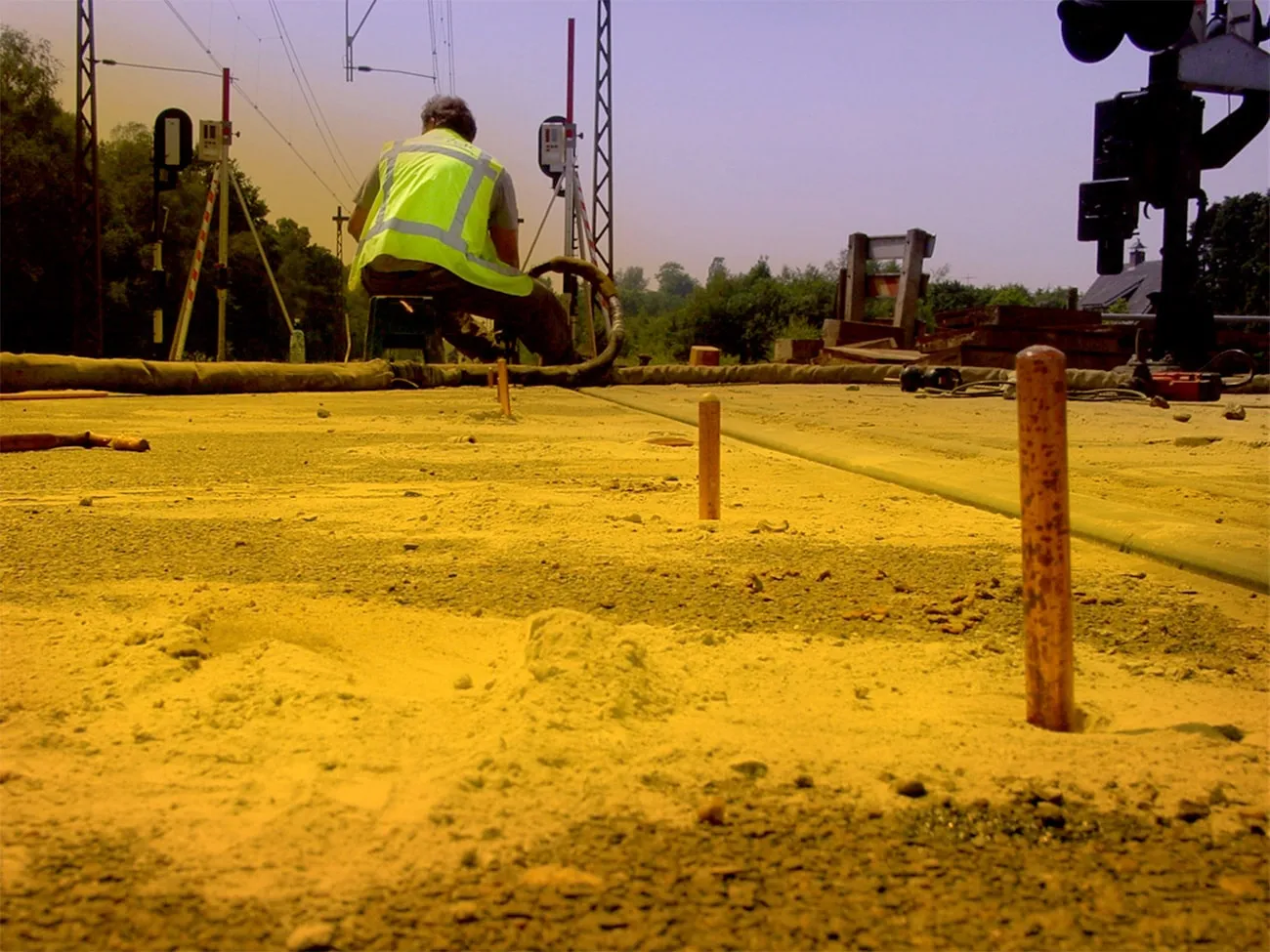
In a rail environment, where work is often carried out during short possessions, the floorlift method offers considerable added value. Knufman says: “Correcting the problem using traditional methods takes far more time and labour. That often does not fit the schedule. Possessions are also getting shorter and shorter. The same method is also ideal for underpinning and lifting approach slabs at bridges and viaducts.” The injection technique can be used in almost all types of soil, is reliable and fast, and causes minimal disruption.
Question about this story? Ask your question
Keep following this
Get an email when a new story is published. No account needed.
- ThemeExtending the life of roads and civil engineering structures
- SubjectFoundations / Site investigation