









Drinking water main rehabilitated without excavation
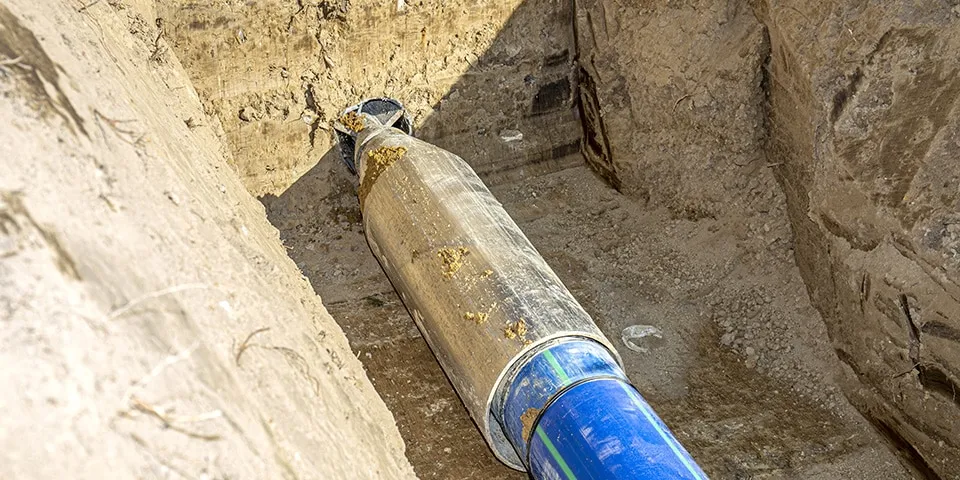
In Bad Hall, one of the oldest drinking water mains still in service needs to be replaced. The old 250 mm diameter fibre-cement pipe has been operating at its capacity limit for some time. In addition, several pipe bursts have had to be repaired over the years. AGRU protective-casing pipes with a diameter of 315 mm and SDR 17 are now being installed as replacements using the pipe-bursting method. This ground-friendly rehabilitation technique avoids having to remove the old pipeline and ensures that the new pipeline follows exactly the route of the original.
A 450 m-long 280 mm diameter rising main to the Voglhub elevated reservoir and a 1,800 m-long 315 mm diameter transmission main, with a branch from this reservoir, are to be installed. On its way to the Pfaffenwimm elevated reservoir, the transmission main overcomes a difference in elevation of 17 metres, and pressure in the pipeline system reaches 5.5 bar at its lowest point.
The last fibre-cement pipe was installed in 1979
“Unfortunately, there have been a few pipe bursts in this area in recent years,” says Anton Pöllabauer, director of the Bad Hall Kurbezirk Waterverband. As the person responsible for maintaining the new PE pipeline system, quality and service life are very important to him: “The last fibre-cement pipe was installed in 1979. However, for more than 20 years we have installed only AGRU PE pipe systems. We have rehabilitated older water mains with AGRU protective-casing pipes using pipe-bursting and ploughing methods, and have had very good experiences with them. We expect the newly installed pipes to have a service life of at least 50 years.”
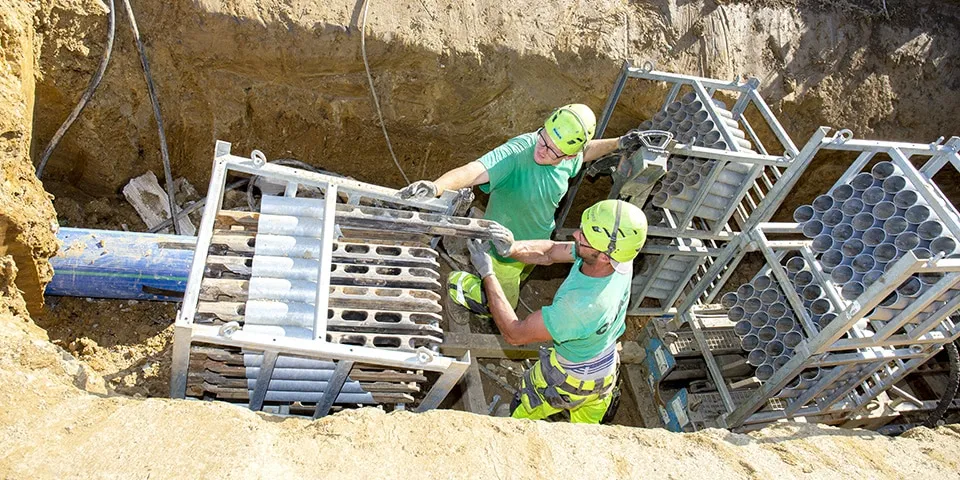
In the reception pit, the sections of pull rod are removed from the machine and stacked
Lower installation costs thanks to long pipe strings
The pipe-bursting method is being used again to ensure the most economical installation possible. The principle is that installation costs decrease as the length of the pipe strings being pulled in increases. The contractor, WDS Bau GmbH, an Upper Austrian civil engineering specialist known for its careful pipeline installation, calculates the maximum insertion lengths between the launch and reception pits based on ground conditions and the resulting tensile forces, which can reach 250 bar. Pipe strings up to 144 m long are made on site by butt-welding 18 m-long protective-casing pipes supplied by AGRU Kunststofftechnik GmbH. Sureline III pipes with a protective casing provide double security, as the stress-crack-resistant PE 100-RC core pipe is protected from fragments of the burst pipe by a scratch-resistant PP casing when the pipe is clamped. Another advantage is the fast butt welding made possible by the factory-stripped pipe ends. AGRU Kunststofftechnik supplied a CNC-controlled butt-welding machine for the welding process. With the new technology, temperature, pressure and time are pre-programmed, ensuring the quality of the welds. The parameters for each individual weld and the welder’s name are also documented. The finished pipe strings are then pulled into the old pipe using a tear-resistant lining. Pipe bursting is a cost-effective method of rehabilitating pipelines made of brittle materials without excavation. By breaking up the old pipe, a new pipe with a significantly larger diameter can be pulled in. Some preparatory work is required.
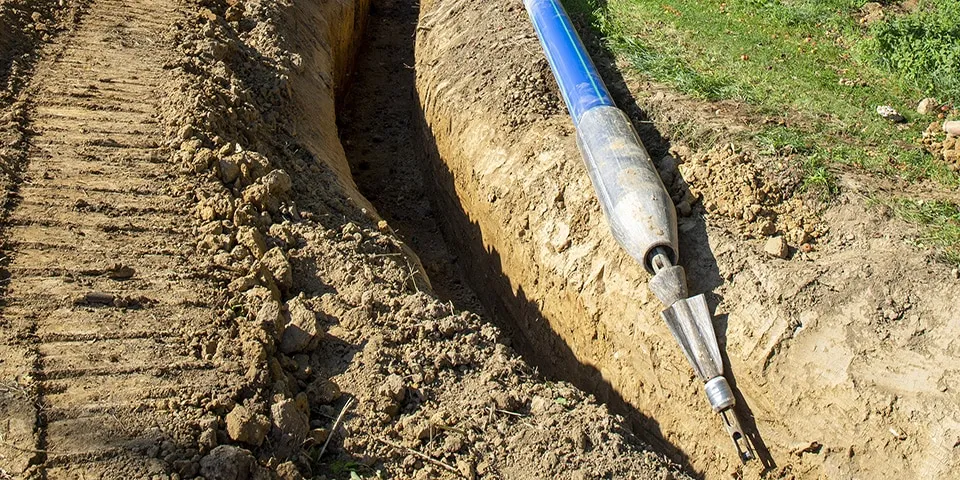
The bursting head and expansion cone are already fitted to the pipe
Pipe bursting: how it works
First, a camera is used to inspect the old pipeline. Metal fittings or those made of cast concrete cannot be broken up and must therefore be removed using the open-cut method. The launch and reception pits are then excavated at precisely specified intervals. The bursting head, with its expansion cone, is positioned in the launch pit, with the pipe string to be pulled in attached to it. A hydraulic pulling unit is located in the reception pit. A pull rod made up of numerous sections is inserted into the old pipe between the two pits. The hydraulic cylinder’s stroke corresponds exactly to the length of one section of the pull rod. The bursting head is now attached to one end of the pull rod, while the other end is connected to the pulling unit. As the rod is pulled, the bursting head breaks the cement pipe into pieces. The expansion cone that follows pushes the resulting fragments into the surrounding ground, making room for the larger-diameter replacement pipe behind it. In this way, the old pipe can be broken up in one operation, the channel enlarged and the new pipe pulled in. After each pull, the site team in the reception pit removes the new section of pull rod from the pit. The process is repeated until the bursting head and the pipe behind it finally reach the reception pit. The tensile forces acting on the pipe are electronically recorded and documented throughout. Once installation is complete, the entire pipeline system is disinfected and pressure-tested.
Gerhard Dieringer is director of WDS Bau GmbH: “The welding machine supplied by AGRU worked perfectly. We divided the site into 12 sections for pipe bursting. We were able to burst and install 1 to 2 sections per day. We were very satisfied with AGRU Kunststofftechnik GmbH’s products and services, from preparation through to delivery and quality.”
Question about this story? Ask your question
Keep following this
Get an email when a new story is published. No account needed.
- SubjectSpecials







