









A striking ribbon of silence winds through Utrecht
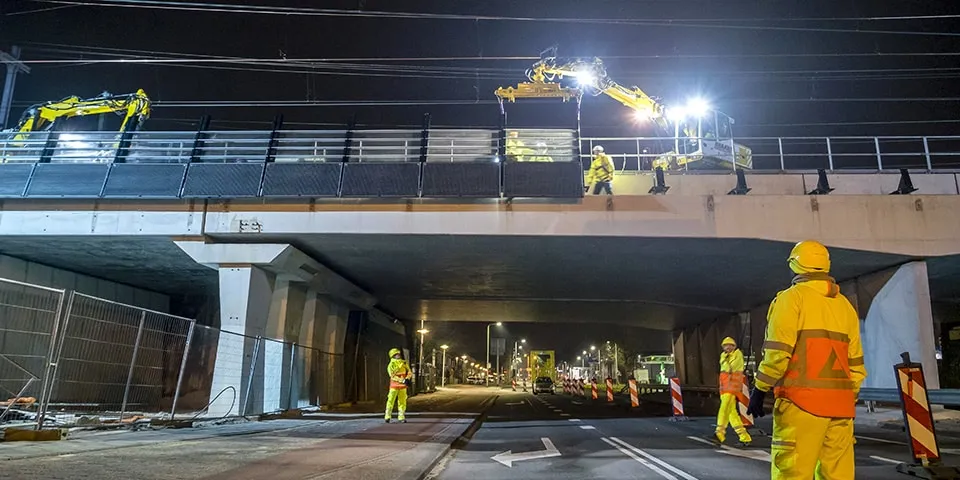
Noise reduction is important in residential areas to safeguard quality of life. For this reason, ProRail included a 1,200-metre-long noise barrier in the ‘UtARK’ project. The project will double the number of tracks between Utrecht Centraal and Leidsche Rijn from two to four. Alongside the track works, construction of structures and a bridge carried out by BAM, the national government also required noise mitigation measures along this route. As a result, noise barriers had to be built.
Following a tender, ProRail put the design and construction of the noise barriers out to market as a separate project. ProRail stipulated that the construction work had to be carried out at the same time as the works being undertaken by BAM. Knipscheer Rail-Infra is responsible for building the noise barriers as part of UtARK. We speak to Arjan Beens, the company’s operations manager, about this special project.
Vibration-free working to minimise disruption
“You can see the barrier we have just built in several places in Utrecht. Designed by an architect, these noise barriers wind their way through the city. They all have a uniform appearance, but each has its own individual design, and they are resistant to graffiti and vandalism,” Beens begins. “First, we installed the steel foundation piles for this noise barrier ourselves. The work was carried out without vibration to avoid disturbing the surrounding area. A concrete capping beam was installed on the piles, with modular steel extensions mounted on top, incorporating transparent panels and aluminium beams.”
Knipscheer Rail-Infra installed one of the first noise barriers in this series back in 2008. “The barrier has now been built as part of the UtARK project. It is 1,200 metres long in total, with heights ranging from 1.5 to 4.5 metres. Its sound insulation is 30 dB, bringing train noise down to an acceptable level for the residential area behind it,” Beens explains.
A contractual marriage with a ‘golden touch’
The noise barrier was completed on 31 January this year. Beens is very pleased with the collaboration with BAM: “This was the first time we had worked with BAM as a subcontractor in such a confined space. We entered into a contractual marriage, and it worked out well for both parties. Cooperation on site was extremely pleasant, thanks in part to clear communication and direct lines of contact on both sides.”
Question about this story? Ask your question
Keep following this
Get an email when a new story is published. No account needed.
- SubjectSpecials







