









800-millimetre-wide CSM walls: no mean feat
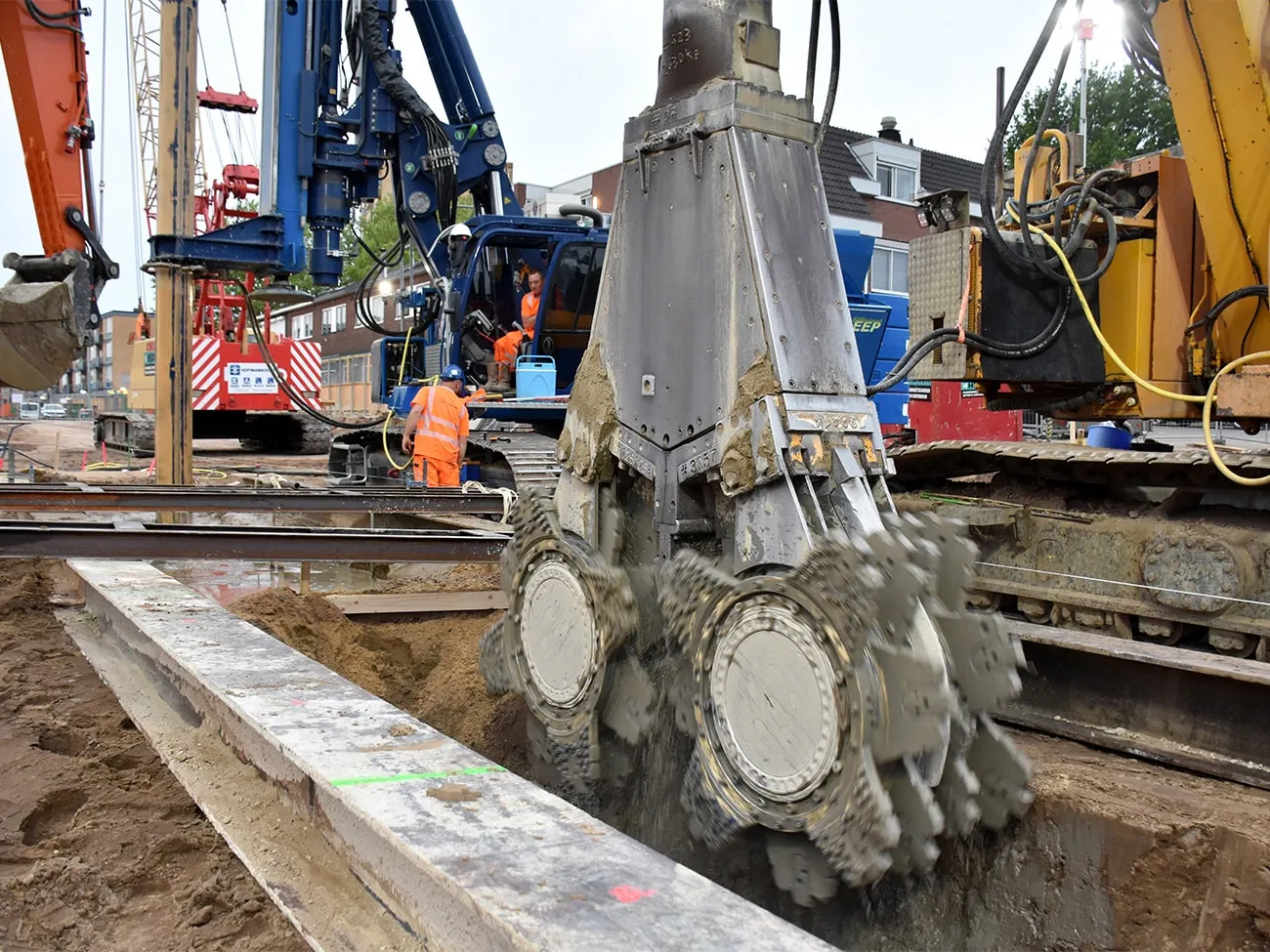
The twin underpass being built in Hilversum as part of the HOV in ’t Gooi project is a technical tour de force. “CSM proved to be the safest and most economical solution for constructing the two-level underpass in a densely built-up area,” says Michael Grondijs, technical adviser at Hoffmann Groep, which is responsible for constructing the CSM walls on the project.
The heaviest category
Given the depth of the underpass and the limited space between it and the adjacent buildings, stringent requirements were set for the deflection and movement of the CSM wall. “A conventional 550-millimetre CSM wall proved inadequate in some areas,” says Melwin Dröse, project manager at Hoffmann Groep. “We are the only company with enough machines to mill walls 800 mm thick, significantly reducing deflection and thereby preventing possible damage to neighbouring buildings founded on shallow foundations. Another unusual feature of this project is the substantial reinforcement. IPE sections of up to 450 mm are normally used, but here HEB 700 beams, 17 to 18 metres long, were also installed. They are extremely heavy and extremely difficult to install within tolerances and quality requirements of just a few centimetres. In addition, we had to construct the walls alongside the railway during a planned line closure. This had never been done before using CSM, but it was highly successful. This was thanks to meticulous preparation and the efforts of several teams, who operated the machines 24/7.”
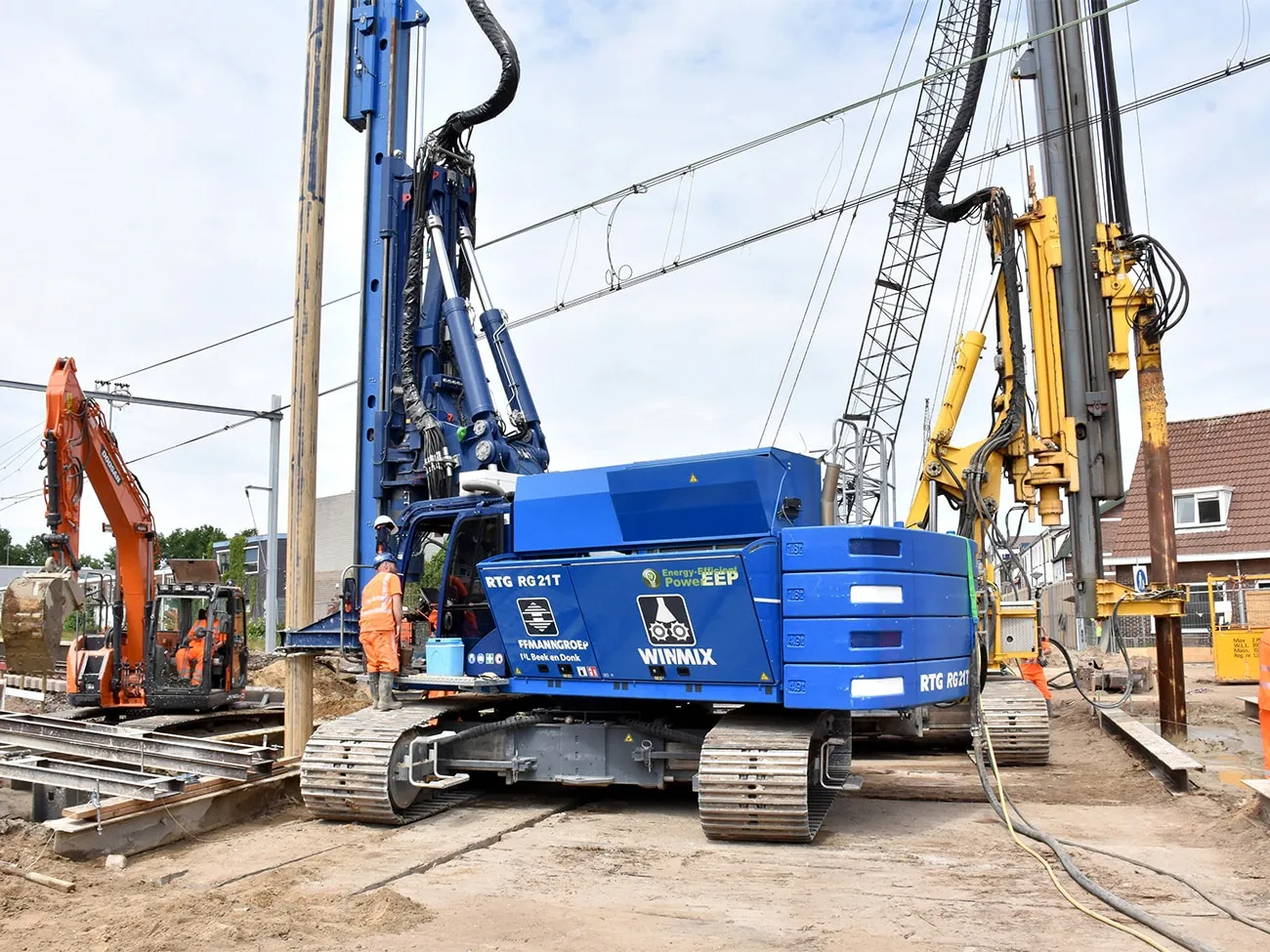
Hoffmann Groep constructed a total of 690 linear metres of CSM walls. “Most of them are 800 millimetres thick, with a small section built using the conventional method,” Dröse explains. “The CSM walls were milled to depths of up to 20 metres, while the retaining depth ranges from 6.50 to 14.70 metres. These are considerable depths. Another advantage of the soil mixing technique is that it offers a better chance of reaching the required depth than pressing in a sheet-pile wall. The soil is milled loose, after all. Another benefit is that no voids are created, so there is no settlement and we can work right alongside buildings founded on shallow foundations.” Hoffmann Groep pioneered the Cuttersoilmix system and developed the prototype further in collaboration with the manufacturer. “We have the longest experience of this technique anywhere in the world. Thanks in part to the excellent cooperation with BAM Infra and all the subcontractors, the HOV in ’t Gooi project was a great success for us.”
Een zakelijke vraag aan Hoffmann Groep? Get in touch
Who worked on it
Double underpass Hilversum in Hilversum
- CSM-wanden
 Hoffmann Groep
Keep following this
Get an email when a new story is published. No account needed.
- ProjectDouble underpass Hilversum
- SubjectSpecials
- CompanyHoffmann Groep







