









“We work together to make the sustainable station the showcase for rail and its surroundings”
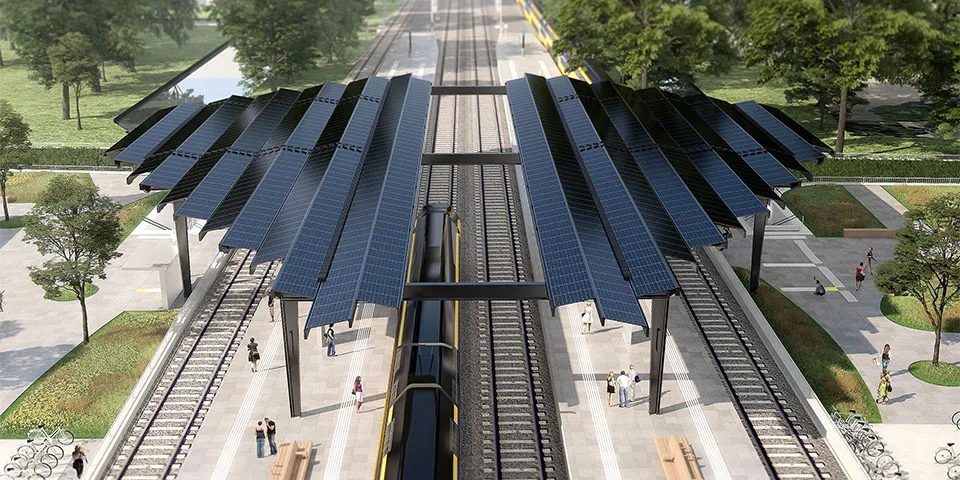
Railway stations have traditionally evoked a special feeling. They are places where people come together, only to go their separate ways a little later. In the past, travelling by train was something special, as it was the first affordable way for large numbers of people to travel longer distances. Working on the railway was a prestigious profession and, as well as providing a safe place to board a train, a station was also somewhere travellers could enjoy hospitality and service.
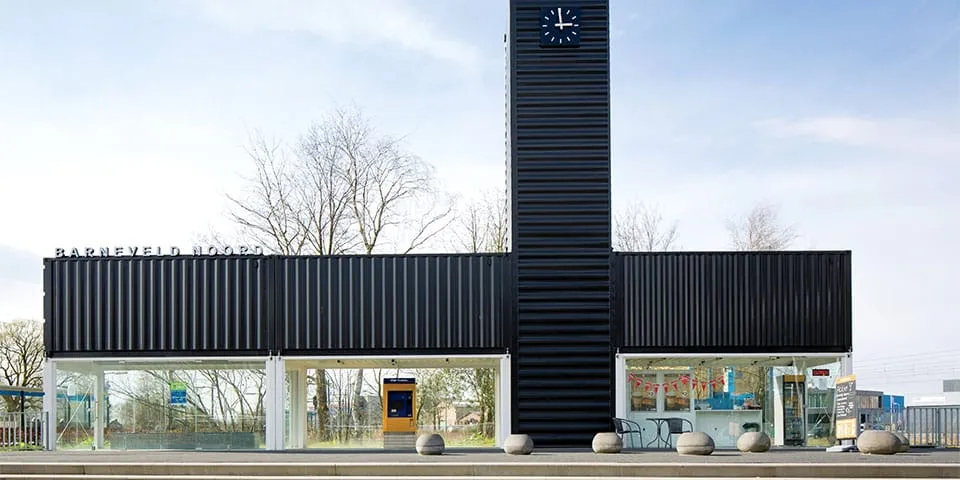
Barneveld Noord station, built from shipping containers. How circular can you get?
And do you know what is so good about it? That has never really changed. “We work together to make the station the showcase for rail and its surroundings,” says Astrid Bunt, Director of Stations at ProRail. What has changed, however, is the approach to designing, building and managing stations. Sustainability and circularity have become the new benchmarks. We make the most of these themes at every stage in a station’s life. We have developed sustainability guidelines for station design, and we use the so-called station sustainability scan at every existing station. We have made it part of the application of the Sustainable GWW approach. We are therefore constantly looking for ways to make stations more sustainable.”
Stations play a central role in people’s lives today
“Today’s station is a multimodal hub, especially compared with the past,” Astrid explains. “A station’s main function used to be simply getting on and off the train. Stations were usually located outside the centre, on the edge of a town or village. Today, stations are vibrant hubs for making connections. They are more centrally located, partly because towns and cities have grown closer to them, and they provide links across the wider public transport network. Travellers are offered trains, buses, trams, the metro, taxis and shared bikes to make their journeys as seamless as possible.”
With the addition of hospitality venues, workspaces, meeting places and even residential facilities, stations now play a central role in people’s lives. “The current trend is for a station to be a catalyst for development that extends beyond the station’s own cadastral boundaries,” Astrid continues. “The surrounding area develops along with the station, particularly at major hubs. This outward-reaching development is gradually blurring the boundary between the station area and its surroundings. It is a positive, gentle integration, which is why the station really is a showcase for its surroundings and for rail.”
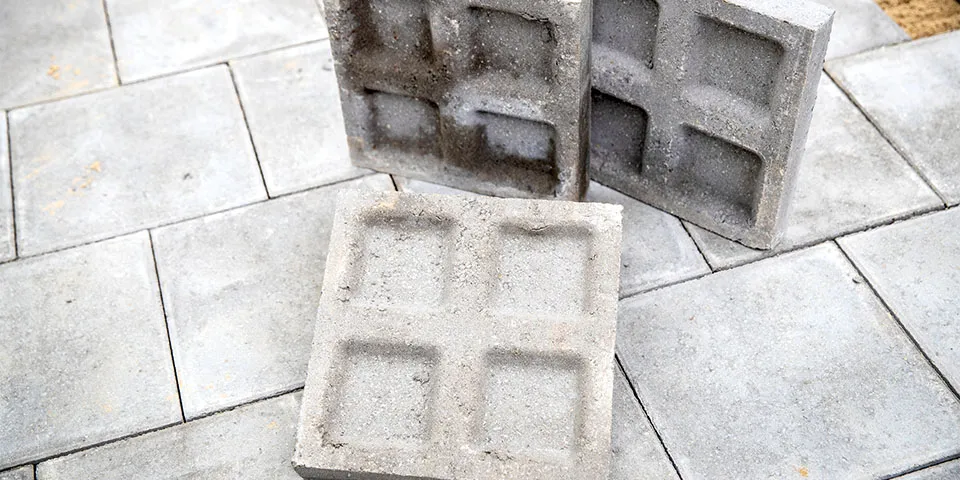
New, lighter sustainable platform tile being trialled at the Railcenter test platform, Amersfoort.
“Connects, improves and makes more sustainable”
According to Astrid, there are around 401 stations in the Netherlands. Is that not an exact figure? “No, because there are also temporary stations for events and new stops are added. Essentially, a station is still a place to get on and off, whether it is a major central station or that ‘little platform in a field’. There are around 50 large and medium-sized stations in the Netherlands, with the rest classed as ‘small’. It is our responsibility, together with NS Stations, to make stations comfortable, accessible and safe, and to keep them that way. We can do this by renovating, adapting or expanding them. Expansion might be requested by a municipality, for example, if it wants to add a forecourt or a cycle parking facility.”
‘Connects, improves and makes more sustainable’ is the motto behind everything ProRail does. “When we look at sustainability at ProRail, we see that it rests on four pillars. The first is energy. This covers both saving energy and generating it. Savings can be achieved, for example, by switching to LED lighting with a dynamic dimming function. No one at the station? Then use as little light as possible. This not only cuts energy consumption, it also benefits flora and fauna to have darkness at night. Last year, for example, we gave Mantgum, a beautiful village in Friesland, its stars back by installing dynamically dimmable lighting on the platforms situated in the middle of a field.”
Energy is also generated on site by installing solar panels on platform canopies. A number of stations have already been fitted with them. “We are now moving on to a second group of stations. This applies to all ProRail assets,” Astrid explains. “At the same time, we are also working on getting rid of gas at stations. The second pillar is the use of sustainable materials. Wherever possible, we opt for materials that can be used circularly, preferably recycled materials. We recently reused the platform slabs from Maarn station at Hof van Cartesius in Utrecht, an urban park under development, and had the worn-out platform tiles from Anna Paulowna station processed into new platform tiles for Bunde Station. Finally, in 2018, we worked with the industry to develop innovative platform tiles that use considerably less concrete, thanks to a waffle pattern on the underside. So we try to do as much as possible with as little material as possible.”
The third pillar is nature. “When designing station developments, we take account of greening, biodiversity and climate-adaptive construction. Good examples can be seen in recently completed projects such as the so-called landscape station at Driebergen-Zeist. The fourth pillar is increasing mobility through public transport. The greatest contribution we can make to this planet is to get as many travellers as possible out of their cars and onto trains. In fact, this fourth pillar has the greatest impact. We want to ensure that hubs are comfortable now and ready for the future at the same time. We are working towards this with NS Stations. The passenger experience needs to average 7 for travellers to consider a station comfortable, with sufficient capacity on the rail network and in the stations. This requires a long-term vision embraced by all stakeholders. We are currently working on the Future Vision for Public Transport 2040, under the direction of the Ministry of Infrastructure and Water Management, together with municipalities, provinces, NS Stations, transport operators and passenger organisations. This involves looking ahead and deciding which hubs we want to develop in the future. Above all, we need to work smartly and innovatively.
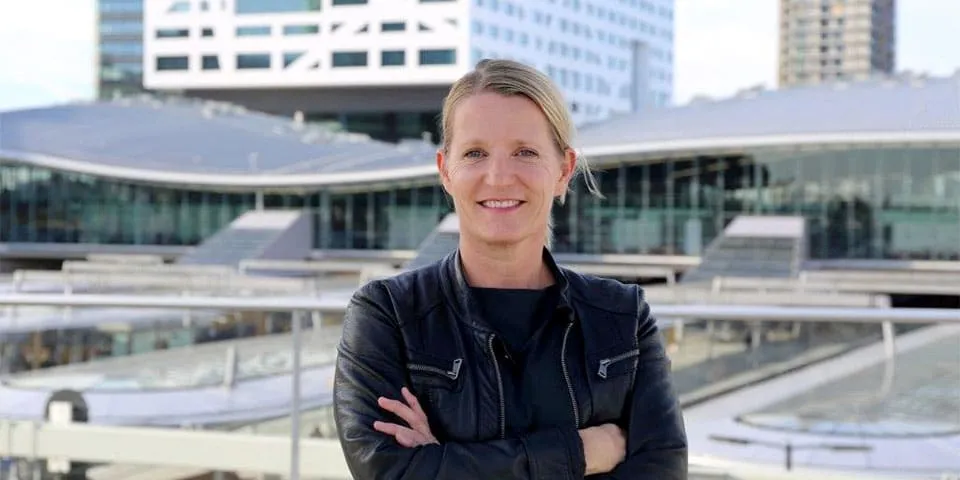
Astrid Bunt, Director of Stations at ProRail.
Cross-sector innovation
According to Astrid, sharing knowledge across sectors is essential to being ready for the future. “To be circular and innovative, you need to work together with an open mind and remove old boundaries. A good example is the ‘What if we design a circular railway station’ challenge, which we are running with NS Stations and Spoorbouwmeester. The What if Lab Circulaire Stations focuses on innovating a small station designed according to circular principles. What does this mean for the design? What innovations are possible? Think, for example, of circular platform tiles, a canopy made from biobased materials or perhaps a leased station that can be moved to another location once it is no longer needed. The challenge attracted more than 40 entries. We discovered people and organisations we would not usually have come across. They inspired not only our people but one another too! In the end, 10 ideas were selected for further development. Of these 10, 3 entries will ultimately get to present their ideas at Dutch Design Week.”
Stations belong to us all
Astrid gives the people in her team the space to work independently and take responsibility. “Innovation requires you to leave people room to act and to bring initiatives with momentum into the spotlight. But I do keep talking to people to encourage a focus on sustainability and new forms of collaboration. And, of course, things do sometimes go wrong, but not trying means standing still, and therefore going backwards.” She concludes: “Stations belong to us all, and together we can make a substantial contribution to sustainability. Not only in the station itself, but also in its surroundings.”
Question about this story? Ask your question
Keep following this
Get an email when a new story is published. No account needed.
- SubjectRoad construction







