









The Oosterweelverbinding: a crucial infrastructure project around Antwerp
Text Léon Tuunter Beeld Architectenbureau Zwarts & Jansma

The Antwerp Ring, officially known in Belgium as the R1, is set to be completed. Over the coming years, work will continue around ’t Stad, as Flanders’ largest city is also known, to finish the ring road. This will be done through several sub-projects and in several phases. Engineering consultancy Iv is playing a key role in the design of the Oosterweelknoop, which connects the city with the Port of Antwerp and the Left Bank.
The Ring is one of Belgium’s most important traffic junctions. With the number of motorists continuing to rise, congestion around Antwerp is only getting worse. Client Lantis wants to tackle this problem. The management company was set up by the Flemish government to oversee these works, as well as several other mobility projects. The Rinkoniên Rechteroever consortium is responsible for construction. Belgian companies Artes Group, CIT Blaton and Stadsbader are working with Dutch contractors Boskalis and Mobilis to carry out the design and construction.
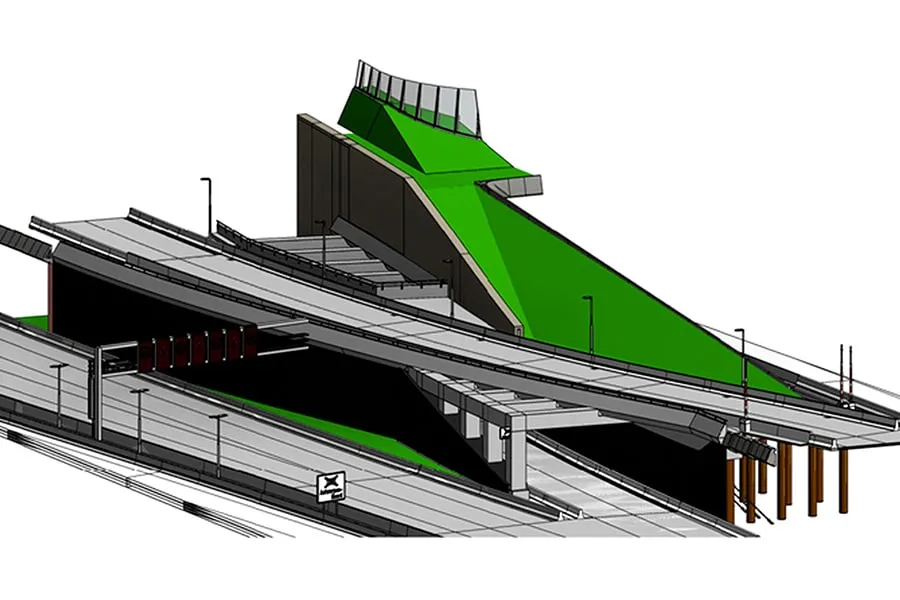
Connections to the tunnels
The Oosterweelknoop is a crucial part of the overall connection. It is located at the southernmost tip of the Port of Antwerp. It links the planned Scheldetunnel on one side with the Kanaaltunnels towards the city. The junction is squeezed between the Amerikadok in the port area to the north and the River Scheldt to the south.
The connections to both tunnels are particularly challenging from a technical and structural perspective. The Oosterweelknoop links the tunnel sections. The Scheldetunnel and Kanaaltunnel will form a twin-deck tunnel, which the junction must connect between.

A complex puzzle with green space in mind
This location makes the project an interesting but complex puzzle. There is little room for the complete transformation planned for the Oosterweelknoop area. At present, this is not a junction on a through motorway, but a local port access road, a two-lane road called the Oosterweelsteenweg, later the Scheldelaan, running alongside the Scheldt. It will become a dynamic traffic junction, set into the landscape, with two four-lane roads in both directions, new slip roads connecting to the surrounding port areas and a new public park above the enclosed section of the junction: Ringpark Noordkasteel.
In short, a great deal will change in a small part of the overall project area. Of all the sub-projects, De R1-Noord, De Scheldetunnel, Kanaaltunnels and Linkeroever/Zwijndrecht, the Oosterweelknoop is a crucial link in completing the Ring.
Iv is working with Sweco and WSP on the design of this major project. In brief, Iv is responsible for two integrated work packages involving the design of numerous concrete structures and the associated geotechnical engineering: how to build in and on the ground. Iv is also providing all the measures needed to integrate the junction into its surroundings, as well as its landscaping and finishing. In addition, an asset management plan for operation and maintenance is being drawn up.
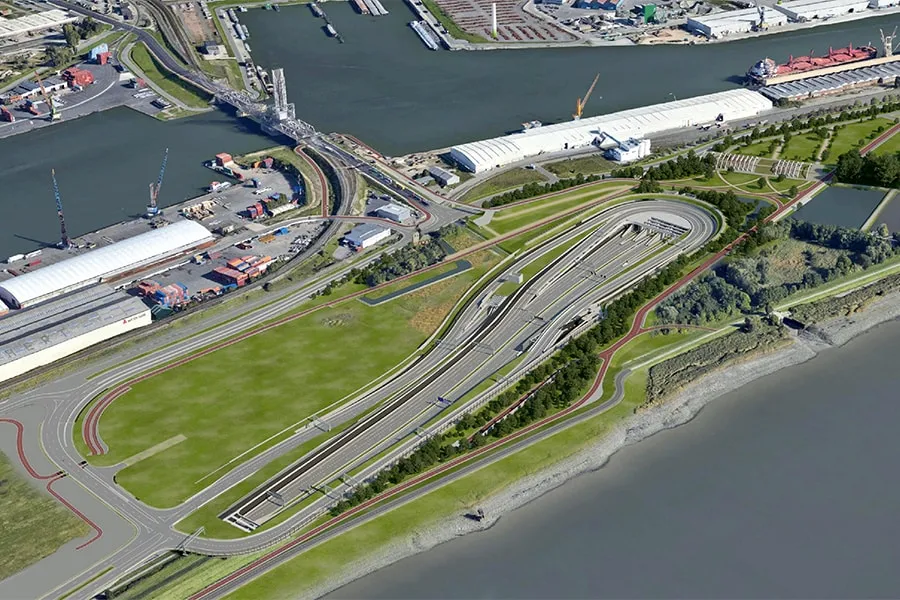
Bottleneck
What makes the Oosterweelknoop special, apart from its location, is the variety of structures. In addition to the tunnels on both sides, flyovers will be built and the crossings designed using a so-called pergola structure. There will also be two cycle tunnels, and the viaduct will be designed in the shape of a paperclip. This section of the Antwerp Ring is a knot, both figuratively and literally, comparable to the Terbregseplein (A20/A16). The key difference in the design is that the Oosterweelknoop is a bottleneck, making it more challenging structurally and more dynamic in terms of logistics and construction phasing.
For Iv, this is truly an integrated project. It is not just the infrastructure team working on solutions: colleagues from the building, industry and water teams are also involved, contributing to tasks including structural detailing and the provision of earthing advice.
The project is divided into two phases. The first phase, which is currently under way, is being delivered through a building team arrangement. This form of collaboration has become increasingly common in recent years. Alongside Iv as the engineering consultancy, the team includes client Lantis, the Rinkoniên Rechteroever contractor consortium and the design consultancies Sweco and WSP. Together, they are working towards a final design.
Letting ’t Stad breathe again
Given the location of the Oosterweel-verbinding, the City of Antwerp also has a major role in the project, as does the Port of Antwerp. Logistics and mobility need to be considered, as well as minimising disruption from traffic, access for cyclists and the creation of green spaces such as Ringpark Noordkasteel. Or, as the project’s motto puts it, the Oosterweelverbinding must let ’t Stad breathe again. An additional ambition is to halve car traffic and make cycling and public transport attractive alternatives. To help achieve this, a fast cycle route will be built, passing through the Oosterweelknoop via cycle tunnels.
A link between the city and industry
Integrating the junction into the area is challenging because it connects to tunnels on both sides and is largely set below ground to reduce visual and noise impacts. This is partly at the request of the City of Antwerp. As the Total Energies refinery is right next to the project site, it is important that cyclists are not affected by it. The cycle route will therefore run through a tunnel for much of its length, with right-angle connections necessitated by the limited space. And all of this has to fit into a very small area. Within the space available, this is technically quite complex.
A business enquiry for WSP? Get in touch
Who worked on Project Oosterweel
- engineering consultancyIvIn this story
- clientLantisIn this story
- contractors' joint ventureRinkoniên RechteroeverIn this story
- design agencySwecoIn this story
- construction consortiumTM RocoMentioned in Kandt delivers precision work on the Oosterweel Link megaproject


Keep following this
Get an email when a new story is published. No account needed.
- ProjectOosterweel project
- SubjectRoad construction
- CompanyWSP
- CompanyBoskalis Nederland
- CompanyIv
- CompanyLantis
- CompanyRinkoniên Rechteroever







