









The 100 hours at Hooipolder
Text Roel van Gils Image ALSÉÉ
A world-class achievement
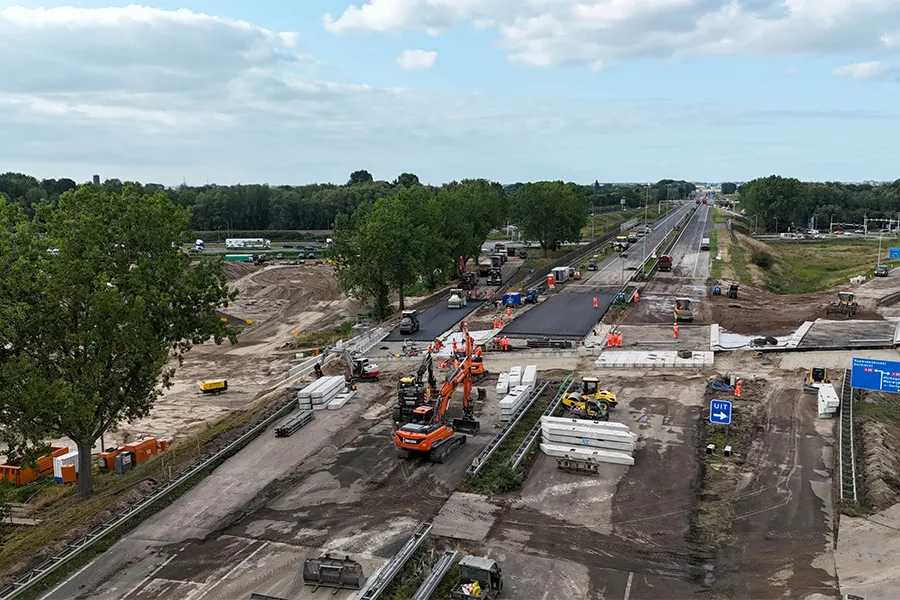
The A27 has been among the Netherlands’ top 10 congestion hotspots for years. Traffic regularly grinds to a halt, particularly at Hooipolder interchange, where the A59 and A27 meet. “The project’s aim is therefore clear: to improve traffic flow and cut journey times,” says Marco Keijzer, project manager at Rijkswaterstaat. “This is being achieved, among other things, by building a new underpass to create a link from the A59 to the A27. Traffic travelling from Rotterdam/Zeeland towards Utrecht will then be able to pass through freely, without traffic lights.”
An ambitious milestone
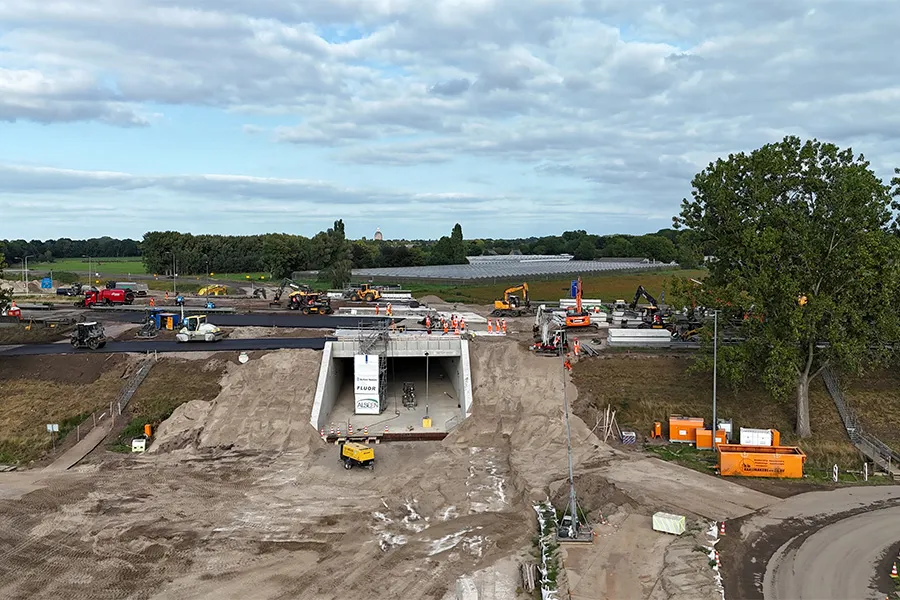
The project forms part of the Route Decision adopted in 2018. In total, 47 kilometres of motorway are being upgraded, including widening, new junctions, dozens of culverts and numerous structures being renewed or modified. The Merwedebrug and Keizersveerbrug are also undergoing a major upgrade. The project is divided into two contracts, covering a northern and a southern section. The southern section is being delivered by the ALSÉÉN construction consortium, comprising Ballast Nedam and Fluor Infrastructure. “What makes this section special is that it is not just about replacing existing infrastructure, there is also a substantial amount of new construction,” says Keijzer. He is referring to the construction of numerous new structures, a new access road for Raamsdonksveer and the upgrade of Hooipolder interchange, including new structures and a new connecting road. “Because of the significant amount of new construction, the ‘reconfiguration’ of Hooipolder interchange was deliberately brought forward in the schedule and must be completed by the end of 2026. An ambitious milestone.”
The idea
According to Keijzer, the original phasing plan envisaged several separate closures. “In consultation with ALSÉÉN, the idea emerged to do everything in one go: a 100-hour closure. This meant that the A27 at Hooipolder had to be closed completely. This option offered the greatest benefits: less disruption in the long term, greater safety for the construction teams and the best quality of work. But you cannot take a decision like that lightly. Rijkswaterstaat had to approve it, and scheduling such a major closure in the busy national traffic calendar was a challenge. It could not clash with other large-scale closures elsewhere in the country. In the end, we managed to schedule the operation for summer 2025.”
Soft ground layer
An operation on this scale depends on thorough preparation. “We began working through all the plans in detail in February 2025,” says Joris van den Hoek, slot coordinator for the 100 hours at Hooipolder on behalf of ALSÉÉN.
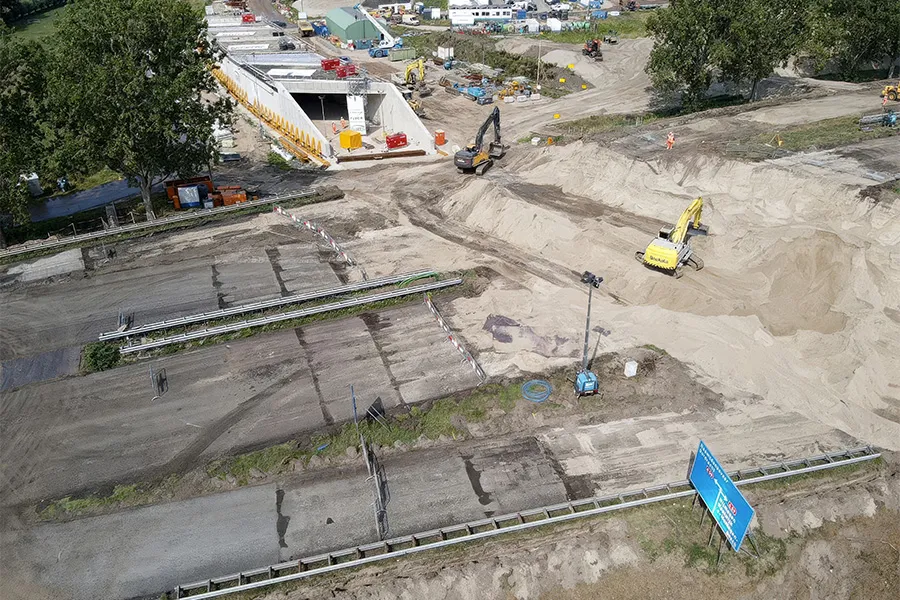
“It was all about identifying and reducing risks. For example, we carried out extensive investigations into the condition of the ground. The A27 was originally built on a relatively soft layer in the ground surface at the time. Although this had not caused any problems over the years, it was crucial to establish exactly how deep the layer was before pushing a structure weighing thousands of tonnes into place. Additional cone penetration tests, mechanical boreholes and monitoring wells gave us a clearer picture. This was decisive in drawing up the hourly schedule, because we needed to know how much time and effort would go into excavating this layer and backfilling with good-quality sand.”
Dress rehearsal
Together with its subcontractors, the ALSÉÉN construction consortium developed a detailed, hour-by-hour schedule for the mega-operation. “We also separated and split up the work to keep everything safe. Fortunately, there was room to do that here,” says Van den Hoek. “Every stage of the 100 hours was illustrated, so that the work sequence and logistics route for each discipline were clear to everyone involved. The cables and pipes were exposed and relocated in advance, so that no valuable time would be lost on them during the closure. The central reservation was also remediated because of contamination, and a dewatering test was carried out to see how the groundwater would behave. We even held a dress rehearsal: a few weeks before the 100 hours, the underpass was moved a few metres to test whether the sliding technique worked. The aim was to eliminate any surprises.”
World-class
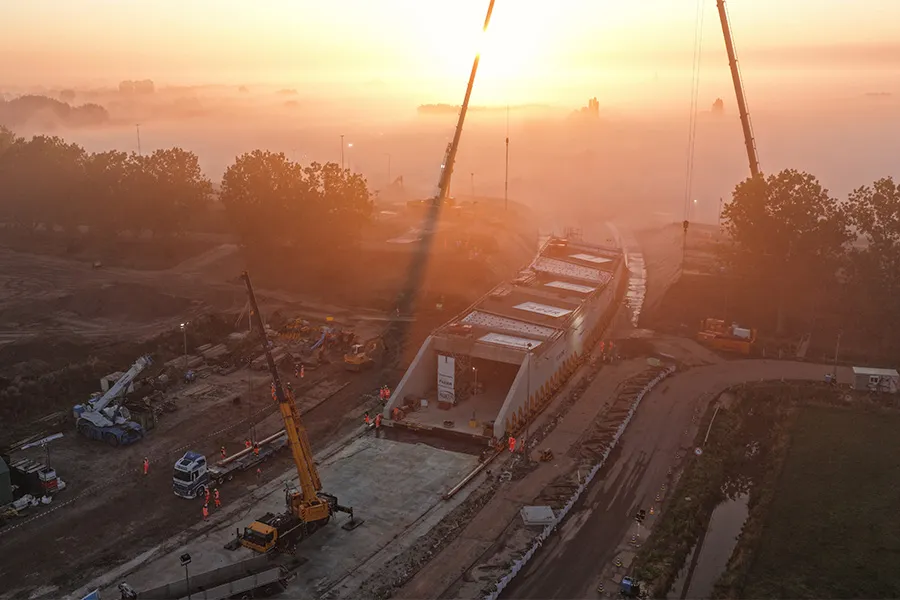
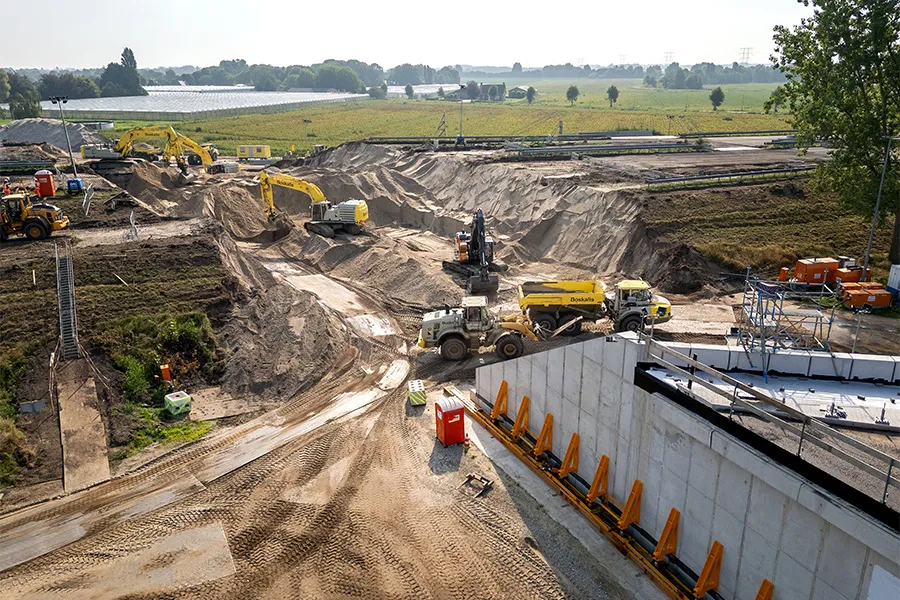
The underpass was built in a field beside the A27. Once the motorway was closed, more than 20,000 m³ of soil was excavated in a hurry. Ground improvement was then carried out, and the sliding operation could begin. The underpass is 115 metres long, 15 metres wide and weighs 6,300 tonnes. “The structure was first lifted 5 centimetres using 90 jacks, then push jacks moved it forwards in short strokes averaging 78 centimetres,” explains Pieter Kastermans, project manager for ALSÉÉN at Hooipolder interchange. “It moved at about twelve metres per hour. The whole structure rested on a specially prepared sliding track. To allow it to move freely above the ground, it had been built on two layers of sheeting and a reinforced working platform. In less than 11 hours, the structure was exactly in position.” The precision is impressive: 0 millimetres of deviation lengthways, just 6 millimetres sideways and 7 millimetres vertically. For a structure of this size, that is a world-class achievement.
Hair-raising
After the slide came the next phase: backfilling with sand, laying transition slabs between the structure and the earthworks, connecting the sewer and laying the asphalt. The lighting and safety barriers also had to be reinstated, along with the landscaping of the verges and the reconnection of cables and pipes. This required more than 600 joints. An average of around 80 people worked at the same time, in rotating teams and across different disciplines. The entire operation was completed safely, with no incidents. The two men look back on the operation with pride. Van den Hoek says: “We planned everything down to the last detail, but then to see it become reality, it gives you goosebumps.”
The operation at Hooipolder was not the last job of its kind. “A second sliding operation at Oosterhoutseweg is due to take place later in 2025,” says Kastermans. With the experience gained and the smaller scale of the work, the team expects it will not need 100 hours. “Some of the equipment used for the 100-hour sliding operation will be used again at Oosterhoutseweg.” With the 100 hours at Hooipolder, the ALSÉÉN construction consortium has shown what can be achieved when preparation, engineering and craftsmanship come together. It lays important foundations for improving traffic flow on the A27.
Een zakelijke vraag aan Ballast Nedam Road Specialties? Get in touch
Who worked on it
Knooppunt Hooipolder
- construction consortium ALSÉÉN
 Ballast
- construction consortium ALSÉÉNFluor Infrastructure
Keep following this
Get an email when a new story is published. No account needed.
- ProjectKnooppunt Hooipolder
- SubjectRoad construction
- CompanyBallast Nedam Road Specialties
- CompanyFluor Infrastructure







