









Sustainable foundation system for weak soils
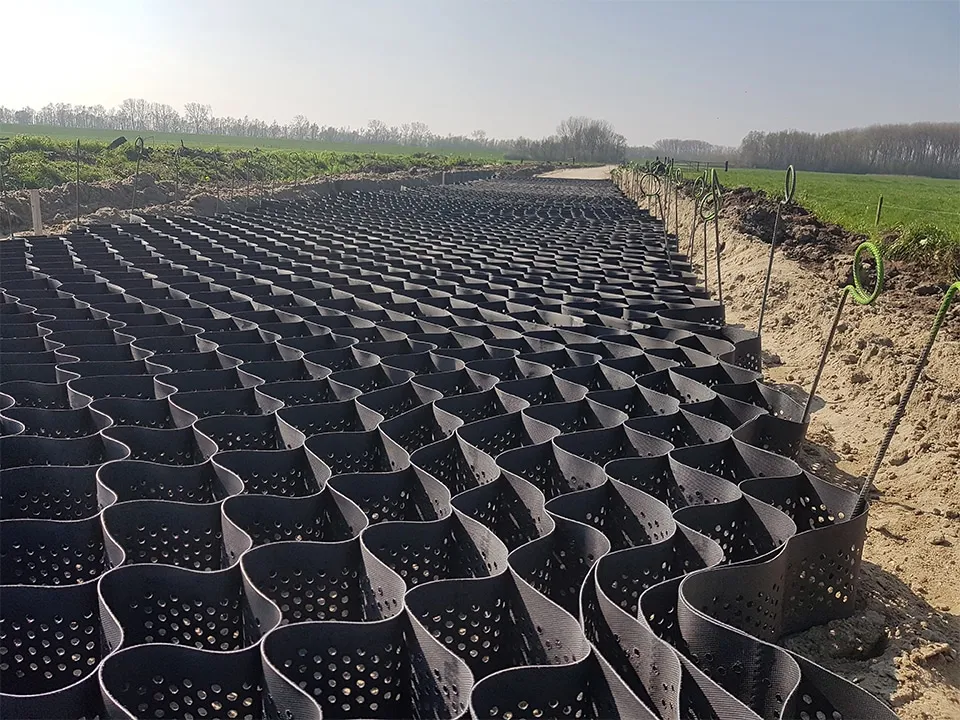
In collaboration with Gasunie, Romfix has developed a substructure system for onshore valve sites that can withstand even extreme loads.
The sustainable foundation system is ideally suited to building a stable road, or even a crane platform, on soft, weak soil. “It delivers almost unimaginable CO2 savings, particularly on peat-rich ground,” says Paul Schmal of Romfix. “Peat oxidation receives far too little attention.”
Gasunie’s valves are located in a wide variety of settings. “On load-bearing sandy soils, covering them with a water- and gas-permeable surface poses no problem. At sites where the ground is less stable, to put it mildly, we faced a challenge,” says Schmal. “These sites are often in rural areas, and the valve must withstand the weight of heavy agricultural machinery. But the heavier the foundation, the further it sinks into soft ground, putting stress on the pipeline.”
Floating foundation package
Together with Gasunie, Romfix has developed a system that combines several sustainable foundation systems. Schmal: “The result is a substructure that is 2.3 times more stable than a conventional system. It is combined with sustainable, lightweight fill material, so the whole structure effectively floats on the peatland while remaining strong enough to bear heavy traffic.” And that is not all. In March this year, Romfix successfully tested the same concept, albeit in a reinforced version, at a crane platform carrying equipment with a total weight of 350 tonnes. The Romfix system is also ideally suited to building temporary access roads to crane platforms, piling rigs, drilling machines and other equipment for projects including wind farms, high-voltage routes and underground infrastructure.
Peat oxidation
“The projects mentioned earlier are generally built in the middle of the countryside, several hundred metres from the ‘paved’ world, for example on peat or clay,” continues Paul van Riel, owner of Romfix. “Temporary roads are built to reach them. The traditional approach is to strip off the topsoil, bring in sand or rubble, and lay steel road plates. In EMVI tenders, considerable effort is then spent calculating the CO2 emissions caused by machinery and all the truck movements. But peat oxidation is not taken into account. Quite simply, because people are unaware of it. What is unknown is often overlooked. When peat is exposed to air, it oxidises. This releases an astonishing amount of CO2, up to ten times more than all the truck movements. With the Romfix system, a stable road can be built directly on the topsoil, keeping an unimaginable amount of CO2 locked away.”
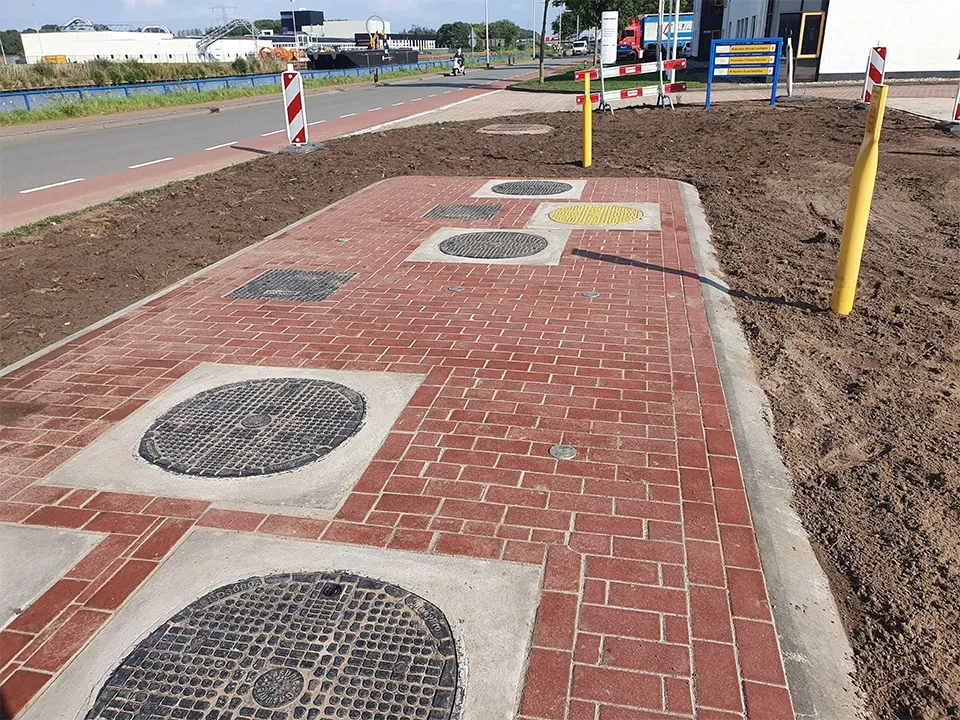
The Netherlands is sinking faster than sea levels are rising. The Romfix system also offers a solution for squares, gardens and town centres. “In Stolwijk, Gouda and Rotterdam, we have already built floating substructures for various squares, pedestrian areas and car parks. They float in place and are finished with a flexible, water- and gas-permeable joint. The system is now so well developed that we can offer a system guarantee,” Schmal concludes.
Question about this story? Ask your question
Keep following this
Get an email when a new story is published. No account needed.
- SubjectRoad construction







