









Specialist drilling operation at Maastricht Station
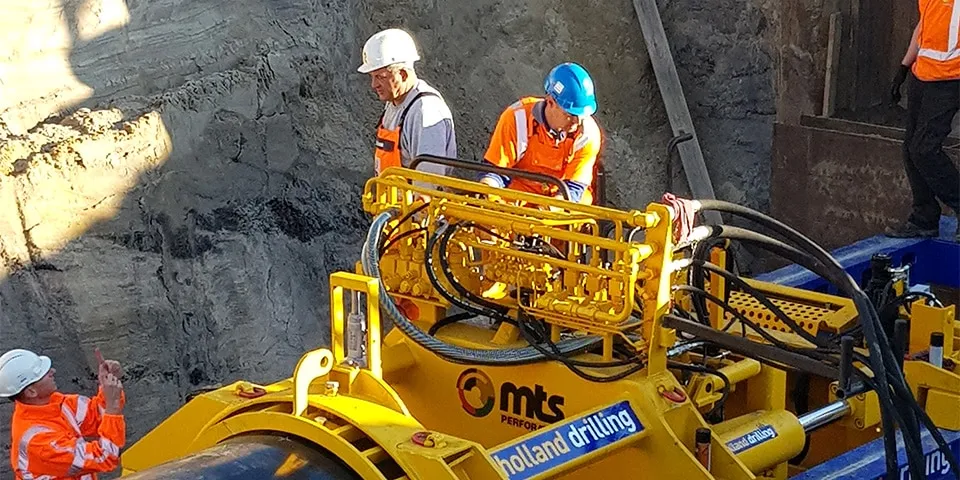
As part of the expansion of Maastricht Station, a comprehensive duct for utilities needs to be installed underground. The innovative trenchless pilot-guided auger boring technique will be used.
Maastricht Station is set to expand and also wants to be prepared for the future. This requires new underground utilities. Work to install a steel casing containing several HDPE pipes will start in September 2019. These will serve as ducts for, among other things, fibre-optic connections and water and electricity lines.
Steel casing beneath 12 railway tracks
Ronald van Krieken, director and co-owner of Holland Drilling, which specialises in the design and execution of various drilling techniques, including horizontal directional drilling, says: “The project involves a 70 m-long steel casing running beneath 12 tracks from the railway yard to the central platform. This is a specialist operation, not least because working space is limited.” Installing the casing is part of a larger project for which ProRail has appointed Wallaard Noordeloos as contractor. The pilot-guided auger boring technique will be used to install the comprehensive steel casing, which has a diameter of 508 mm. “We have several auger boring machines with a capacity of up to 320 tonnes,” explains Van Krieken. “We select the right machine based on the required thrust, which is 100 tonnes here. To meet ProRail’s safety requirements and prevent future settlement of the track, we fill the space between the steel casing and the HDPE pipes with the cement-based filler Dämmer®.”
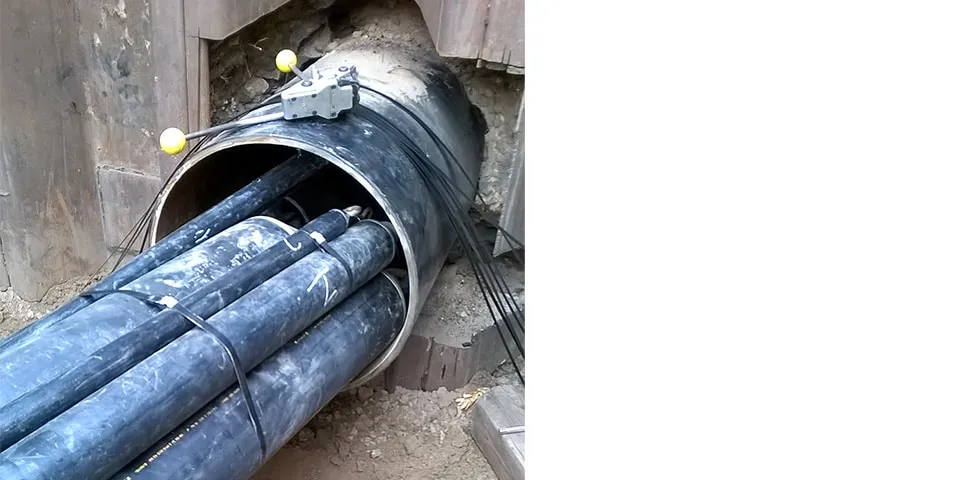
Bored steel casing containing HDPE pipes.
Supplying and pumping the filler is a specialist service that the company, based in Cuijk, provides in-house. It uses a specially developed mixing and pumping system that enables the materials to be precisely dosed and mixed to within a kilogram.
Geology makes drilling more difficult
The geology, consisting of marl, gravel and Maas river boulders, also makes the work challenging. The auger boring method cuts through the ground and pushes the pipe horizontally into place along the route established by the pilot bore. The excavated soil is removed via the auger. The permitted tolerance makes it necessary to use a dedicated laser system in combination with a camera mounted in the drill head. “The laser is positioned in the launch pit, from where we drill, and is aimed at the target at the front of the drill head. From the drilling cabin, the drilling supervisor can monitor to the nearest centimetre whether the bore is deviating from the line and make corrections if necessary,” says Van Krieken.
Question about this story? Ask your question
Keep following this
Get an email when a new story is published. No account needed.
- SubjectRoad construction







