









Road construction concrete with the lowest possible environmental cost
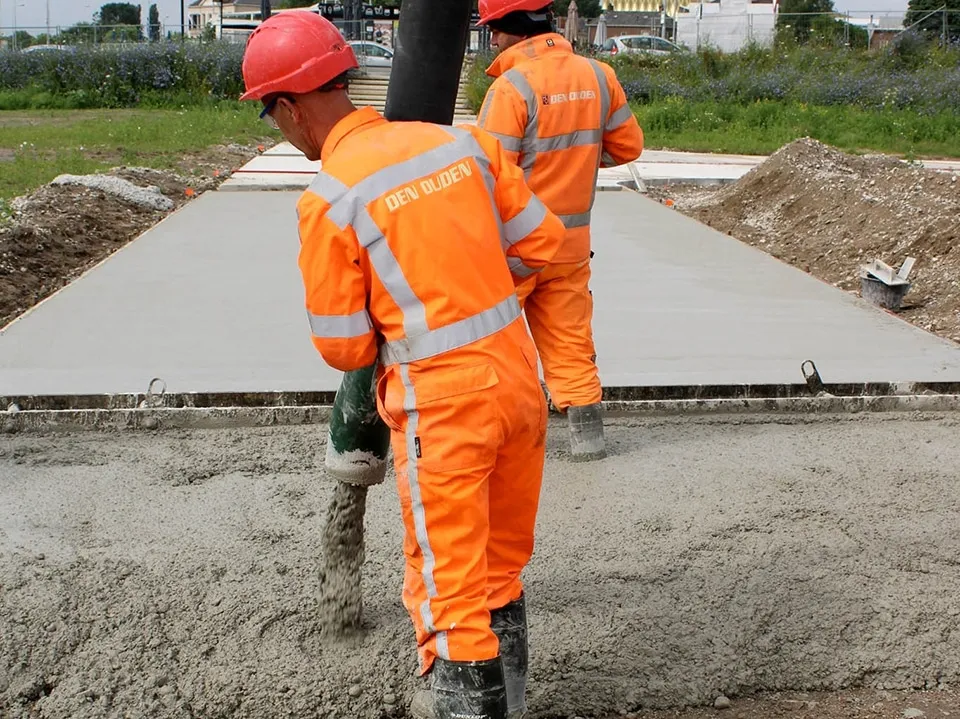
All the road construction concrete on the N395 is placed in situ by Den Ouden Groep. During the preparatory phase, considerable attention was paid to finding the right mix designs to achieve both a shorter construction period and a favourable environmental cost indicator (MKI). We spoke to Sjoerd van Ingen, project manager at Den Ouden Groep.
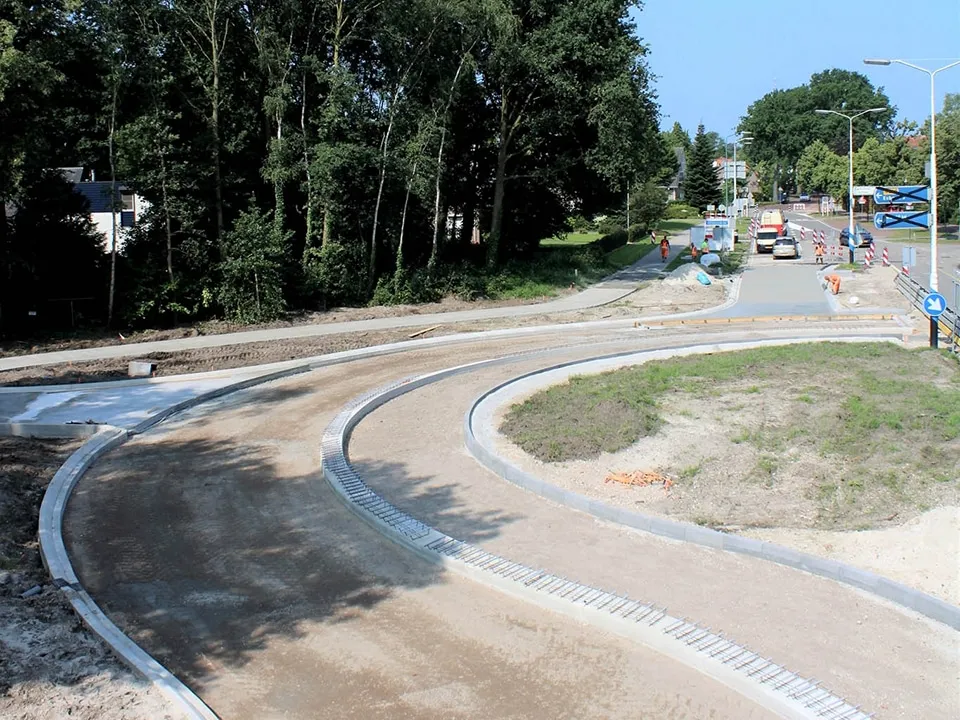
“BAM Infra Nederland approached us in 2020 to submit a joint bid for this project,” says Van Ingen. “We have successfully worked on various roundabouts in the past, and the collaboration has always gone very well. We have always worked well together and provided input at an early stage on the schedule and, in particular, on the mixes we could use to reduce CO2 emissions as much as possible. Together with our concrete supplier Mebin, we sought to achieve the lowest possible MKI score. BAM scored well on this in its MEAT tender.”
Faster
The linear elements, printed concrete, the road surface on the dumbbell roundabout and the cycle paths are all being cast in situ. “It was a deliberate choice,” says Van Ingen. “The N395 reconstruction is being carried out in phases, largely while traffic continues to use the road. So the time available for each phase is limited. You can imagine that mechanically installing more than 9,000 metres of kerbs is many times faster than using precast elements that a paviour has to lay by hand. The limited time available also led us to use structural fibres on the dumbbell roundabout rather than a continuously reinforced design. This saves around five days per phase on installing the reinforcement.”
More sustainable
In this case, casting the road construction concrete for the N395 in situ is also a more sustainable choice, and produces a stronger end result. The Den Ouden 2.0 mix is being used. “It has substantially lower CO2 emissions. This gives us a low MKI score without compromising on quality. The only drawback is that the mix sets more slowly,” Van Ingen acknowledges. “Where the phasing schedule is tight, we use a mix with a higher Portland cement content, as on part of the road surface on the dumbbell roundabout. At the initiative of the province of North Brabant, an additional item has also been included to gain experience with geopolymer concrete, which helps to reduce CO2 emissions further. Around 2,000 m2 of cycle path will be built using this product, in collaboration with the A. Jansen batching plant.”
“Not only are the construction periods extremely short, but changing circumstances also mean that the schedule sometimes has to be revised. Fortunately, as an organisation we can respond flexibly and adjust the mixes accordingly. This ensures they cure sufficiently at the right times, so that other teams can continue their work. Delays are simply not an option.”
Question about this story? Ask your question
Keep following this
Get an email when a new story is published. No account needed.
- SubjectRoad construction







